Darcy's Law and Duipits Theory - Ground Water and Well Hydraulics - Water Resource Engineering 1
TL;DR
This video explains Darcy's Law, which calculates groundwater velocity, and Dupet's Theory, which calculates aquifer discharge.
Transcript
hello everyone in this video we are going to discuss the darcy's law which is used to calculate the flow velocity and the dupet's theory for the calculation of the discharge for aquifers so let's start so first of all what is the darcy's law of this darcy's law that is used for determining the groundwater velocity the rate at which the water flows ... Read More
Key Insights
- 🤕 Darcy's Law is a fundamental principle used to calculate groundwater velocity based on head loss, cross-sectional area, and soil sample length.
- 🇦🇪 The hydraulic gradient is a crucial factor in Darcy's Law, representing the rate of loss of head per unit length.
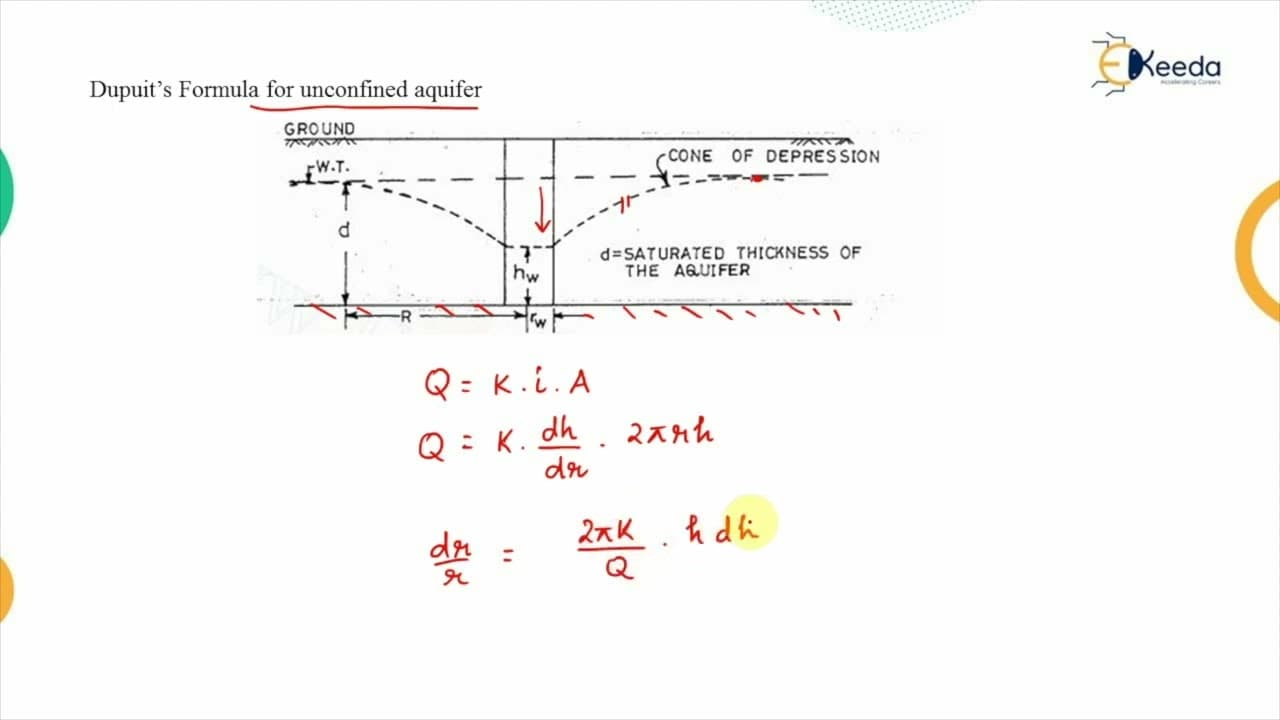
- 🏛️ Dupet's Theory builds upon Darcy's Law and incorporates drawdown, radius of influence, and aquifer depth in the calculations for unconfined and confined aquifers.
- 💐 Discharge velocity is lower than the actual flow velocity due to the restriction of flow through the voids of the cross-sectional area.
- 💐 Darcy's Law is applicable to laminar flow conditions, which are typically found in soil.
- ❓ The formulas for unconfined and confined aquifers under Dupet's Theory involve variables such as permeability, hydraulic gradient, drawdown, and the radius of influence.
- 💐 Dupet's Theory provides a mathematical framework for analyzing groundwater flow in different types of aquifers.
Install to Summarize YouTube Videos and Get Transcripts
Explore YouTube Video Summarizer or Get YouTube Transcript Extractor
Questions & Answers
Q: What is Darcy's Law used for?
Darcy's Law is used to calculate the velocity of groundwater flow in soil based on the head loss, cross-sectional area, and length of the samples.
Q: What is the significance of the hydraulic gradient in Darcy's Law?
The hydraulic gradient, represented by the symbol i, is the ratio of the head loss to the length of the soil sample. It determines the rate of loss of head per unit length and is used in the calculation of groundwater flow.
Q: How is the discharge velocity different from the actual flow velocity?
The discharge velocity, represented by v, is the velocity of water flowing through the voids of the cross-sectional area. It is calculated by multiplying the actual velocity by the porosity of the soil, which results in a reduction in velocity.
Q: What is the difference between Darcy's Law and Dupet's Theory?
Darcy's Law calculates groundwater velocity, while Dupet's Theory expands on it by considering drawdown, radius of influence, and depth of the aquifer in the calculations for unconfined and confined aquifers.
Summary & Key Takeaways
-
Darcy's Law, formulated by a French scientist named Darcy, determines the rate of groundwater flow based on the head loss, cross-sectional area, and length of soil samples.
-
The equation for Darcy's Law is Q = k * i * A, where Q is the discharge, k is the permeability, i is the hydraulic gradient, and A is the cross-sectional area.
-
Dupet's Theory expands on Darcy's Law by considering the drawdown, radius of influence, and depth of the aquifer, providing formulas for unconfined and confined aquifers.
Read in Other Languages (beta)
Share This Summary 📚
Summarize YouTube Videos and Get Video Transcripts with 1-Click
Try YouTube Summary with ChatGPT & Claude or YouTube Transcript Generator
Explore More Summaries from Ekeeda 📚






Summarize YouTube Videos and Get Video Transcripts with 1-Click
Try YouTube Summary with ChatGPT & Claude or YouTube Transcript Generator