Why Did GPT-5 Feel Worse After Its Launch?
TL;DR
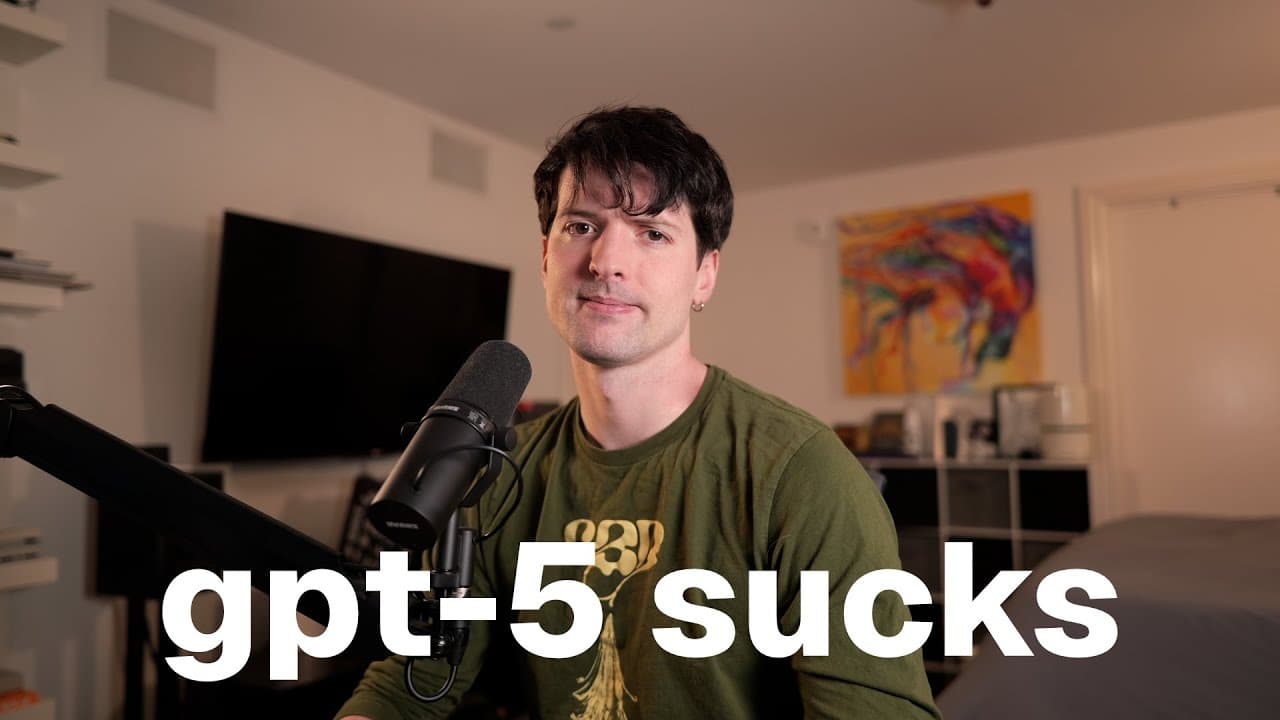
GPT-5 felt worse after launch because the public experience in ChatGPT, Cursor, and other tools did not match the creator’s stronger early API and prelaunch Cursor testing. Repeated coding prompts later produced slower, less polished, and visibly broken interfaces. He suspects tool integration or configuration changes, but the exact cause remains unresolved. Read on for the tests, costs, and launch circumstances behind his reassessment.
Transcript
I think it's fair to say that we need to have a talk about the GPT5 launch. It didn't quite go how I expected and uh if you've seen the comment section on my recent videos, you'll see just how much people did not get what they thought they were getting with this model. There's a lot of layers to this and many of them are actually to some extent my ... Read More
Key Insights
- The creator's initial enthusiasm was based primarily on GPT-5 performance through the API and Cursor, not the ChatGPT website. He says the high-reasoning API endpoint may still provide the model quality he experienced, but that it differs from the default experience encountered by many users.
- The creator says OpenAI did not pay him to praise GPT-5. He reports being approximately $25,000 down from inference expenses for T3 Chat over two to three weeks, although OpenAI offered a separate $1,000 appearance fee connected to its launch video.
- The public GPT-5 experience did not match the creator's prelaunch testing. He describes the nectarine 725 Cursor build as substantially better than the later high-fast version, while emphasizing that the surrounding experience may have changed even if the underlying model remained available.
- The creator's main acknowledged mistake was publishing an enthusiastic assessment before examining public reception. He was attending Defcon and taking a vacation when GPT-5 launched, so he had limited exposure to the problems that users were reporting through ChatGPT, Cursor, and other tools.
- Identical prompts produced visibly different interface results across later tests. The creator observed misplaced or missing gradients, rendering glitches, poor contrast, overflowing text, ignored navigation instructions, and moving interface elements when repeating a prompt that had previously generated a polished AI image studio redesign.
- Several users reportedly experienced strong GPT-5 performance during the first day or two before noticing degradation. One described the same prompt falling from a 10 out of 10 result to roughly a five, which aligned with the creator's later experience after returning to sustained coding.
- Cursor and OpenAI collaborated before launch to integrate GPT-5, according to the creator. He says he contacted both organizations after observing weaker results and suspects that attempts to improve GPT-5 inside Cursor may have been hurting its performance at that moment.
- The creator's comparison with Opus 4 did not reverse his preference for the stronger GPT-5 experience he had previously tested. Opus generated poor contrast, text overflow, an enlarged glowing navigation area that should have been removed, and interface elements that moved when clicked.
Install to Summarize YouTube Videos and Get Transcripts
Explore YouTube Video Summarizer or Get YouTube Transcript Extractor
Questions & Answers
Q: Why did GPT-5 feel worse after its launch?
The creator’s later experience with GPT-5 in public-facing tools did not match his stronger early testing through the API and a prelaunch Cursor build. Repeated prompts produced weaker designs, ignored instructions, and visible interface errors. He suspects tool integration or configuration changes, but does not identify a confirmed cause.
Q: Was the creator paid by OpenAI to praise GPT-5?
The creator says OpenAI did not pay him to praise GPT-5 or control his opinion. OpenAI offered a $1,000 appearance fee for its launch video, while he reports being approximately $25,000 down from T3 Chat inference costs over two to three weeks. He also says OpenAI did not review his separate reaction video before publication.
Q: How did early GPT-5 testing differ from public use?
The creator found GPT-5 impressive through the API and even stronger in Cursor, while he considered the website less capable even before launch. He says the prelaunch Cursor build called nectarine 725 delivered substantially better results than the later high-fast version. The public experience therefore differed significantly from the access behind his initial praise.
Q: What mistake did the creator make when reviewing GPT-5?
He says his biggest mistake was publishing an enthusiastic assessment before understanding the public response. He was at Defcon and on vacation when GPT-5 launched, so he paid limited attention to problems users were reporting. He also acknowledges that his claim that other tools were no longer relevant was irresponsible.
Q: What evidence suggested that the GPT-5 experience had degraded?
The creator repeated the same AI image studio redesign prompt and compared the resulting interfaces. Later attempts showed misplaced or missing gradients, rendering glitches, poor contrast, inconsistent layouts, and ignored instructions. He also cites a user who rated the same prompt’s decline from 10 out of 10 to roughly five.
Q: Did the creator blame the underlying GPT-5 model?
He says the experience was significantly worse, but does not conclusively blame the underlying model. He suspects GPT-5’s configuration or integration within tools such as Cursor may have contributed. He believes the stronger model experience may still be available through the GPT-5 high-reasoning API endpoint.
Q: How did GPT-5 compare with Opus 4 in the interface test?
Opus 4 also performed poorly, so the comparison did not reverse the creator’s preference for the stronger GPT-5 experience he had tested earlier. Its output had poor contrast, overflowing text, an enlarged glowing navigation area that should have been removed, and elements that moved when clicked.
Q: Why did users question the creator’s credibility?
His highly positive claims conflicted with the disappointing GPT-5 results many users encountered in ChatGPT and coding tools. His post suggesting competing tools were no longer relevant made the praise appear untrustworthy to people receiving weaker outputs. He understands that suspicion but maintains that his reaction reflected genuinely stronger early results.
Summary & Key Takeaways
-
The creator says his enthusiastic assessment reflected genuine early testing, especially through the API and a prelaunch Cursor build called nectarine 725. He found the website less impressive even then. After returning from vacation and repeating coding tasks, he concluded that the available GPT-5 experience was significantly worse than what originally prompted his praise.
-
He denies being paid to praise OpenAI and says he was approximately $25,000 down from inference costs for T3 Chat over two to three weeks. OpenAI offered a $1,000 appearance fee for its launch video, but he says it did not review his separate video before publication or control his expressed opinions.
-
The creator accepts responsibility for publishing strong claims while away at Defcon and before understanding public reactions. Repeating an interface redesign prompt produced weaker gradients, rendering glitches, ignored instructions, and inconsistent layouts across Cursor and Copilot. He suspects integrations or configurations may be responsible, while leaving the exact cause unresolved.
Read in Other Languages (beta)
Share This Summary 📚
Summarize YouTube Videos and Get Video Transcripts with 1-Click
Try YouTube Summary with ChatGPT & Claude or YouTube Transcript Generator
Explore More Summaries from Theo - t3․gg 📚

Summarize YouTube Videos and Get Video Transcripts with 1-Click
Try YouTube Summary with ChatGPT & Claude or YouTube Transcript Generator