Why Do People Follow Unwritten Social Rules?
TL;DR
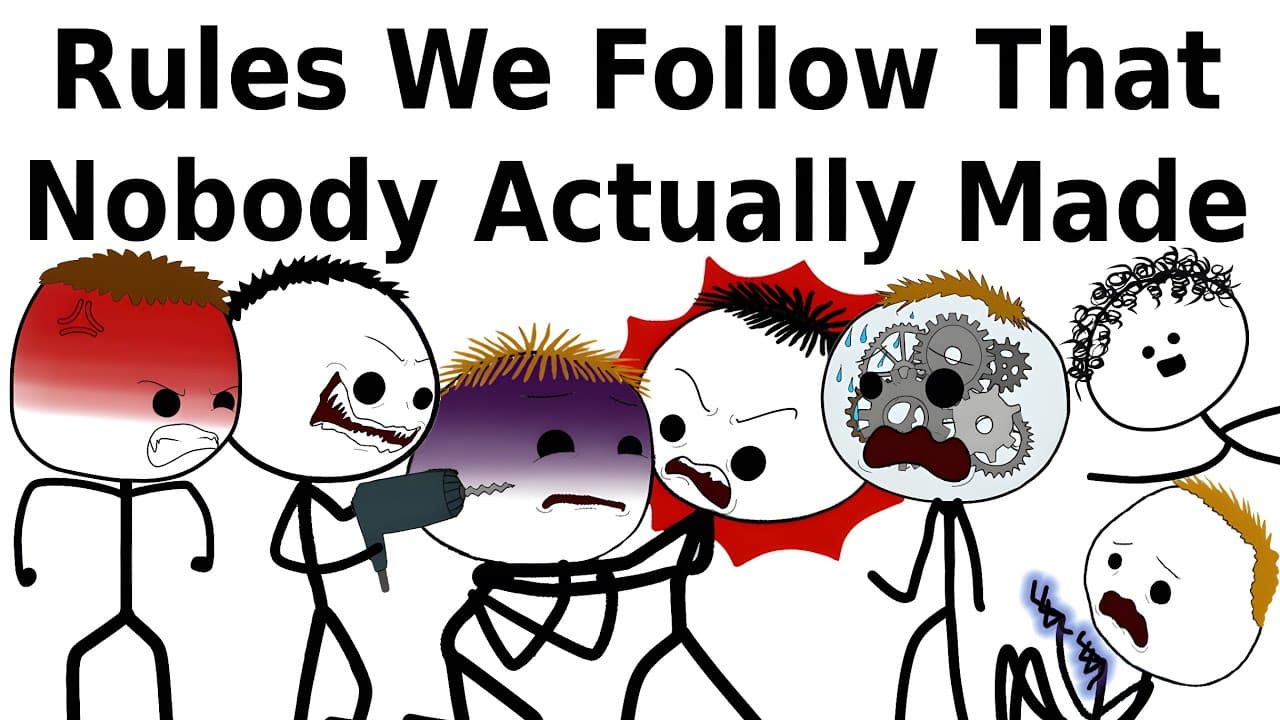
People follow unwritten social rules because limited attention, habitual responses, privacy concerns, and the desire to preserve social harmony shape everyday behavior. Turning down music can reduce competing mental demands, while keeping distance at an ATM, facing elevator doors, avoiding the last slice, and returning shopping carts signal respect, restraint, or cooperation without formal enforcement.
Transcript
Let's get right into it. Number 10, the car radio silence. You're driving along, jamming to your favorite tunes, when suddenly you realize you're lost. What's the first thing you do? You turn down the radio. How exactly is lowering Taylor Swift's volume going to help you find your way? It's not like the street signs are going to whisper directions ... Read More
Key Insights
- Turning down a car radio reduces competing mental demands when a driver is lost or parking. The brain is already checking signs, searching for landmarks, and recalling familiar places, so removing music allows more processing power to be directed toward navigation and visual attention.
- ATM users receive a larger personal-space bubble than people in ordinary situations. Bystanders stand back, look at their phones, or focus elsewhere to demonstrate that they are not watching the screen or PIN, because approaching too closely can be interpreted as threatening or intrusive.
- The one-trip grocery carry is a self-imposed challenge with no formal reward or penalty. People overload their arms and risk damaged groceries, painful fingers, and difficulty retrieving their keys simply to avoid returning to the vehicle for another load.
- Elevator etiquette minimizes conflict in a confined space. Passengers typically face forward, stare at the doors, avoid conversation, and shift away from one another, while anyone facing backward or reaching across another person violates expectations that people appear to ignore each other.
- Thermostat control is a major source of roommate and office conflict. The transcript says three out of four workers secretly change workplace settings, while some people tolerate uncomfortable temperatures because touching a thermostat controlled by someone else feels socially forbidden.
- The last slice standoff is driven by concern about appearing greedy. People repeatedly offer the final portion to others or divide it into smaller pieces, and the strength of this behavior changes depending on whether the group consists of strangers, close friends, or siblings.
- Returning a shopping cart is a voluntary act that prevents inconvenience for other people. Abandoned carts can encourage more shoppers to leave theirs behind, while requiring a coin deposit may replace the moral question with a financial transaction and weaken the sense of obligation.
- Automatic social replies make routine interactions easier but sometimes produce mismatched answers. A person may say "you too" after being told to enjoy a movie or meal because the brain retrieves a familiar response before checking whether it logically applies to the situation.
Install to Summarize YouTube Videos and Get Transcripts
Explore YouTube Video Summarizer or Get YouTube Transcript Extractor
Questions & Answers
Q: Why do drivers turn down the radio when they are lost?
Drivers turn down the radio because navigation already requires substantial mental processing. They must inspect street signs, search for landmarks, and remember whether places look familiar. Music adds another demand, and the transcript says brain scans show that listening to it can weaken part of visual processing. Lowering the volume therefore directs more attention toward finding the correct route.
Q: Why do people stand far away from someone using an ATM?
People create extra distance at an ATM to protect privacy and reduce perceived danger. The transcript says ordinary personal space is about an arm's length, but the bubble becomes significantly larger around an ATM. Standing too close can suggest an attempt to see the user's PIN or steal money, so bystanders often look at their phones or elsewhere.
Q: Why do people try to carry every grocery bag in one trip?
The one-trip carry is presented as a voluntary test people impose on themselves even though nobody is keeping score. They load numerous bags onto their arms and may risk broken eggs, crushed bread, painful fingers, or difficulty reaching their keys. The behavior persists across generations despite having no formal rule, public reward, or meaningful penalty for taking another trip.
Q: Why does everyone face the doors inside an elevator?
Facing the doors helps people manage close physical proximity while minimizing social tension. The transcript compares the behavior with animals avoiding conflict in confined spaces by pretending others are not present. Elevator passengers stare forward, limit conversation, protect space around the controls, and subtly reposition themselves. Someone facing backward disrupts this shared expectation and makes the situation feel uncomfortable.
Q: Why is touching someone else's thermostat considered rude?
A thermostat represents control over a shared environment, so changing it can provoke roommate or workplace conflict. The transcript connects the taboo partly to energy-saving campaigns from the 1970s, which treated thermostat control as the responsibility of the head of a household. It also says many office standards reflect the metabolism of a 40-year-old, 154-pound man wearing a suit.
Q: Why do people hesitate to take the last slice of food?
People hesitate because taking the final portion can make them appear greedy or inconsiderate. The transcript describes the standoff as a politeness contest found across cultures and says the response varies with the relationship between diners. Concern for social harmony leads people to offer the slice repeatedly or divide it, even though this reluctance can result in wasted food.
Q: What does returning a shopping cart reveal about behavior?
Returning a shopping cart illustrates voluntary cooperation because there is no stated law, fine, or direct reward, yet doing it prevents inconvenience for others. The surrounding environment also influences the choice. According to the transcript, abandoned carts encourage more abandonment through the broken windows effect, while a coin deposit can turn the decision from a moral responsibility into a financial transaction.
Q: Why do people accidentally say "you too" at the wrong time?
People mistakenly say "you too" because common exchanges trigger automatic responses. The brain prepares shortcuts for phrases such as "have a nice day," allowing routine social interactions to proceed without deliberate thought. Sometimes that response activates after a ticket worker says to enjoy a movie or a waiter says to enjoy a meal, even though the reply does not logically apply.
Summary & Key Takeaways
-
Many seemingly irrational habits reduce mental demands. Drivers lower the radio while navigating or parking because music competes with visual processing, while automatic phrases such as "you too" spare people from consciously constructing every routine response. These shortcuts are useful, although they can produce awkward mistakes when a familiar reply does not fit.
-
Unwritten rules regulate privacy and personal space. People stand farther away from ATM users, avoid reaching across elevator passengers, face the doors, and hesitate to touch another person's thermostat. These behaviors reduce perceived threats and conflicts when money, physical proximity, shared controls, or limited space make people especially sensitive to intrusion.
-
Social cooperation often depends on voluntary restraint. People hesitate before taking the last slice because appearing greedy may threaten harmony, and they return shopping carts despite receiving no direct reward. Visible behavior also spreads, since abandoned carts can encourage further neglect, while financial deposits may transform a moral choice into a transaction.
Read in Other Languages (beta)
Share This Summary 📚
Summarize YouTube Videos and Get Video Transcripts with 1-Click
Try YouTube Summary with ChatGPT & Claude or YouTube Transcript Generator
Explore More Summaries from Chill Dude Explains 📚
Summarize YouTube Videos and Get Video Transcripts with 1-Click
Try YouTube Summary with ChatGPT & Claude or YouTube Transcript Generator