How to Build Muscle and Increase Strength
TL;DR
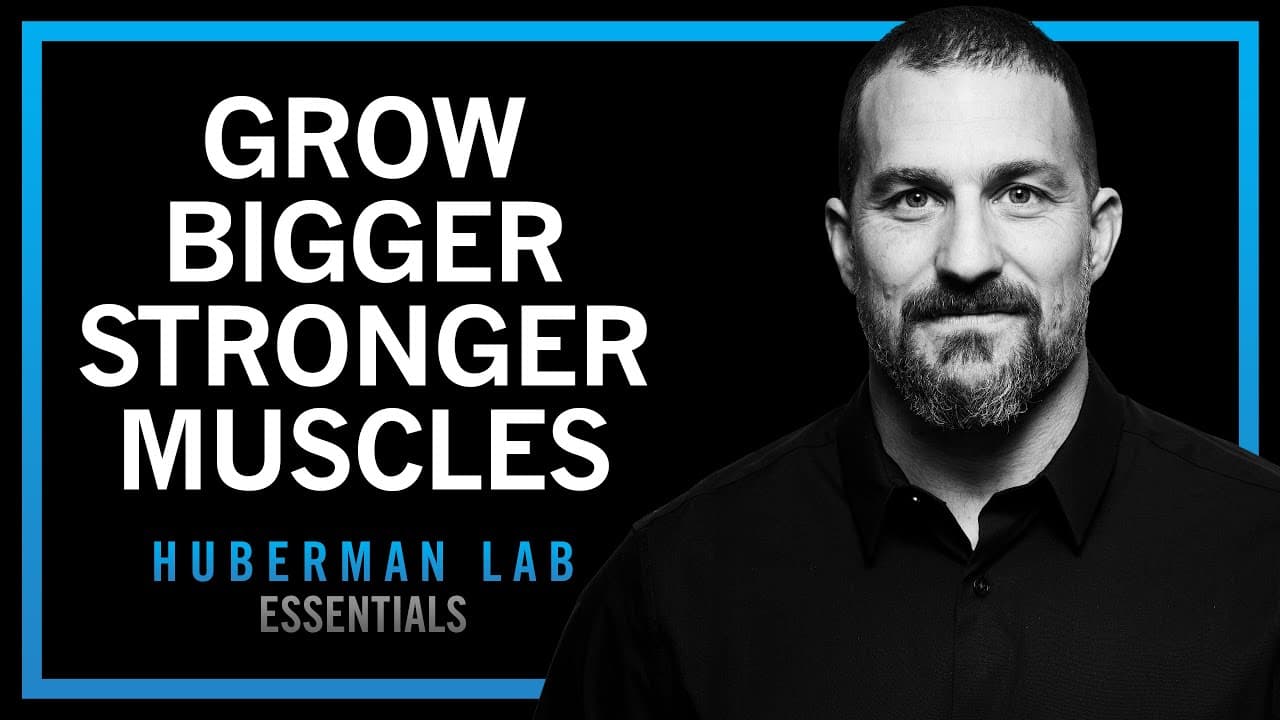
Building muscle strength and size involves understanding the role of the nervous system in muscle movement and using effective resistance training protocols. Key factors include the Henneman size principle, specific training stimuli, and adequate recovery. Nutrients like creatine and electrolytes play crucial roles in supporting muscle development, while tools like carbon dioxide tolerance tests can assess recovery readiness.
Transcript
Welcome to Huberman Lab Essentials, where we revisit past episodes for the most potent and actionable science-based tools for mental health, physical health, and performance. I'm Andrew Huberman, and I'm a professor of neurobiology and ophthalmology at Stanford School of Medicine. This podcast is separate from my teaching and research roles at Stan... Read More
Key Insights
- Muscle movement is controlled by the nervous system, which uses upper and lower motor neurons and central pattern generators.
- The Henneman size principle describes how motor units are recruited from low to high threshold based on the effort required.
- Muscle hypertrophy and strength can be achieved without heavy weights, using a range of 30-80% of one's maximum weight capacity.
- Resistance training should include 5-15 sets per muscle group weekly, with at least 10% of sets performed at high intensity.
- Recovery is crucial for muscle growth, and can be assessed using grip strength and carbon dioxide tolerance tests.
- Cold baths and NSAIDs can interfere with muscle growth by reducing inflammation necessary for muscle repair.
- Creatine enhances muscle performance by increasing power output and improving hydration at cellular levels.
- Adequate salt, potassium, and magnesium intake are essential for optimal nerve-to-muscle communication and performance.
Install to Summarize YouTube Videos and Get Transcripts
Explore YouTube Video Summarizer or Get YouTube Transcript Extractor
Questions & Answers
Q: How does the nervous system control muscle movement?
The nervous system controls muscle movement through a network of neurons, including upper motor neurons in the motor cortex and lower motor neurons in the spinal cord. Central pattern generators in the spinal cord facilitate rhythmic movements, while acetylcholine is released to cause muscle contraction. This system allows for both deliberate and reflexive actions.
Q: What is the Henneman size principle?
The Henneman size principle states that motor units, the connections between nerves and muscles, are recruited in a pattern from low to high threshold based on the effort required. This principle ensures energy conservation, using minimal nerve-to-muscle energy for light tasks and increasing recruitment for heavier tasks, facilitating muscle growth and strength.
Q: How can muscle hypertrophy be achieved without heavy weights?
Muscle hypertrophy can be achieved by using weights ranging from 30% to 80% of one's one-repetition maximum. This approach, combined with specific training parameters, stimulates changes in nerve-to-muscle connections, leading to muscle growth and strength. Heavy weights are not mandatory; rather, consistent effort and proper technique are crucial for hypertrophy.
Q: What are effective resistance training protocols for muscle growth?
Effective resistance training protocols involve performing 5-15 sets per muscle group weekly, with at least 10% of sets at high intensity. This range supports muscle maintenance and growth. Additionally, exercises should be performed in the 30-80% range of one-repetition maximum to maximize hypertrophy and strength while allowing adequate recovery time between workouts.
Q: How can recovery be assessed for muscle training?
Recovery can be assessed using grip strength and carbon dioxide tolerance tests. Grip strength measures the nervous system's ability to generate isolated force, while carbon dioxide tolerance tests assess systemic recovery. Both tests provide insights into whether the body is ready for further training, ensuring optimal recovery and performance.
Q: Why might cold baths and NSAIDs hinder muscle growth?
Cold baths and NSAIDs can hinder muscle growth by reducing inflammation, which is necessary for muscle repair and growth. Inflammation triggers pathways like mTOR, essential for muscle development. While cold baths reduce soreness, they may interfere with these pathways, and NSAIDs can prevent the gains from exercise, affecting endurance and strength.
Q: How does creatine enhance muscle performance?
Creatine enhances muscle performance by increasing power output and improving hydration at the cellular level. It allows for greater force generation during activities like sprinting, jumping, and weightlifting, with studies showing a 12-20% increase in power. Creatine also aids in reducing fatigue, supporting sustained physical performance and muscle development.
Q: Why are salt, potassium, and magnesium important for muscle performance?
Salt, potassium, and magnesium are crucial for muscle performance as they facilitate nerve-to-muscle communication. Sodium ions generate the electrical impulses necessary for nerve cells to fire, while potassium and magnesium support overall cellular function. Adequate intake of these electrolytes ensures optimal neuronal activity and muscle contraction, enhancing physical performance.
Summary & Key Takeaways
-
Muscle movement relies on the nervous system's control, using upper and lower motor neurons. The Henneman size principle helps in recruiting motor units efficiently. For hypertrophy and strength, weights ranging from 30-80% of maximum capacity are effective. (50 words)
-
Resistance training should include 5-15 sets per muscle group weekly, with some sets at high intensity. Recovery is key, assessable via grip strength and carbon dioxide tolerance. Cold baths and NSAIDs may hinder muscle growth by reducing necessary inflammation. (50 words)
-
Creatine boosts muscle performance by enhancing power output and cellular hydration. Adequate intake of salt, potassium, and magnesium is crucial for nerve-to-muscle communication. Nutrients like leucine support muscle development, and a balanced diet is essential for muscle repair and growth. (50 words)
Read in Other Languages (beta)
Share This Summary 📚
Summarize YouTube Videos and Get Video Transcripts with 1-Click
Try YouTube Summary with ChatGPT & Claude or YouTube Transcript Generator
Explore More Summaries from Andrew Huberman 📚


Summarize YouTube Videos and Get Video Transcripts with 1-Click
Try YouTube Summary with ChatGPT & Claude or YouTube Transcript Generator