How to Build AI Agents for Knowledge Work
TL;DR
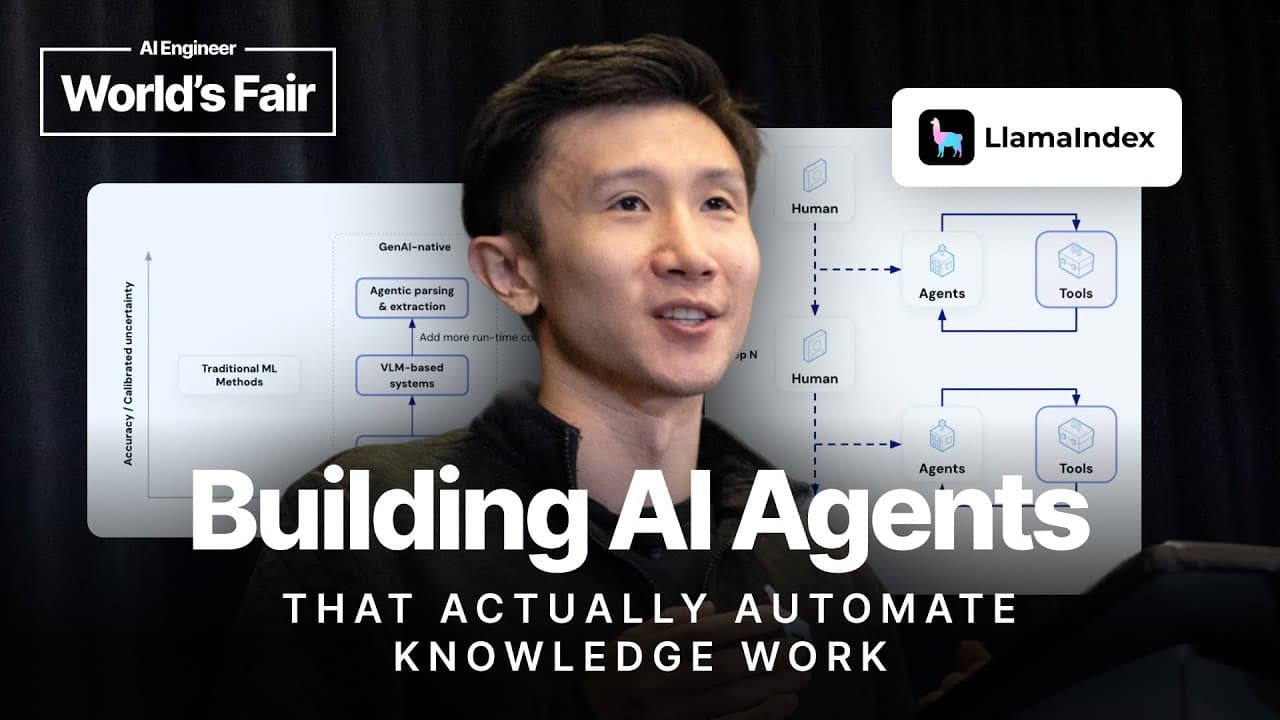
Effective knowledge-work agents require two foundations: high-quality tools for processing and interacting with documents, plus carefully tailored reasoning workflows that encode business logic. They should move beyond one-shot retrieval by supporting semantic search, file lookup, structured queries, manipulation, and actions, while choosing an assistive or automated design according to the task and desired level of human involvement.
Transcript
okay hey everyone uh I'm Jerry co-founder CEO of Llama Inducts it's great to be here um and today my topic uh the talk title is building AI agents that actually automate knowledge work so basically a big promise of AI agents these days is making knowledge workers more efficient um I'm I'm sure you've heard the like highlevel business speak of this ... Read More
Key Insights
- Enterprise knowledge work is largely document-centric, with the talk stating that 90% of enterprise data exists in documents such as PDFs, PowerPoints, Word files, and spreadsheets. Agents can reason over this unstructured context to perform research, analysis, synthesis, decisions, and actions.
- Knowledge-work agents fall into two broad categories: assistive agents help humans obtain information faster through chat-like interfaces, while automation agents execute routine tasks with less human involvement. The appropriate design depends on the workflow, its business logic, and the actions the agent must perform.
- Effective agent systems require both strong tools and a suitable reasoning architecture. Tools connect agents to external information and actions, while the architecture encodes business logic through general or constrained workflows that guide the agent toward completing a specific task.
- A document toolbox extends beyond naive retrieval-augmented generation. One-shot vector retrieval and synthesis are insufficient for many workflows, so agents also need semantic search, file lookup, metadata access, document manipulation, and structured queries that produce aggregate insights from extracted information.
- Document preprocessing is essential because agents depend on properly synchronized and structured data. Connectors must bring in documents, permissions, and metadata, while parsing and extraction must preserve meaningful information from tables, charts, images, headers, footers, and irregular page layouts.
- Complex-document accuracy depends on combining language and vision models with traditional parsing techniques. The approach described also adds agentic validation and reasoning at test time, because incorrectly processed source documents will cause failures regardless of the quality of the downstream language model.
- Spreadsheet automation requires semantic structure understanding because many Excel files are not clean two-dimensional tables. Gaps, irregular rows, and irregular columns make retrieval or text-to-CSV conversion inadequate, so the presented Excel agent first learns a semantic map and then exposes specialized tools.
- The presented Excel agent reportedly raises transformation accuracy from a 70–75% code-interpreter baseline to 95% on a private collection of synthetic spreadsheets. The talk also reports a 90% human baseline, while noting that the system supports normalization and agentic question answering over original and normalized sheets.
Install to Summarize YouTube Videos and Get Transcripts
Explore YouTube Video Summarizer or Get YouTube Transcript Extractor
Questions & Answers
Q: How do AI agents automate knowledge work?
AI agents automate knowledge work by reasoning over large amounts of unstructured information, synthesizing findings, and taking actions connected to a business process. The talk emphasizes that useful automation requires more than a chat interface. Agents need high-quality tools for accessing documents and an architecture that guides retrieval, analysis, decision-making, and operational actions from beginning to end.
Q: What components are required to build a knowledge-work agent?
A knowledge-work agent requires two main components: high-quality tools and an appropriate agent architecture. The tools let the agent retrieve context, inspect files, query structured information, manipulate documents, and take external actions. The architecture supplies general or constrained reasoning loops that encode business logic and guide the agent through the steps needed to complete a particular task.
Q: What is the difference between assistive and automation agents?
Assistive agents usually provide a chat-style experience that helps people find and understand information more quickly, with substantial human involvement. Automation agents handle routine tasks more independently, may operate in the background, and can take actions with less human input. The choice should reflect the workflow, the required reliability, and how much oversight the task needs.
Q: Why is naive RAG insufficient for document automation?
Naive retrieval-augmented generation generally performs retrieval followed by one-shot synthesis, but document workflows often require several additional operations. Agents may need to locate a specific file, inspect metadata, run semantic searches, query structured databases for aggregate insights, manipulate documents, or take external actions. A broader document toolbox supports these multi-step activities instead of limiting the system to answering retrieved questions.
Q: How should enterprise documents be prepared for AI agents?
Enterprise documents should pass through a preprocessing layer that connects to their source systems, synchronizes permissions and metadata, parses their contents, and extracts useful structure. The resulting information can be indexed in vector systems, SQL tables, graph databases, or other representations. This process gives agents reliable interfaces for searching, querying, understanding, and manipulating the underlying documents.
Q: Why is accurate parsing important for complex documents?
Accurate parsing is important because complex PDFs and similar files contain tables, charts, images, irregular layouts, headers, and footers that were designed for people rather than machines. If those elements are interpreted incorrectly, even a strong language model can produce incorrect results. The described approach combines language and vision models, traditional parsing, and agentic validation to improve document understanding.
Q: How can an AI agent understand irregular Excel spreadsheets?
An AI agent can understand an irregular spreadsheet by first analyzing its structure and learning a semantic map of the sheet. That map captures relationships that are obscured by gaps, unusual row arrangements, or irregular columns. The system can then provide specialized tools to the agent, enabling it to normalize the spreadsheet into a two-dimensional table and answer questions over both forms.
Q: How accurate is the presented Excel automation approach?
The talk reports that an ordinary language model using a code-interpreter tool reaches approximately 70–75% accuracy on a private collection of synthetic Excel sheets. The specialized Excel agent reportedly reaches 95% accuracy, compared with a stated 90% human baseline for performing the transformation manually. These figures concern the presented spreadsheet transformation task and the described private dataset.
Summary & Key Takeaways
-
Knowledge-work agents can operate across the unstructured documents that dominate enterprise workflows, including PDFs, presentations, word-processing files, and spreadsheets. Their purpose extends beyond answering questions. With suitable tools and reasoning workflows, they can research information, analyze large contexts, synthesize findings, make decisions, and perform actions that automate routine operational work.
-
A capable document toolbox begins with connectors that synchronize content, permissions, and metadata from sources such as SharePoint, Google Drive, S3, and Confluence. Parsing and extraction must accurately interpret tables, charts, images, and irregular layouts. Indexed representations can then support semantic retrieval, file lookup, structured querying, document manipulation, and other agent operations.
-
Agent architecture should match the workflow. Assistive agents use familiar chat interfaces to help people retrieve information faster, keeping humans closely involved. Automation agents run routine tasks more independently and can take actions in the background. Reliable systems combine constrained or general reasoning loops with specialized document tools and encoded business processes tailored to specific tasks.
Read in Other Languages (beta)
Share This Summary 📚
Summarize YouTube Videos and Get Video Transcripts with 1-Click
Try YouTube Summary with ChatGPT & Claude or YouTube Transcript Generator
Explore More Summaries from AI Engineer 📚




Summarize YouTube Videos and Get Video Transcripts with 1-Click
Try YouTube Summary with ChatGPT & Claude or YouTube Transcript Generator