Which Skills Become More Valuable as AI Improves?
TL;DR
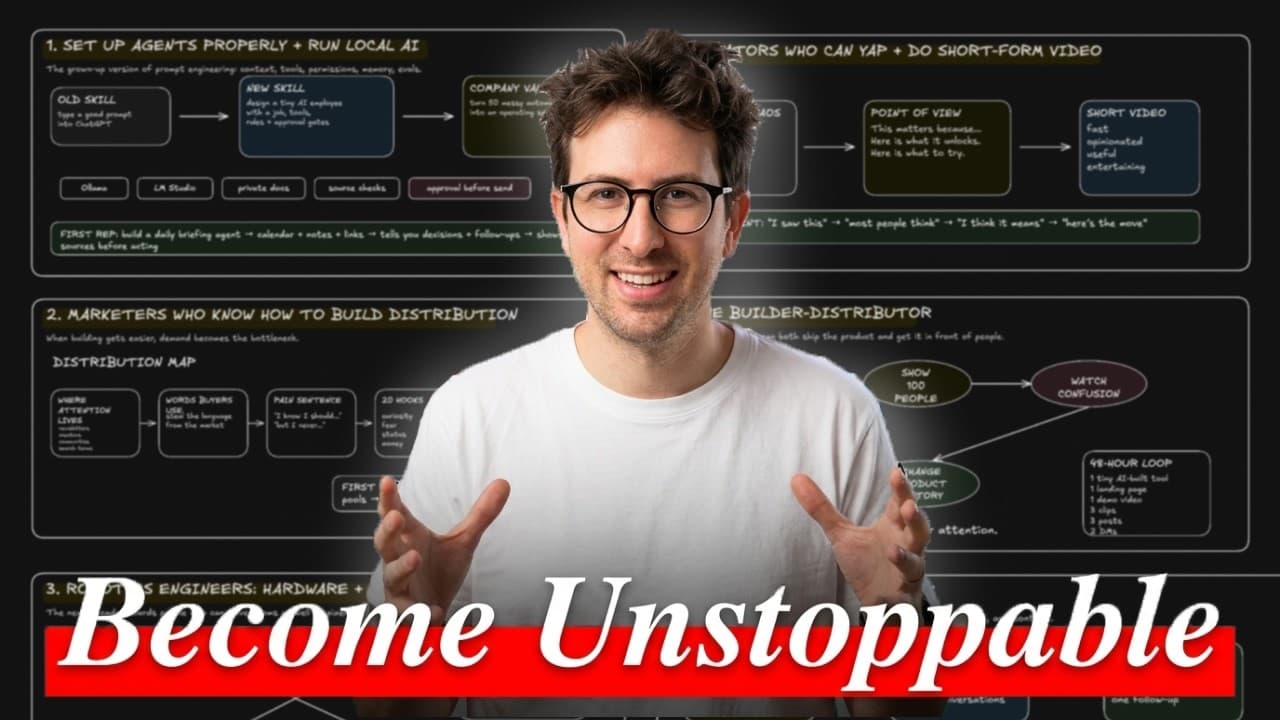
The most durable path is to build a complementary skill stack around AI: managing agents, creating distribution, working with robotics, curating ideas, combining building with promotion, and organizing in-person communities. Start with one small, measurable project, such as a daily briefing agent, a niche distribution map, or a low-cost robot arm task, then expand only after it produces useful results.
Transcript
Imagine it's a few years from now. AI can build almost anything, write almost anything, and do most of the tasks people used to get paid for. In that world, I got to ask, what skill is still valuable? I've been thinking about this non-stop, and I've narrowed it down to six core skills. None of them require a fancy degree or connections, and all of ... Read More
Key Insights
- AI agent management is the grown-up version of prompt engineering because it requires designing an AI worker with context, tools, permissions, memory, a goal, and a method for checking its work before requesting human attention.
- A daily briefing agent is a practical first project because it teaches context management, retrieval, tool use, permissions, and evaluation. It should use a few defined sources, identify daily priorities and follow-ups, show its sources, and request approval before sending anything.
- Local AI models are valuable when privacy, cost, latency, or control matter. Running models locally also teaches which tasks require a large cloud model and which can be handled by a smaller, reliable system operating on a personal machine.
- Distribution is deeper than posting because it begins with understanding where attention already exists, what an audience fears or wants, and which words people use to describe their problems. Its purpose is to establish trust before asking anyone to purchase.
- A distribution map is a useful training exercise that identifies the newsletters, creators, communities, podcasts, events, searches, and paid tools serving a chosen niche. Writing realistic pain statements and multiple hooks then converts audience research into practical messaging.
- Robotics is becoming more accessible through open-source robot-learning projects, inexpensive cameras, low-cost arms, improved simulation, multimodal models, and shared datasets. The valuable practitioner can connect hardware, AI training, repeated task performance, supplier evaluation, and manufacturing considerations.
- A builder-distributor combines product creation and attention generation in one loop. This skill supports the possibility of a one-person company because the same person can ship an offering, communicate its value, study audience response, and use that response to guide further building.
- In-person community building grows more valuable as real rooms and human belonging become scarcer. Along with curation and short-form communication, it represents work grounded in judgment, trust, shared attention, and relationships rather than only the automated production of digital outputs.
Install to Summarize YouTube Videos and Get Transcripts
Explore YouTube Video Summarizer or Get YouTube Transcript Extractor
Questions & Answers
Q: What skills become more valuable as AI improves?
The six skill sets identified are managing AI agents and local models, building distribution, combining robotics with hardware sourcing and manufacturing knowledge, curating ideas through frequent short-form communication, becoming a builder-distributor, and creating in-person communities. Each complements increasingly capable AI by adding system design, audience understanding, physical execution, judgment, commercial reach, or human belonging.
Q: How can I start learning to manage AI agents?
Build a small daily briefing agent for yourself. Give it a calendar, a folder of notes, saved links, and a few defined information sources. Ask it to identify what matters today, which decisions are waiting, and which follow-ups you owe. Require it to show sources and obtain approval before sending anything, then schedule it and evaluate whether its output saves time or catches something useful.
Q: Why are local AI models a valuable skill?
Local models matter for workflows where privacy, cost, latency, or control are important. Experimenting with tools such as Olama or LM Studio helps you understand which work can remain on your own machine, which private documents should stay behind a controlled boundary, and which tasks genuinely require a larger cloud model. The practice teaches system architecture even if local models become smaller.
Q: What is the difference between distribution and posting?
Posting is the act of publishing content, while distribution begins with understanding an audience. It requires finding where attention already lives, identifying what people are anxious about, learning the language they use, and building trust before selling. A skilled distributor can turn one insight into social posts, short videos, titles, newsletters, landing-page headlines, founder stories, and sales conversations.
Q: How do I create a distribution map for a niche?
Choose a niche you genuinely care about, then list the places its members direct their attention, including newsletters, creators, Reddit threads, Slack groups, podcasts, events, search terms, and tools they already purchase. Write a painful sentence a member might actually say aloud, then develop multiple hooks around curiosity, fear, status, money, and lessons they wish they had learned earlier.
Q: Why does robotics remain valuable in an AI-driven economy?
Robotics connects AI to physical work, so success requires more than generating software. The useful skill set includes assembling hardware, mounting a camera, collecting demonstrations, training or fine-tuning a model, making a robot repeat one useful task, assessing supplier listings, and understanding whether a design can be manufactured. Open-source projects, low-cost arms, cheaper cameras, better simulation, and shared datasets make entry more accessible.
Q: What is a builder-distributor?
A builder-distributor is someone who can create a product and develop demand for it within the same operating loop. Instead of finishing a product and only then considering promotion, this person studies existing desires, ships an offering, communicates it across useful channels, observes the response, and applies what they learn to future development. This combination helps make a one-person company more realistic.
Q: How should I build a skill stack for the AI era?
Begin with one concrete, limited practice project rather than trying to master every field or create an all-knowing AI system. Give the project a clear success measure, such as saving time, catching a missed obligation, producing something you would use, reaching an audience, or repeating one physical task. Once it creates genuine value, add complementary abilities across technology, distribution, judgment, and community.
Summary & Key Takeaways
-
AI agent management goes beyond writing effective prompts. It involves configuring context, tools, permissions, memory, goals, approval points, source visibility, and evaluation. A useful starting project is a scheduled daily briefing agent that reads selected sources, notes, saved links, and a calendar, then identifies priorities, pending decisions, and follow-ups.
-
Distribution becomes more important when AI makes products easier to create. Strong marketers investigate where a niche already directs its attention, study the language people use for painful problems, and convert one useful insight into several formats. They connect product ideas to existing desires before development instead of treating promotion as a final step.
-
The broader opportunity includes robotics, curation, short-form media, builder-distributor work, and in-person community building. These skills join technical execution with attention, judgment, physical-world capability, and human connection. The recommended approach is to begin with a concrete practice project, measure whether it creates value, and gradually assemble a complementary personal skill stack.
Read in Other Languages (beta)
Share This Summary 📚
Summarize YouTube Videos and Get Video Transcripts with 1-Click
Try YouTube Summary with ChatGPT & Claude or YouTube Transcript Generator
Explore More Summaries from Greg Isenberg 📚


Summarize YouTube Videos and Get Video Transcripts with 1-Click
Try YouTube Summary with ChatGPT & Claude or YouTube Transcript Generator