How to Start an AI Startup as a Leveraged Agency
TL;DR
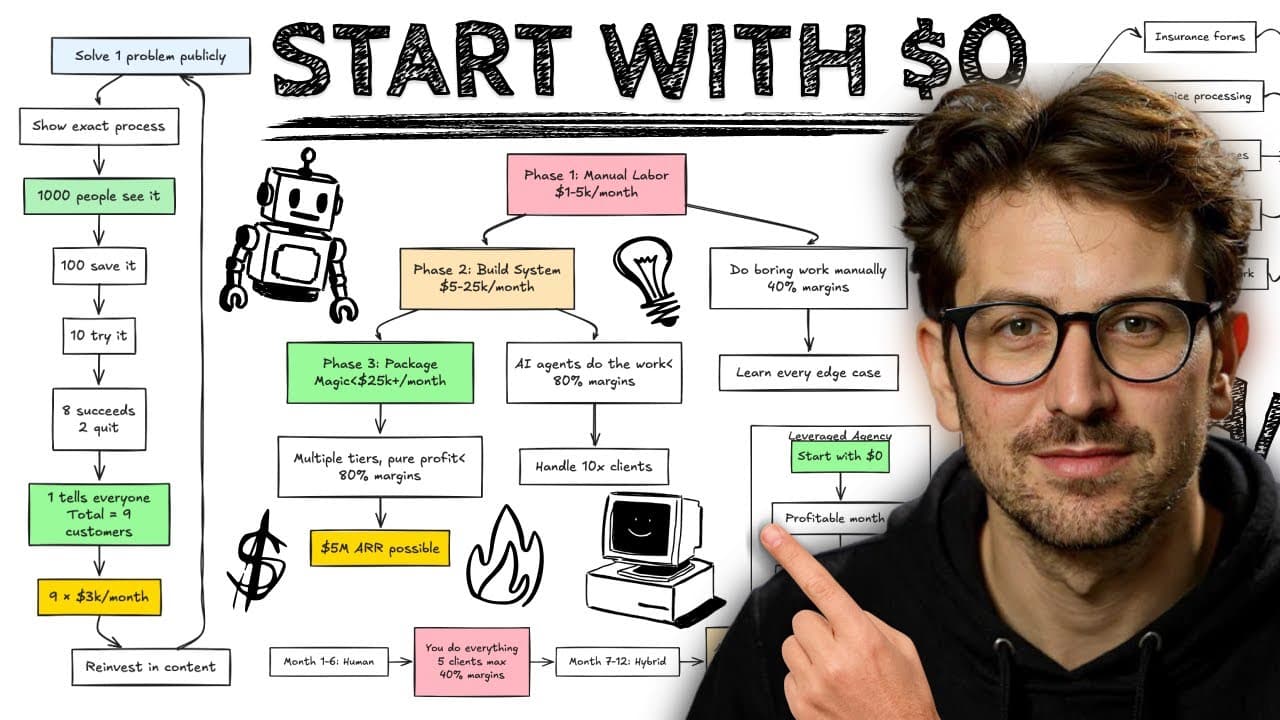
Start by launching a manual service business to learn edge cases, then replace routine tasks with AI agents to lift margins, and finally scale with multiple pricing tiers and content distribution. The approach keeps you profitable from month one, preserves equity, and grows from a niche service into an AI driven system.
Transcript
Today we're going to talk about creating an AI startup. So I'm actually going to go through the process of how you can start with a relatively small nonAI startup doing$1 to $5,000 a month that you can build it to $5 to $25,000 and that you can eventually get to $5 million ARR with an AI startup. So basically you start with a nonAI startup and you ... Read More
Key Insights
- Phase 1 is a manual service business that targets one boring painful task and earns $1K-$5K per month.
- Phase 2 introduces AI agents to automate the tasks, aiming to double margins and handle more clients.
- Phase 3 adds multiple pricing tiers such as enterprise, self serve, and API to reach higher revenue levels while preserving pricing insights from the edge cases learned earlier.
- Building an audience through daily content creation drives customer acquisition and credibility.
- The leveraged agency approach helps retain equity and allows reinvestment into agents and distribution for growth.
- Starting with a practical, nitty gritty service helps uncover edge cases and real customer needs before scaling with AI.
- The process emphasizes documenting SOPs during the manual phase to mirror them with AI agents later on.
- Content distribution is crucial for scaling and finding customers as the AI system matures.
- More videos from this channel:
- More from this channel: Greg Isenberg
Install to Summarize YouTube Videos and Get Transcripts
Explore YouTube Video Summarizer or Get YouTube Transcript Extractor
Questions & Answers
Q: How does the three phase AI startup framework work according to the video
The three phase framework starts with Phase 1, a manual service business delivering one boring task to generate initial revenue and learn edge cases. Phase 2 adds AI agents to automate work, increasing margins and capacity. Phase 3 introduces multiple pricing tiers, including enterprise, self serve, and an API, to scale to higher ARR while maintaining the original pricing and value delivered.
Q: What is the purpose of starting with a manual service in Phase 1
Starting with a manual service allows you to immediately generate revenue in the $1K-$5K per month range while learning all edge cases and SOPs. This approach provides real customer feedback, validates product-market fit, and preserves equity, creating a foundation for reinvestment into AI agents and scalable distribution.
Q: How are AI agents used in Phase 2
In Phase 2, AI agents are wired to mirror the SOPs created during Phase 1, automating repetitive tasks and reducing reliance on human labor. This shift aims to double margins, increase capacity to handle more clients, and add enterprise value by replacing a portion of manual work with automated workflows.
Q: What pricing strategy is suggested for scaling to higher ARR
The strategy involves maintaining the initial service pricing while adding tiers later, including enterprise, self serve, and potentially API access. This tiered pricing enables higher revenue as you scale, while preserving the outcomes customers receive and the edge cases learned in Phase 1 and 2.
Q: Why is building an audience important in this approach
Building an audience is important because it drives word of mouth and credibility, helps identify customer pain points, and accelerates customer acquisition. By publishing daily content and showcasing the process, you attract attention, gather feedback, and create a flywheel where more paying customers enable further investment in distribution and AI agent development.
Q: What role does content distribution play in scaling
Content distribution serves a dual purpose: it helps acquire customers through visibility and trust, and it informs product development by highlighting what customers want. A mix of high quality cinematic content and low fidelity daily posts creates a scalable content engine that supports growth and inbound demand for the AI driven system.
Q: How does this approach compare to VC backed startups
The approach is presented as a leveraged alternative to VC backed startups. It starts with a service business, achieves profitability from month one, and allows reinvestment into agents and distribution, preserving equity. In contrast, VC backed startups may burn cash before you reach product market fit, with a longer, higher risk path to scale.
Q: What is the ultimate goal of the three phase process
The ultimate goal is to reach hundreds of clients with high margins by building a fully AI driven system, while keeping the core pricing for services steady. This culminates in ARR growth, expanded distribution, and an operational model where AI agents perform much of the work, enabling scalable, sustainable profitability.
Summary & Key Takeaways
-
A leveraged agency begins with a boring pain point turned into a service to generate initial revenue while learning edge cases and SOPs, then uses AI agents to automate workflows and extend capacity without sacrificing outcomes.
-
The strategy emphasizes maintaining the same pricing while expanding delivery through automation, followed by adding enterprise, self serve, and API tiers to reach higher ARR targets and broader client coverage.
-
A strong audience and public building plan supports customer acquisition and distribution, reinforcing the cycle of content creation, feedback, and investment in better workflows and agents to sustain growth.
Read in Other Languages (beta)
Share This Summary 📚
Summarize YouTube Videos and Get Video Transcripts with 1-Click
Try YouTube Summary with ChatGPT & Claude or YouTube Transcript Generator
Explore More Summaries from Greg Isenberg 📚






Summarize YouTube Videos and Get Video Transcripts with 1-Click
Try YouTube Summary with ChatGPT & Claude or YouTube Transcript Generator