How to Implement Deep Deterministic Policy Gradients in TensorFlow
TL;DR
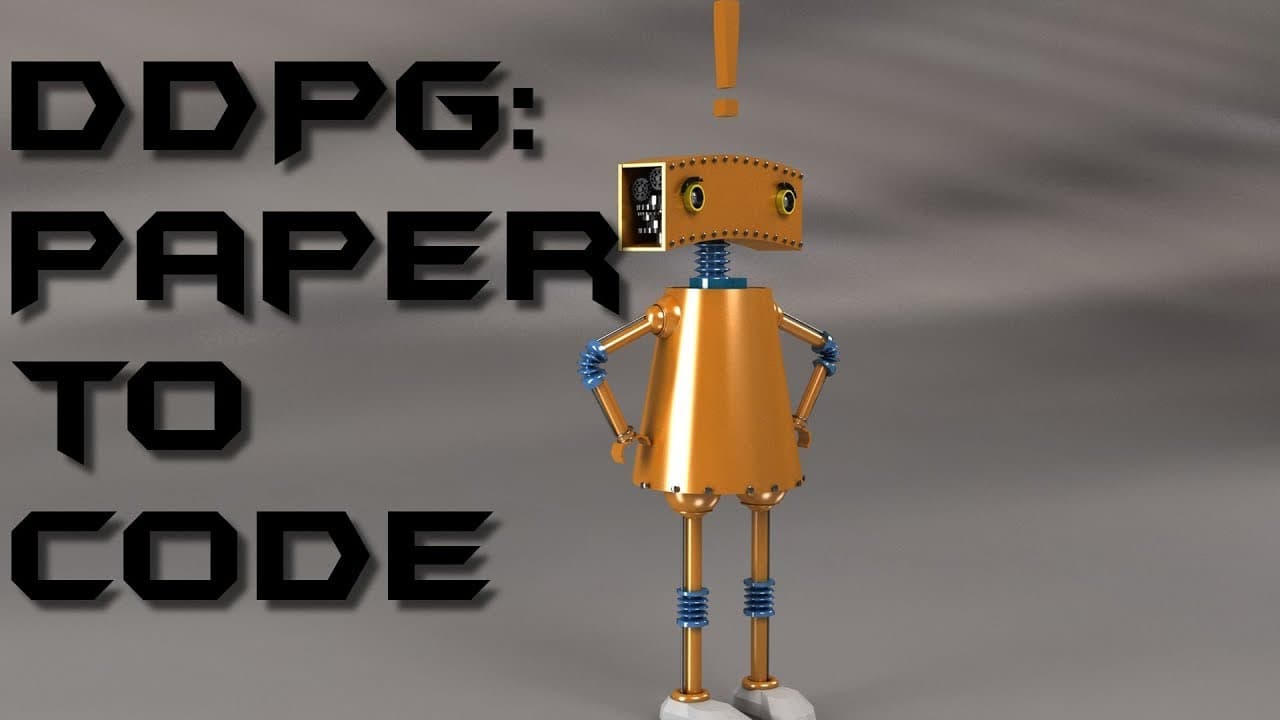
To implement deep deterministic policy gradients (DDPG) in TensorFlow, start by thoroughly reading the algorithm, actor and critic network details, and the structure of the replay buffer outlined in the research paper. Key steps include utilizing the Ornstein-Uhlenbeck process for action exploration and maintaining separate target networks for stabilization during training.
Transcript
what is up everybody in today's video we're gonna go from the paper on deep deterministic policy gradients all the way into a functional implementation in tensor flow so you're gonna see how to go from a paper to a real-world implementation all in one video grab a snack a drink cuz this is gonna take a while let's get started so the first step in m... Read More
Key Insights
- 👨🔬 Understanding the abstract, introduction, background, and algorithm sections of a research paper is crucial for implementing deep deterministic policy gradients.
- 🤩 The actor and critic networks, replay buffer, and exploration techniques using the Ornstein-Uhlenbeck noise process are key elements to consider in the implementation.
- 🎮 The video highlights the importance of implementation details provided in the supplementary materials, such as network architectures and parameter choices.
- 🫠 Reading the paper carefully and taking notes can help in developing a solid understanding of the algorithm and implementing it effectively in TensorFlow.
Install to Summarize YouTube Videos and Get Transcripts
Explore YouTube Video Summarizer or Get YouTube Transcript Extractor
Questions & Answers
Q: How does the video explain the process of going from a research paper to a functional implementation of deep deterministic policy gradients?
The video emphasizes the importance of reading the abstract, introduction, background, and algorithm sections of the paper to understand the motivation behind the algorithm and grasp the key elements needed for implementation. It also highlights the need to focus on the details of the algorithm and experimental setup to ensure a successful implementation.
Q: What are the key elements discussed in the video?
The video covers the importance of reading the abstract, introduction, background, and algorithm sections of the paper. It emphasizes the need to understand the actor and critic networks, the replay buffer, and the exploration techniques using the Ornstein-Uhlenbeck noise process. Additionally, the video highlights the implementation details provided in the supplementary materials.
Q: How does the video explain the process of implementing the exploration policy in deep deterministic policy gradients?
The video discusses the use of the Ornstein-Uhlenbeck noise process to create exploration policy in deep deterministic policy gradients. It explains that the noise is added to the policy output, allowing for exploration while using a deterministic policy. The video also mentions the need to reset the noise process at the start of each episode.
Q: What strategies are suggested for reading and understanding the research paper on deep deterministic policy gradients?
The video suggests starting with the abstract to understand the high-level idea of the paper. It then recommends reading the introduction and background sections to learn about the motivation, related work, and mathematical foundation of the algorithm. Finally, it advises carefully studying the algorithm section, including the pseudocode and experimental details.
Summary & Key Takeaways
-
The video discusses the process of implementing deep deterministic policy gradients (DDPG) from a research paper to a functional implementation in TensorFlow.
-
It emphasizes the importance of reading the abstract, introduction, background, and algorithm sections of the paper to gain a solid understanding of the topic.
-
Key elements covered include the actor and critic networks, replay buffer, exploration techniques using the Ornstein-Uhlenbeck noise process, and the implementation details described in the supplementary materials.
Read in Other Languages (beta)
Share This Summary 📚
Summarize YouTube Videos and Get Video Transcripts with 1-Click
Try YouTube Summary with ChatGPT & Claude or YouTube Transcript Generator
Explore More Summaries from Machine Learning with Phil 📚


Summarize YouTube Videos and Get Video Transcripts with 1-Click
Try YouTube Summary with ChatGPT & Claude or YouTube Transcript Generator