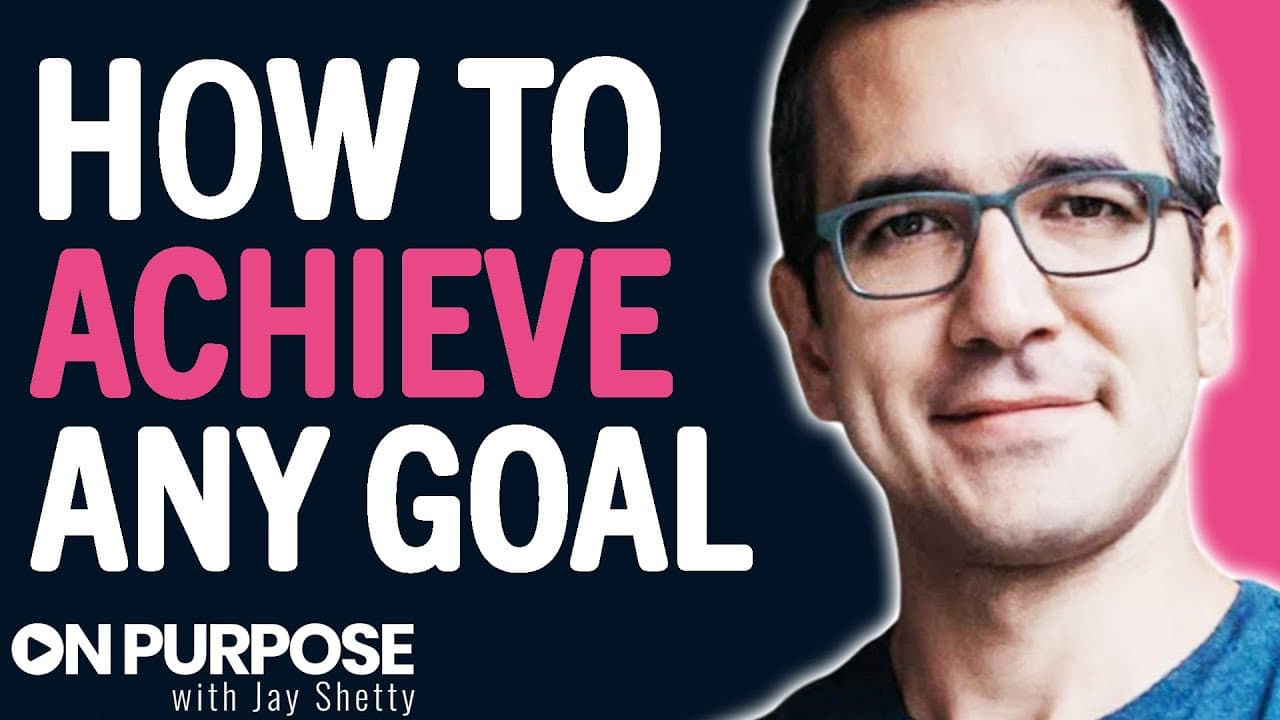
The SECRET To Achieving Your Most AMBITIOUS GOALS In Life | Ozan Varol & Jay Shetty
TL;DR
Giant leaps come from a repeatable thought process, not raw genius. Rocket scientists convert the seemingly impossible into the possible using nine simple strategies for handling uncertainty, innovating within constraints, and reframing problems. Breakthroughs usually begin not with a smart answer but with a smart question that reframes the problem in a way no one else sees.
Transcript
breakthroughs we tend to think begin with a smart answer but they often begin with a smart question that reframes a problem and sees it in a light that no one else is seeing it hey everyone welcome back to on purpose the number one health podcast in the world thanks to each and every single one of you who come back every single week to listen learn... Read More
Key Insights
- Rocket science is not an official college major or job title. The term is used colloquially for the science and engineering behind space travel, so people become rocket scientists through fields like astrophysics or aeronautical engineering.
- Breakthroughs often begin with a smart question rather than a smart answer. A reframing question that sees a problem in a light no one else is seeing tends to spark the actual innovation.
- The moon landing was a triumph of humans, not just technology. Ozan Varol credits the thought process people used to turn the seemingly impossible into the possible, not the machines themselves.
- Kennedy's 1962 moon pledge was a genuine moonshot. No American had worked outside a spacecraft, two craft had never docked, and Kennedy said some required metals had not even been invented yet.
- Progress can compress across a single human lifespan. A child who was six during the Wright brothers' 1903 flight would have been 72 when humans reached the moon, only 66 years later.
- Success can be more dangerous than failure. Varol's final chapter, 'Nothing fails like success,' argues success breeds complacency, tunnel vision, and conformity that hide the bad decisions behind good outcomes.
- The Challenger and Columbia disasters each killed all seven astronauts on board and followed strings of triumphant NASA successes. Managers ignored engineers because prior missions succeeded despite the same damage.
- Analyzing your wins matters as much as analyzing your losses. You can succeed despite a serious misstep, so conducting the same scrutiny after a success as after a failure prevents repeating hidden flaws.
Install to Summarize YouTube Videos and Get Transcripts
Explore YouTube Video Summarizer or Get YouTube Transcript Extractor
Questions & Answers
Q: What does it mean to think like a rocket scientist?
It means using a specific, repeatable thought process to convert the seemingly impossible into the possible. Ozan Varol distills it into nine simple strategies covering how to approach uncertainty, innovate within constraints, and handle both failure and success. The goal is to show ordinary people how to make giant leaps in work and life, rather than treating this thinking as something reserved only for geniuses.
Q: How do you actually become a rocket scientist?
There is no college major called rocket science and probably no one with the official job title 'rocket scientist.' The term is used colloquially for the science and engineering behind space travel. Varol majored in astrophysics at Cornell, but you could also enter the field through aeronautical engineering. Broadly, it refers to people working on space travel and on converting the seemingly impossible into the possible.
Q: Why did Ozan Varol write Think Like a Rocket Scientist?
Varol wanted to challenge how people think, similar to Jay Shetty's aim with Think Like a Monk. He argues the moon landing's giant leap belongs to the humans and their thought process, not just the technology. Because 'rocket science' intimidates people and gets reserved for geniuses, he wrote about nine simple, practical strategies so readers could apply that thinking to make giant leaps in their own lives.
Q: Why do breakthroughs begin with a question rather than an answer?
Varol says breakthroughs tend to begin not with a smart answer but with a smart question that reframes a problem and sees it in a light no one else is seeing. Reframing the problem itself opens possibilities that a rush to answers would miss. This mindset underlies turning the seemingly impossible into the possible, since a better question redefines what solutions are even considered.
Q: What is the 'Nothing fails like success' idea?
It is the counter-intuitive final chapter of Varol's book, arguing that success can be harmful. Success can create complacency, tunnel vision, and conformity. When we win, our instinct is to celebrate, but we may have succeeded despite a bad decision or serious misstep. Without the same analysis you would run after a failure, hidden flaws go unexamined and can eventually lead to disaster.
Q: How did success contribute to the Challenger and Columbia disasters?
Both NASA disasters, which each killed all seven astronauts on board, followed a string of triumphant successes that bred tunnel vision. Engineers warned that the O-rings were being damaged flight after flight, but managers reasoned that since previous missions succeeded despite the damage, repeating the process guaranteed success. Columbia had a different technical flaw but the same cultural flaw: success creating complacency and conformity.
Q: What was the O-ring warning before the Challenger disaster?
About six months before the Challenger disaster, one engineer wrote a memo that proved prescient. He warned that if the O-ring problem was not fixed, it would be a catastrophe of the highest order, including loss of human life. O-rings are flexible rings that seal the boosters so hot gases do not escape, a critical function. Managers ignored the warning because past missions had succeeded despite O-ring damage.
Q: How fast did humanity progress from first flight to the moon landing?
The Wright brothers' first powered flight in 1903 lasted about 12 seconds and moved roughly 100 feet. Just 66 years later, in less than seven years after Kennedy's 1962 pledge, Neil and Buzz took their giant leap on the moon. Varol notes a child who was six at the 1903 flight would have been 72 at the moon landing, so it all happened within a single human lifespan.
Summary
In this episode, Jay Shetty interviews Ozan Varol, a former rocket scientist and author of the book "Think Like a Rocket Scientist." They discuss the importance of asking smart questions, reframing problems, and thinking differently to achieve breakthroughs in work and life.
Questions & Answers
Q: How do you become a rocket scientist?
There is no college major called rocket science, and there is no official job title of rocket scientist. The term is used broadly to refer to people working on space travel and converting the seemingly impossible into the possible. One can become a rocket scientist by majoring in astrophysics or aeronautical engineering.
Q: Why did you think it was important to challenge people to think like a rocket scientist?
I wanted to challenge the mindset of people and encourage them to think differently. The thought process used by rocket scientists to turn the seemingly impossible into the possible can be applied in various aspects of life. By understanding and applying these strategies, individuals can make giant leaps in their work and personal lives.
Q: Can you share an example of a breakthrough achieved by applying rocket science principles?
President John F. Kennedy's pledge to land a man on the moon and return him safely to Earth before the end of the 1960s is a prime example. At the time, many believed it to be a moonshot and thought it was impossible. However, through the innovative thinking and problem-solving of rocket scientists, the moon landing became a reality within seven years.
Q: How can we fail effectively and learn from our failures?
Failure can be the best teacher if we approach it properly. Instead of just failing fast, we should focus on learning fast. It is important to analyze our failures, understand what went wrong, and make adjustments for future endeavors. The goal is to learn from failures and not repeat the same mistakes. Scientists take this approach and view failure as a stepping stone to success.
Q: Can you explain what first principles thinking is and how Elon Musk has used it?
First principles thinking is a way of cutting through assumptions and unlearning what we know in order to pave the way for better solutions. Elon Musk applied this thinking when he realized that buying rockets from others was expensive. He went back to the basics of what a rocket is made of and figured out that building rockets from scratch could be much cheaper. Musk also challenged the assumption that rockets could not be reused and created the concept of reusable rocket stages, ultimately reducing the cost of space travel.
Q: What is the difference between strategy and tactics, and why is strategic thinking important?
Strategy is an overall plan for achieving an objective, while tactics are the specific tools and actions used to reach that objective. Strategic thinking involves stepping back from the immediate actions and considering the broader goals and approaches. It allows for more flexibility and creativity in finding the best possible solutions. Tactical thinking, on the other hand, often focuses on short-term actions without considering the overall strategy.
Q: How can we think more strategically in our own lives?
By identifying the broader goals and objectives we want to achieve, we can develop a clear strategy to guide our actions. Rather than getting caught up in immediate tactics or seeking shortcuts, we should focus on the inputs and processes that will lead to long-term success. By asking smart questions and reframing problems, we can think differently and make strategic decisions that support our goals.
Q: How can we overcome societal and educational conditioning that limits our thinking?
It takes purpose, effort, and intention to overcome societal and educational conditioning. We need to challenge assumptions, regain our childlike curiosity, and reorient our focus on long-term goals. Asking ourselves what's the worst that can happen and what's the best that can happen can help us overcome our own limitations and push past societal conditioning. It's important to remember that breakthroughs often come from those who think differently and challenge the status quo.
Q: How can we avoid getting caught up in short-term outcomes and focus more on the inputs and processes?
Shifting our focus from short-term outcomes to the inputs and processes allows us to think more strategically and make better decisions. Celebrating successes or dwelling on failures without analyzing them can prevent us from learning and growing. Emphasizing the quality of the inputs and focusing on the process rather than the immediate outcome can lead to long-term success and fulfillment.
Q: Can you share a practical example of how thinking strategically can lead to better results?
Tina Seelig's five-dollar challenge is a great example. In this challenge, teams were given five dollars and two hours to make as much money as possible. Most teams focused on tactical approaches like setting up car washes or lemonade stands. However, the winning team took a strategic approach and recognized that their most valuable resource was a three-minute presentation to the class. They sold their presentation slot to a company interested in recruiting Stanford students and made seven hundred dollars. This example shows the power of strategic thinking and reframing problems to find more effective solutions.
Takeaways
Breaking through limitations and achieving success often begins with asking smart questions and reframing problems. By challenging assumptions, thinking strategically, and focusing on the inputs and processes, individuals can make significant leaps in their work and personal lives. Failure can be an invaluable teacher if we learn from it, and first principles thinking allows us to cut through assumptions and pave the way for innovative solutions. By overcoming societal and educational conditioning, regaining curiosity, and embracing a long-term perspective, individuals can think differently and unlock their full potential. Remember, breakthroughs often come from those who challenge the status quo and think outside the box.
Summary & Key Takeaways
-
Ozan Varol, a former rocket scientist turned law professor and author of 'Think Like a Rocket Scientist,' joins Jay Shetty to explain that giant leaps in work and life come from a learnable thought process rather than genius reserved for a special few.
-
Varol opens his book with Kennedy's 1962 Rice University pledge to land a man on the moon, a moonshot many at NASA thought impossible because key prerequisites, and even some required metals, did not yet exist. Humanity built the capability anyway within seven years.
-
The book's most counter-intuitive lesson is that nothing fails like success. Using the Challenger and Columbia shuttle disasters, Varol shows how repeated wins created complacency, made managers dismiss engineers' warnings about damaged O-rings, and turned success into a hidden path to catastrophe.
Read in Other Languages (beta)
Share This Summary 📚
Summarize YouTube Videos and Get Video Transcripts with 1-Click
Try YouTube Summary with ChatGPT & Claude or YouTube Transcript Generator
Explore More Summaries from Success Habits 📚


Summarize YouTube Videos and Get Video Transcripts with 1-Click
Try YouTube Summary with ChatGPT & Claude or YouTube Transcript Generator