How Enterprise AI Creates Real Business Value
TL;DR
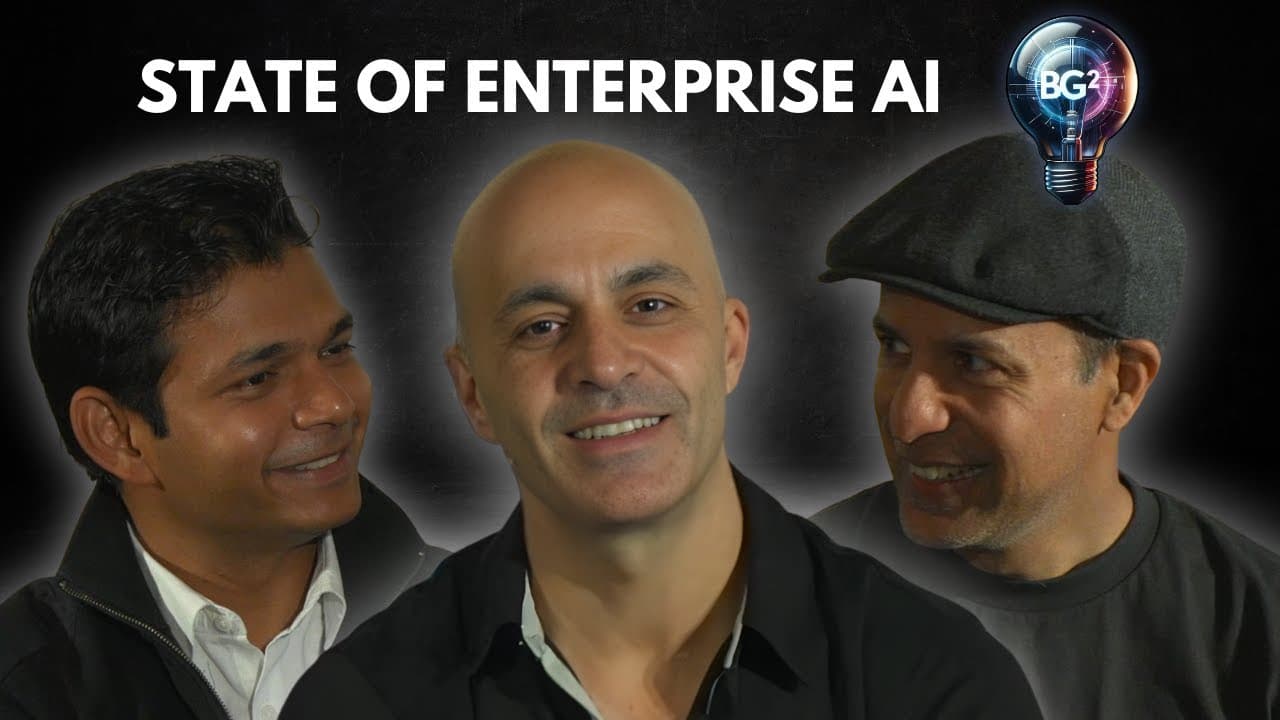
Enterprise AI creates durable value when it uses proprietary company data to improve distinctive workflows, rather than merely wrapping interchangeable language models. Successful deployments require evaluations, production engineering, capable teams, and workflow integration, while a high failure rate can reflect necessary experimentation with rapidly changing technology.
Transcript
I think we have AGI. I think we have artificial general intelligence. We really haven't. You you hear these 95% of projects fail, but like you know like that's that's that's actually what you want. I I think the LLM is a commodity. People are not saying that, but it is a commodity. Like you can get gas from this gas station. You can get gas from th... Read More
Key Insights
- • A high AI project failure rate is compatible with productive experimentation. The interview argues that companies exploring a rapidly changing technology should test many ideas, accept that most will not succeed, and use those failures to identify the smaller set of deployments that generate meaningful organizational benefits.
- • Production AI is an engineering discipline, not an automatic consequence of releasing agents. Reliable deployments require evaluations, production work, sustained effort, and a capable team, especially when the goal is to create an advantage that competitors cannot reproduce with an equally simple implementation.
- • Royal Bank of Canada uses agents to assemble equity research inputs and produce a report in 15 minutes after an earnings call. The process gathers current and previous earnings reports, competitor information, market developments, and news, compared with an industry standard of two hours.
- • Merck developed Teddy, a transformer-enabled drug discovery model that identifies a missing genome and models gene regulatory relationships. The example shows how transformer architectures can be applied beyond next-word prediction to investigate gene expression and support early work related to drug discovery.
- • 7-Eleven uses agents to automate parts of its marketing stack, including audience segmentation, targeted material creation, and campaign assembly. Automated content generation allows finer segmentation and more customized web materials because producing separate content for many groups requires less manual human labor.
- • Large language models are becoming commodities because providers and model rankings can change quickly. The interview argues that choosing a temporarily stronger model is less strategically important than building AI that understands proprietary company data, internal business processes, and organizational knowledge unavailable to competitors.
- • Proprietary data and distinctive workflows are the primary sources of durable enterprise AI advantage. A company can differentiate when AI understands its secret information or improves the particular processes through which it delivers products and services, rather than reproducing capabilities available to every organization.
- • Demonstration software is easier to create than production value. Generative AI can produce impressive prototypes quickly, but a compelling demonstration does not establish reliability, differentiation, or economic benefit. Some internal projects also take much longer than expected, even when they are not classified as outright failures.
Install to Summarize YouTube Videos and Get Transcripts
Explore YouTube Video Summarizer or Get YouTube Transcript Extractor
Questions & Answers
Q: Why do 95% of enterprise AI projects fail?
The interview treats a high failure rate as a natural result of broad experimentation rather than proof that enterprise AI has no value. Organizations are testing a rapidly changing technology, so many ideas will fail, take longer than expected, or become obsolete when new capabilities appear. The important objective is to explore enough possibilities to identify the smaller group of applications that can be engineered into useful production systems.
Q: What makes an enterprise AI project successful?
A successful enterprise AI project combines relevant company data, a valuable workflow, evaluations, production engineering, sustained effort, and a capable team. Simply releasing an agent is not enough. The strongest opportunities improve a process that is distinctive to the company or use information competitors do not possess, creating value that cannot be duplicated through the same generic model and a quickly assembled interface.
Q: How did Royal Bank of Canada use AI agents?
Royal Bank of Canada built agents that begin working when an earnings report appears. The system gathers the current report, previous reports, competitor earnings, market developments, and relevant news, then performs analysis and assembles an equity research report. It can produce the report within 15 minutes of the earnings call, compared with an industry standard of two hours described in the interview.
Q: How is Merck using transformers for drug discovery?
Merck created Teddy, which stands for transformer-enabled drug discovery. Instead of predicting a missing word, the model is described as determining which genome is missing when one is removed. This helps it represent the gene regulatory network and examine what is happening with gene expression. The work is characterized as an early but important application that could support drug discovery tasks not previously possible.
Q: How does 7-Eleven use AI in marketing?
7-Eleven uses agents to automate parts of its marketing stack. The agents can segment audiences, determine what different groups should hear, create targeted marketing materials, and assemble campaigns. Because content creation previously required substantial manual labor, automation permits finer segmentation and more customized web experiences. The company can therefore perform more of the marketing process through agents and complete that work faster.
Q: Why are large language models becoming commodities?
Large language models are described as commodities because they are increasingly interchangeable, much like purchasing the same basic product from different suppliers. One model may be stronger now and another may lead the following week, making rankings difficult to track. As a result, the selected model alone is unlikely to provide durable differentiation. Price and practical fit become more important than temporary benchmark leadership.
Q: Why is proprietary data an enterprise AI moat?
Proprietary data is a moat because generic AI systems do not automatically understand a company's internal knowledge, secret information, business processes, or distinctive way of delivering products and services. When an organization builds AI around information its competitors lack, the resulting capability is harder to reproduce. The interview therefore frames an effective AI strategy as closely connected to the company's data strategy and unique operational strengths.
Q: What causes promising AI demonstrations to fail in production?
Promising demonstrations can fail because generative AI makes it easy to assemble something impressive without establishing reliability, differentiation, or economic value. Production deployment requires evaluations, engineering, workflow integration, and a strong team. Projects may also lose relevance quickly as new model capabilities appear. The Databricks discussion cites fine-tuning for specific product uses as work that did not pan out when existing models became the better choice.
Summary & Key Takeaways
-
Enterprise AI adoption differs from benchmark progress because useful deployment requires more than a capable model. Employees already use general AI tools, but production systems must satisfy organizational requirements. The guests argue that extensive experimentation, including failed projects, is necessary for companies to discover applications that produce measurable economic value.
-
Successful examples span several industries. Royal Bank of Canada reduced the preparation time for an equity research report from the industry standard of two hours to 15 minutes. Merck developed a transformer model for gene regulatory analysis, while 7-Eleven used agents to automate audience segmentation, content creation, and marketing campaigns.
-
The interview argues that language models are becoming interchangeable commodities, so durable differentiation comes from proprietary data, unique processes, and deep workflow integration. Attractive demonstrations are easy to build, but production systems require evaluations, engineering effort, and strong teams. Companies should prioritize applications rooted in capabilities their competitors cannot easily reproduce.
Read in Other Languages (beta)
Share This Summary 📚
Summarize YouTube Videos and Get Video Transcripts with 1-Click
Try YouTube Summary with ChatGPT & Claude or YouTube Transcript Generator
Explore More Summaries from Bg2 Pod 📚






Summarize YouTube Videos and Get Video Transcripts with 1-Click
Try YouTube Summary with ChatGPT & Claude or YouTube Transcript Generator