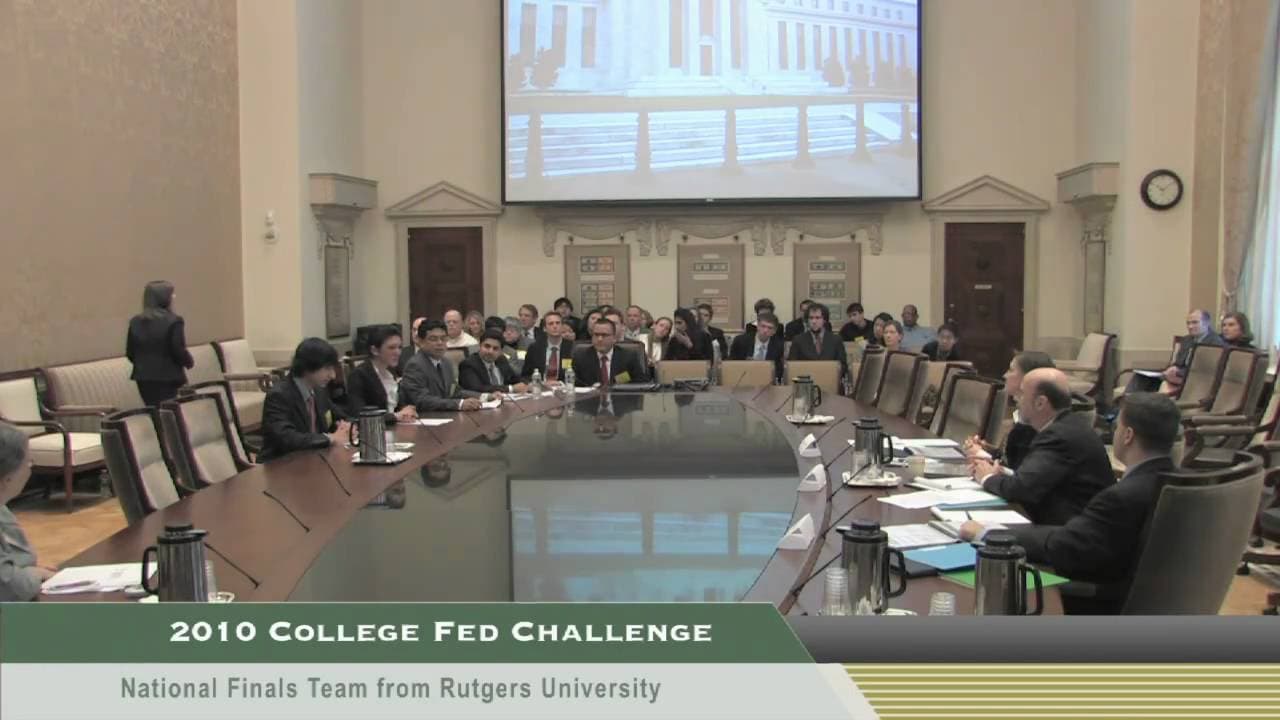
2010 College Fed Challenge, National Finals Team from Rutgers
TL;DR
Rutgers’ 2010 College Fed Challenge national finalists argue that the recovery had lost momentum, helping explain the FOMC’s decision to begin QE2. They cite third-quarter GDP growth of 2.5%, unemployment of 9.6%, more than eight million jobs lost, constrained consumer spending, and persistent housing distress. Read on for their evidence on consumption, employment, real estate, business investment, and monetary policy.
Transcript
All right. Good morning, and my name is Victor Castaneda. Good morning, everyone. My name is Lakshya Aeri. Good morning. My name is Henry Ruiz. Good morning. I'm Gassia Assadourian. Hi. I'm Sher Singh. And, judges, if you'd do the same. My name is Alex Olbrecht. I'm the executive director of the Eastern Economic Association; and I was participating... Read More
Key Insights
- ✋ High school students gain insights into Federal Reserve policymaking and the economy through the Fed Challenge competition.
- ❓ Federal Reserve officials explain economic conditions, inflation expectations, and the rationale behind policy decisions.
- 📈 Structural changes in the labor market impact consumption trends and job market outcomes, posing challenges for economic recovery.
- 🫵 Discussion on quantitative easing, inflation targeting, and financial sector stability highlights divergent views on monetary policy.
Install to Summarize YouTube Videos and Get Transcripts
Explore YouTube Video Summarizer or Get YouTube Transcript Extractor
Questions & Answers
Q: What did the Rutgers team present at the 2010 College Fed Challenge National Finals?
The team staged a monetary-policy talk show featuring Federal Reserve district bank presidents with divergent views on the economy. Their discussion examined the economic conditions surrounding the FOMC’s November decision to implement a second round of large-scale asset purchases, known as QE2.
Q: Why did the FOMC decide to implement QE2?
The presentation says the economic recovery that began in summer 2009 had lost momentum in recent months. Third-quarter GDP expanded by a modest 2.5%, down from 5% in the fourth quarter of the previous year.
Q: How was weak employment affecting consumer spending?
Consumers faced a difficult job market and depressed home values, so they largely limited purchases to necessities and nondiscretionary items. Although retail sales had risen for four consecutive months, they remained sluggish, constraining business-sector growth.
Q: What labor-market evidence showed that the recovery remained weak?
The unemployment rate was 9.6%, while the U6 measure of labor underutilization was almost twice as high. There were five unemployed workers per job opening, and the economy remained far from recovering the more than eight million jobs lost during the recession.
Q: Why was long-term unemployment a major concern?
The number of people unemployed for 27 weeks or longer reached a post-World War II high in May. It remained unprecedentedly high afterward, even as private payrolls continued to expand and the latest employment report appeared encouraging.
Q: What problems remained in the housing market?
Existing-home sales remained depressed despite historically low mortgage rates, while housing starts were below the low levels recorded in June of the previous year. More than 20% of borrowers owed more than their homes were worth, leaving them vulnerable if house prices fell further.
Q: What did the presentation say about manufacturing and business investment?
Manufacturing, described as the leading sector of the recovery and a barometer of overall economic activity, had slowed in recent months. Nonresidential fixed investment had rebounded from the previous year’s lows, suggesting renewed business confidence, but further growth depended on less-constrained consumption.
Q: How serious were the commercial real estate problems?
Commercial real estate prices had continued to decline and had fallen to 2002 levels. The presentation treated this decline alongside residential foreclosures and mortgage distress as evidence that real estate remained a major economic concern.
Summary & Key Takeaways
-
High school students participate in the Fed Challenge discussing economic recovery, consumption trends, and labor market issues.
-
Federal Reserve officials explain the rationale behind the FOMC decision on QE2 and the impact on inflation expectations.
-
Divergent views on monetary policy and recommendations for future actions to stimulate the economy are discussed.
Read in Other Languages (beta)
Share This Summary 📚
Summarize YouTube Videos and Get Video Transcripts with 1-Click
Try YouTube Summary with ChatGPT & Claude or YouTube Transcript Generator
Explore More Summaries from Federal Reserve 📚


Summarize YouTube Videos and Get Video Transcripts with 1-Click
Try YouTube Summary with ChatGPT & Claude or YouTube Transcript Generator