What Is AI Risk at the UN Security Council?
TL;DR
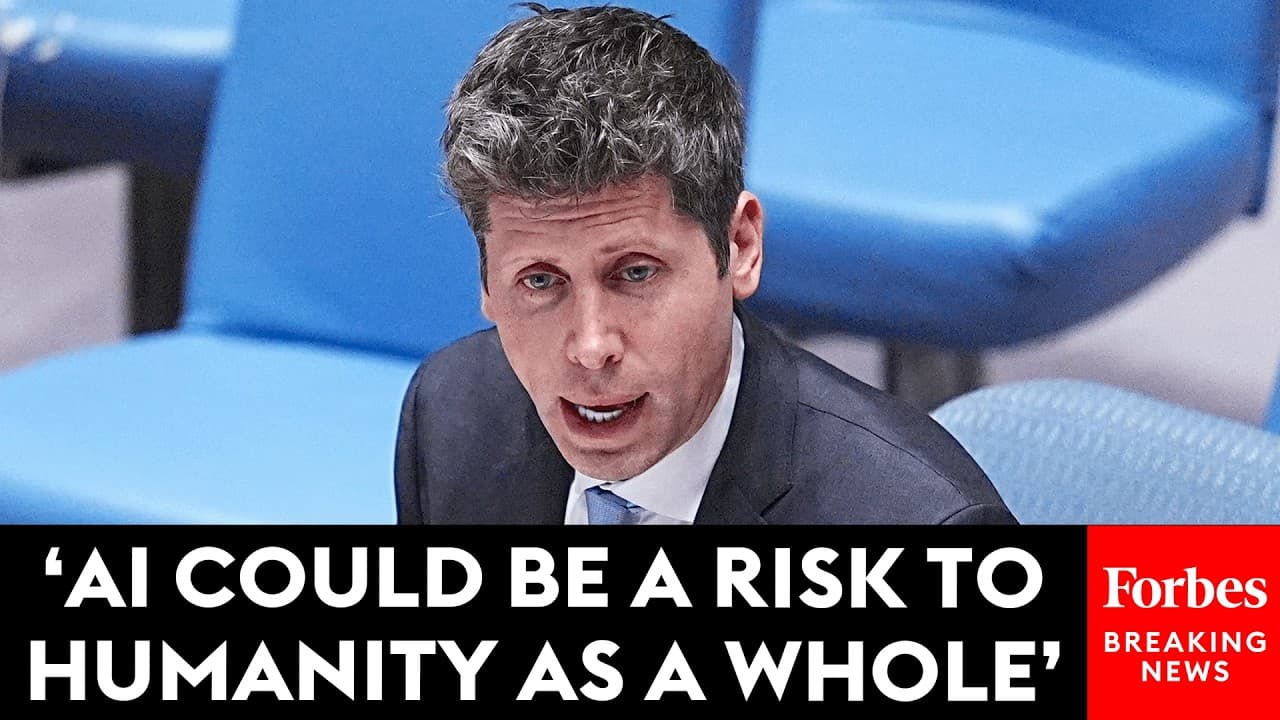
AI risk hinges on keeping humans in control while progress accelerates. Altman warns of two dangerous paths: losing control to AI or concentrating power in too few hands, and he presents three guiding principles plus a push for international standards to govern AI safety and democratic oversight.
Transcript
I thank Mr. Benj for his briefing. I now give the floor to Mr. Sam Alman. >> Thank you, Mr. President and your excellencies. I'm honored to be here and to be able to speak with you all at this important time. We've been talking about artificial intelligence for years, but it feels different in recent weeks and months. Rapid model progress has made ... Read More
Key Insights
- AI progress can either empower people or concentrate power; the choice is deliberate and measurable.
- The key to safe AI is keeping humans at the center and ensuring alignment with human values.
- A balance between rapid innovation and risk management is essential to avoid dystopian outcomes.
- Transparency and accountability are critical as systems become more autonomous and capable.
- International cooperation and shared standards are crucial for global safety and governance.
- Standards should assess capabilities, safeguards, and safeguards while enabling both open and closed model developers.
- Democratic processes and governance are necessary to guide AI development, not labs alone.
- Continuous learning and broad participation in AI policy will help democratize its benefits.
Install to Summarize YouTube Videos and Get Transcripts
Explore YouTube Video Summarizer or Get YouTube Transcript Extractor
Questions & Answers
Q: What is the core risk Sam Altman highlights at the UN Security Council?
The core risk is that AI could progress so fast that people cannot follow what is happening or intervene when needed, potentially allowing loss of human control. This risk requires strong alignment, safety guarantees, and evidence that systems behave as intended, even as they become highly capable.
Q: What are the two bad directions AI progress could take, according to Altman?
Altman identifies two dangerous directions: one is losing control of the future to AI, where progress moves too fast for people to intervene; the other is concentrating power in a few hands, enabling entities to impose their worldview. Both require careful, modeled mitigation and governance.
Q: What are the three guiding principles Altman mentions?
The three guiding principles are: 1) AI should keep people at the center, with alignment ensuring human control and values; 2) benefits of progress must be by people for people, empowering doctors, teachers, researchers, and communities; 3) technology should empower individuals, helping them realize potential and create value.
Q: Why does Altman emphasize democratic processes in AI governance?
Democratic processes ensure that decisions about AI, including standards and safety, reflect public values and accountability. He argues that AI cannot be governed solely by labs in one city and that international cooperation and government-led oversight are essential to prevent unilateral or opaque power.
Q: What role do international standards play in Altman’s view?
International standards would provide a common framework for measuring capabilities, assessing risks, verifying safeguards, and maintaining meaningful human oversight. They would enable countries to compare evidence, share vulnerabilities, and learn from failures while avoiding locking in incumbents or stifling innovation.
Q: What example does Altman give to illustrate AI’s potential to advance knowledge?
Altman cites progress in math where models progressed from basic grade school math to solving complex problems like Navier-Stokes, illustrating AI's ability to discover knowledge and support breakthroughs in healthcare, education, and economic development when guided by human aims.
Q: What is Altman’s stance on reckless speed versus deliberate pace in AI development?
He argues against rash, race-driven development and supports slowing down when necessary to ensure alignment, safety, and safeguards. The aim is a pragmatic path that balances innovation with governance, avoiding both blind optimism and dystopian complacency.
Q: How does Altman propose we handle the risk of AI systems becoming autonomous?
The proposal is to ensure strong evidence that systems will remain under human control, with ongoing monitoring, safety guarantees, and alignment with human values. This includes establishing mechanisms for oversight, incident reporting, and transparent cooperation across borders to manage emergent threats.
Summary & Key Takeaways
-
Altman frames AI as a potential renaissance or upheaval, emphasizing human agency and safeguards over automation for its own sake.
-
He outlines two dire futures where AI either escapes human control or concentrates power, urging cautious, aligned development.
-
He calls for global standards, democratic process involvement, and cooperative governance to ensure AI benefits humanity.
Read in Other Languages (beta)
Share This Summary 📚
Summarize YouTube Videos and Get Video Transcripts with 1-Click
Try YouTube Summary with ChatGPT & Claude or YouTube Transcript Generator
Explore More Summaries from Forbes Breaking News 📚




Summarize YouTube Videos and Get Video Transcripts with 1-Click
Try YouTube Summary with ChatGPT & Claude or YouTube Transcript Generator