Elon Musk and Jensen Huang on AI, Robots, and Jobs
TL;DR
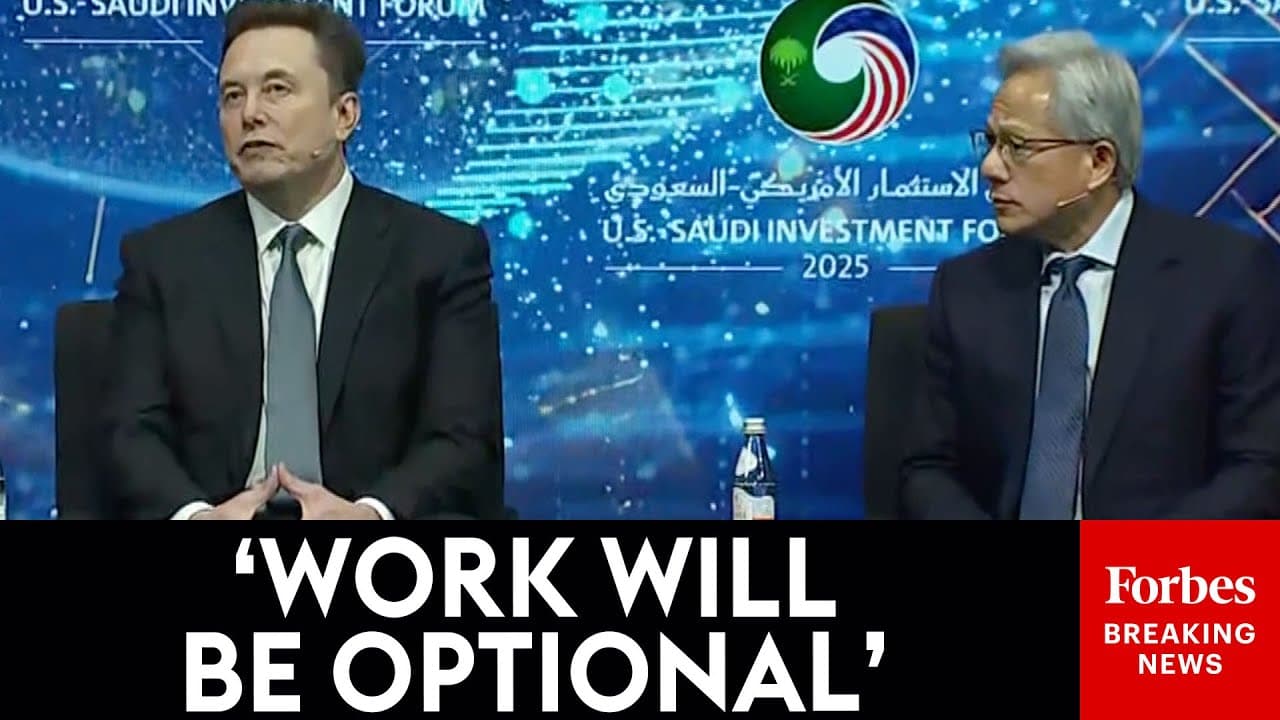
Elon Musk predicts that within 10 to 20 years work will be optional and money may stop being relevant, driven by AI and humanoid robots. Jensen Huang argues that in the near term AI will make people more productive but busier. He cites radiology, where AI adoption led to more radiologists being hired, not fewer. Both spoke at the U.S.-Saudi Arabia Investment Forum.
Transcript
Leadership and ingenuity will define tomorrow's digital landscape. It is my great honor to introduce his excellency Abdullah Al Swaha, Minister of Communications and Information Technology of the Kingdom of Saudi Arabia. Your Excellency, thank you so much. Good to see you. Also with us this morning are two incredible visionaries. Please join me in ... Read More
Key Insights
- Musk describes his companies' work as creation rather than disruption: there were no reusable rockets when SpaceX began, no electric cars you could buy when Tesla started, and no useful humanoid robots today.
- Reusability is the essence of revolutionizing space travel, according to Musk, because throwing a rocket away after every flight keeps the cost of access to space extremely high.
- Humanoid robots will be the biggest product ever, Musk predicts, bigger than cell phones, because everyone will want one or more for personal use and many will work in industry.
- AI and humanoid robots are, in Musk's view, the only real way to eliminate poverty and make everyone wealthy. He expects Tesla to pioneer useful humanoid robots, with many other companies also making them.
- Computing is shifting from retrieval-based to generative, according to Jensen Huang: instead of fetching prebuilt content, software now generates unique content in real time based on the user's prompt and context.
- AI factories are needed all over the world because generative AI produces different content every time, Huang explains, which makes AI foundational infrastructure used by every company, industry, and country.
- Musk predicts that within 10 to 20 years work will be optional, like growing vegetables at home when you could buy them, and that currency may eventually become irrelevant, with power and mass remaining as constraints.
- Radiology shows that AI can increase jobs, Huang says: AI made image reading more productive, so radiologists accepted more patients, and more radiologists are now being hired, not fewer.
Install to Summarize YouTube Videos and Get Transcripts
Explore YouTube Video Summarizer or Get YouTube Transcript Extractor
Questions & Answers
Q: What does Elon Musk predict about the future of work?
Elon Musk predicts that in the long term, which he defines as roughly 10 to 20 years, work will be optional. He compares it to growing vegetables in your backyard when you could simply buy them at a store: some people will still choose to do it because they enjoy it. He notes that a lot of work remains before that point is reached.
Q: Why does Elon Musk think humanoid robots will be the biggest product ever?
Musk argues that humanoid robots will be bigger than cell phones or any other product because everyone will want their own personal robot, comparing it to having a personal C-3PO or R2-D2, and possibly more than one. Many more will also work in industry providing products and services. He says Tesla will make the first useful humanoid robots, and other companies will follow.
Q: What is the difference between retrieval-based and generative computing according to Jensen Huang?
Jensen Huang explains that past computing was retrieval-based: content such as stories, art, or ads was prebuilt by someone, and systems like Hadoop retrieved the appropriate version for each user. Generative computing creates unique content in real time based on the user's context, circumstances, and prompt, so every interaction is different. That makes results contextually sensible and therefore intelligent.
Q: Why are AI factories needed according to Jensen Huang?
Huang says AI factories are needed because generative AI produces different content for every user every time, so the content must be generated in real time rather than retrieved from storage. Because digital intelligence applies to every company, industry, and country, AI is foundational infrastructure. He praised Saudi Arabia's story of moving from building oil refineries to building AI factories.
Q: Will AI eliminate jobs like radiology?
Jensen Huang says radiology shows the opposite. Radiologists were predicted to be among the first jobs lost to AI, but more radiologists are now being hired. The goal of a radiologist is to diagnose disease, not to study images. AI made image study so productive that radiologists can review more images and modalities, spend more time with patients, and accept more patients.
Q: How does Elon Musk think poverty will be eliminated?
Musk says that despite long-standing talk and many NGO efforts to eliminate poverty, those efforts have not succeeded. He believes AI and humanoid robots will eliminate poverty, calling them basically the only way to make everyone wealthy. He expects Tesla to pioneer useful humanoid robots, while many other companies will make them as well.
Q: Will money become irrelevant in the future according to Elon Musk?
Musk guesses that if AI and robotics continue to improve, money will stop being relevant at some point in the future. He recommends Iain Banks' Culture books, where money no longer exists, as a picture of a probable positive AI future. He adds that fundamental physical constraints such as electricity, power, and mass will still remain.
Q: Will AI make people less busy at work?
Jensen Huang predicts the opposite in the near term. AI will make difficult or mundane tasks simple, which makes people more productive, but people and companies have large backlogs of ideas they want to pursue. Greater productivity lets them get to those ideas faster, so he expects both himself and Elon Musk to be busier as a result of AI.
Summary & Key Takeaways
-
Saudi Minister Abdullah Al Swaha hosted Elon Musk and Jensen Huang to celebrate the U.S.-Saudi AI strategic partnership. Saudi Arabia is committing capital, energy, and land to support the U.S. AI ecosystem, building inference and training nodes, and moving from an energy-based economy to the intelligence age.
-
Musk said his work is creation, not disruption, citing reusable rockets, electric cars, and humanoid robots. He predicted humanoid robots will be the biggest product ever and that AI and robotics will eliminate poverty. Huang described the shift from retrieval-based to generative computing that requires AI factories.
-
On jobs, Musk predicted work will become optional within 10 to 20 years and that money may stop being relevant, pointing to Iain Banks' Culture books. Huang argued that people will be more productive yet busier in the near term, citing more radiologists being hired after AI adoption.
Read in Other Languages (beta)
Share This Summary 📚
Summarize YouTube Videos and Get Video Transcripts with 1-Click
Try YouTube Summary with ChatGPT & Claude or YouTube Transcript Generator
Explore More Summaries from Forbes Breaking News 📚

Summarize YouTube Videos and Get Video Transcripts with 1-Click
Try YouTube Summary with ChatGPT & Claude or YouTube Transcript Generator