How to Learn About Money Before It's Too Late
TL;DR
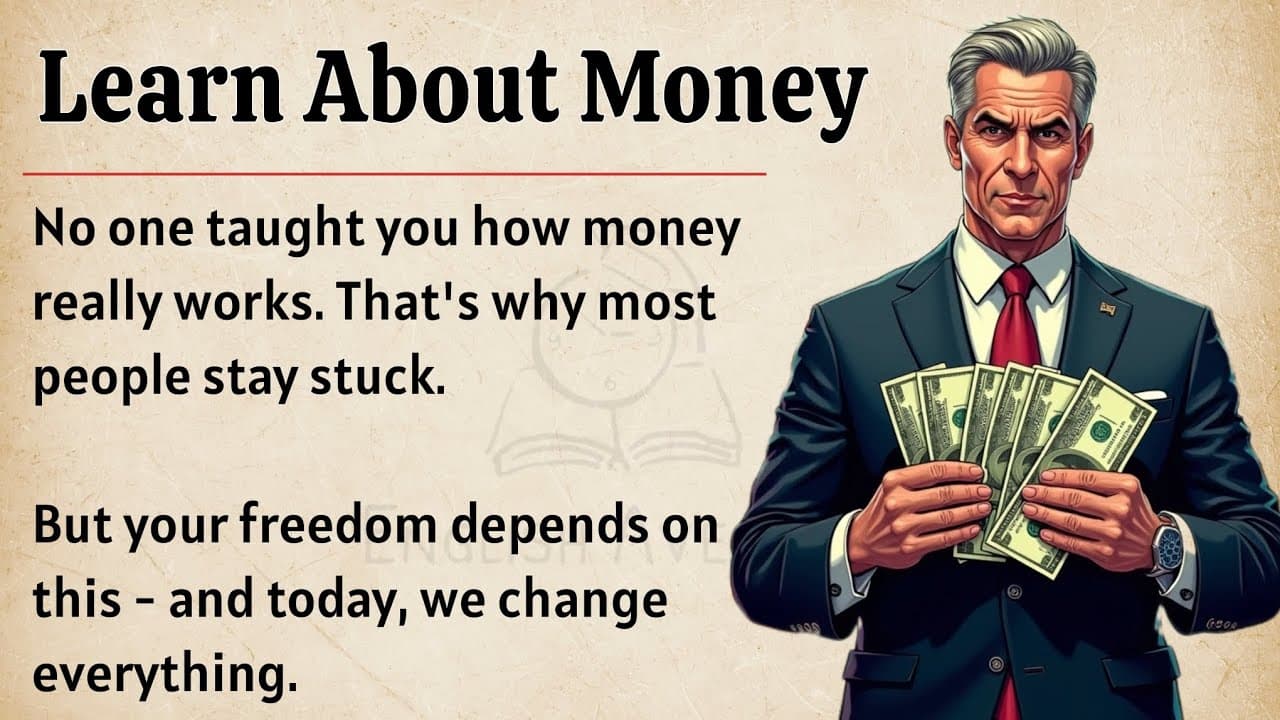
Money is a tool for freedom, not a goal, and you should learn how it works before you are rich. Start early, because compound growth rewards time more than size. Track every dollar with a budget, and focus on becoming rich rather than looking rich.
Transcript
Welcome everyone. This is not just another video. This is the video I wish someone made for me when I was lost, broke, confused, angry, tired of watching everyone else succeed while I kept asking myself, "What am I doing wrong? Why does money always slip away from me? Why am I working hard but still struggling?" Let me tell you something no one wil... Read More
Key Insights
- Money is a tool, not the goal. Its value comes from what it buys: time, freedom, health, and the ability to live on your own terms, not from the number itself or from looking rich.
- Higher income does not equal wealth. The speaker contrasts a $100,000 earner buried in loans with a $30,000 earner who has zero debt, invests monthly, and sleeps peacefully.
- The best time to learn about money is when you have little of it. Without knowledge, a sudden $10,000 can vanish in months through unneeded purchases, credit card traps, bad investments, and fake gurus.
- Time is more powerful than money because it cannot be bought, borrowed, or stolen. Compound growth means interest earns interest, so early starters gain an advantage that late starters cannot easily match.
- Starting early beats investing more. In the example, Alex invests $100 a month from age 20 to 30, totaling $12,000, and ends up with more than Ben, who invests $100 a month from 30 to 60, totaling $36,000.
- Start now, even with $5 or a jar. The speaker argues that it is about when, not how much, and that every delay means losing growth that went to someone who started earlier.
- Budgeting is power, not punishment. Telling your money where to go, instead of wondering where it went, replaces stress and guilt with clarity, calm, and confidence.
- A planned budget gives every dollar a purpose. In the $500 example, money is split across rent $150, food $100, transport $50, savings $50, emergency fund $30, fun money $50, education $20, and miscellaneous $50.
Install to Summarize YouTube Videos and Get Transcripts
Explore YouTube Video Summarizer or Get YouTube Transcript Extractor
Questions & Answers
Q: Why is money described as a tool and not a goal?
The speaker says money is only paper or numbers on a screen until it is used to create time, buy freedom, protect health, support dreams, and build a life. People who chase it blindly burn out and still feel empty, because the real goals are peace, freedom, and control over their time.
Q: Do you need to be rich to learn about money?
No. The speaker says the best time to learn is when you have none, because you are humble and every dollar matters. You can read about compound interest, learn to save, and understand how banks, inflation, debt, and budgeting work without wealth, so you are ready when money arrives.
Q: What happens if you receive money without knowing how to manage it?
The speaker warns that even $10,000 can disappear within a few months. People buy things they do not need, try to impress others, and fall into credit card traps, bad investments, fake gurus, and lifestyle addiction, often ending back at zero or in debt.
Q: How does compound growth reward starting early?
Compound growth means your money earns interest and then that interest earns more interest, like a snowball rolling down a mountain. In the video, Alex invests $100 a month for 10 years starting at 20 and ends with more than Ben, who invests for 30 years starting at 30.
Q: How much should you start investing or saving with?
The speaker says to start now, even with just $5 or by saving in a jar, even if it does not feel like real money. The argument is that it is not about how much but when, since waiting makes time your biggest enemy instead of your best friend.
Q: Why does the video say a person earning $30,000 can be richer than one earning $100,000?
The $100,000 earner has a big house, two cars, and expensive things but is drowning in loans, works 12 hours a day, and cannot take a month off. The $30,000 earner has zero debt, invests monthly, works from home, travels when he wants, and controls his life.
Q: What does it mean to control money so that it does not control you?
The speaker says that without control you live paycheck to paycheck, panic in emergencies, avoid your bank account, and let bills decide your choices. Control means telling your money where to go through budgeting, so every dollar serves a purpose you chose.
Q: How does the video suggest splitting a $500 monthly budget?
The example plans every dollar: rent $150, food $100, transport $50, savings $50, emergency fund $30, fun money $50, education $20, and miscellaneous $50. The speaker says this lets you still enjoy life while feeling strong, calm, clear, and confident because you are in charge.
Summary & Key Takeaways
-
The video opens by arguing that the system keeps people busy and broke, and that nobody teaches money skills in school or at home. It promises twelve honest rules, not get-rich-quick tricks, aimed at helping viewers understand how money works and take control of their financial lives.
-
Rules one and two reframe money as a tool for peace, freedom, and control over time. Using the contrast between a high earner in debt and a modest earner with no debt, the speaker says you should start learning about money now, while you have little, by reading, budgeting, and tracking spending.
-
Rules three and four focus on time and control. Compound growth rewards starting early, shown by the Alex and Ben example, while budgeting lets you direct every dollar. Rule five begins a discussion of avoiding the appearance of wealth in favor of actually building it.
-
The video is a graded reader for English learners at beginner to intermediate levels, using simple vocabulary and clear narration. Its description notes the financial content is simplified for language learning and is not professional financial advice.
Read in Other Languages (beta)
Share This Summary 📚
Summarize YouTube Videos and Get Video Transcripts with 1-Click
Try YouTube Summary with ChatGPT & Claude or YouTube Transcript Generator
Explore More Summaries from English Avenue 📚
Summarize YouTube Videos and Get Video Transcripts with 1-Click
Try YouTube Summary with ChatGPT & Claude or YouTube Transcript Generator