What Is the Origin of Bytes in Computing?
TL;DR
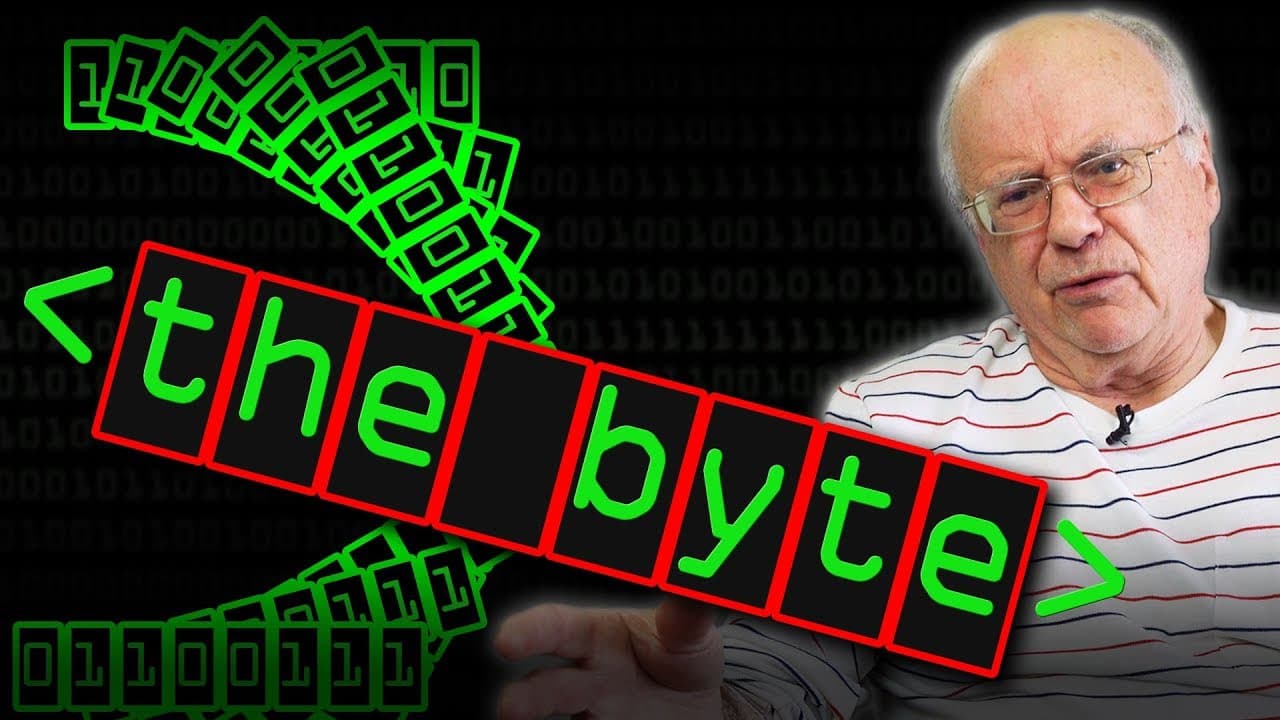
The term 'bit' was first introduced in 1947 by John Tukey at Bell Labs, leading to the concept of bytes as a standard data unit. IBM significantly influenced the evolution of character handling by standardising the byte as an 8-bit entity, which optimised both commercial and scientific computing.
Transcript
there's plenty of superb anecdotes about the history of the bite and and so on i suppose the earlier question uh which if we want to go right back to ground zero who invented the word bit a chap at guess where bell labs john chooky worked with shannon and others a bit i think it was here in a paper in 1947 actually uttered the word bit rather than ... Read More
Key Insights
- 💋 The term "bit" was first used in 1947 by a researcher at Bell Labs, marking the beginning of the binary system's development.
- 🥺 Early computers prioritized numeric calculations and decimal accuracy, leading to the adoption of the byte as a storage unit for characters.
- 🖐️ IBM played a significant role in commercial computing and proposed the byte as an eight-bit entity, revolutionizing data storage and manipulation.
- 🧑🏭 The 3.322 multiplying factor highlights the additional binary circuitry required for arithmetic calculations compared to decimal arithmetic.
- 😒 The byte's standardized use allowed for efficient character handling and advanced the fields of scientific computing and commercial databases.
- 🚨 Companies like CDC and Cray emerged in the supercomputer market as alternatives to IBM.
- 😚 IBM's influence extended to microcomputers, although they lost control of the market for 8-bit microprocessors.
Install to Summarize YouTube Videos and Get Transcripts
Explore YouTube Video Summarizer or Get YouTube Transcript Extractor
Questions & Answers
Q: Who invented the term "bit"?
The term "bit" was coined by a researcher at Bell Labs named John Chooky in 1947, who worked with Shannon and others.
Q: Why did early computers transition from word-based systems to bytes?
Early computer pioneers were interested in building computers for scientific applications that required decimal accuracy, which led to the development of the byte as a unit of storage for holding characters.
Q: What is the significance of the multiplying factor 3.322 in binary circuitry?
The multiplying factor of 3.322 indicates how much more binary circuitry is needed in the arithmetic unit of a computer compared to decimal arithmetic. It is necessary to maintain accuracy in calculations.
Q: Why did IBM propose the use of eight-bit bytes?
IBM recognized the limitations of early character handling in computers and suggested the use of eight-bit bytes to address the inefficiencies. This allowed for individual addressing and future expansion, benefiting both commercial and scientific computing.
Summary & Key Takeaways
-
The term "bit" was first used in 1947 by a researcher at Bell Labs, and early computers were word-based before the concept of the byte emerged.
-
Real programmers prioritize numbers and accuracy over text, leading to the development of binary arithmetic and decimal accuracy calculations.
-
IBM played a crucial role in commercial computing and proposed the standardization of the byte as an eight-bit entity, allowing for efficient data storage and manipulation.
Read in Other Languages (beta)
Share This Summary 📚
Summarize YouTube Videos and Get Video Transcripts with 1-Click
Try YouTube Summary with ChatGPT & Claude or YouTube Transcript Generator
Explore More Summaries from Computerphile 📚





Summarize YouTube Videos and Get Video Transcripts with 1-Click
Try YouTube Summary with ChatGPT & Claude or YouTube Transcript Generator