The Insane Engineering of Re-Entry
TL;DR
Explores the engineering behind Space Shuttle's re-entry challenges.
Transcript
This video is brought to you by Onshape. Try the professional plan for free for up to 6 months with the link in the description After spending 7 days in orbit around the earth, the Space Shuttle Orbiter now has arguably the most difficult portion of its mission to complete. A hell blazing journey through the earth’s upper atmosphere. Where it ... Read More
Key Insights
- The Space Shuttle's re-entry involves a critical maneuver to adjust its speed by just 1.3% to enter the Earth's atmosphere correctly. This precision is necessary to avoid overshooting or crashing due to overheating.
- The shuttle's design combines the needs of both a spacecraft and an aerodynamic glider, requiring specialized engineering to balance thermal protection and aerodynamic stability.
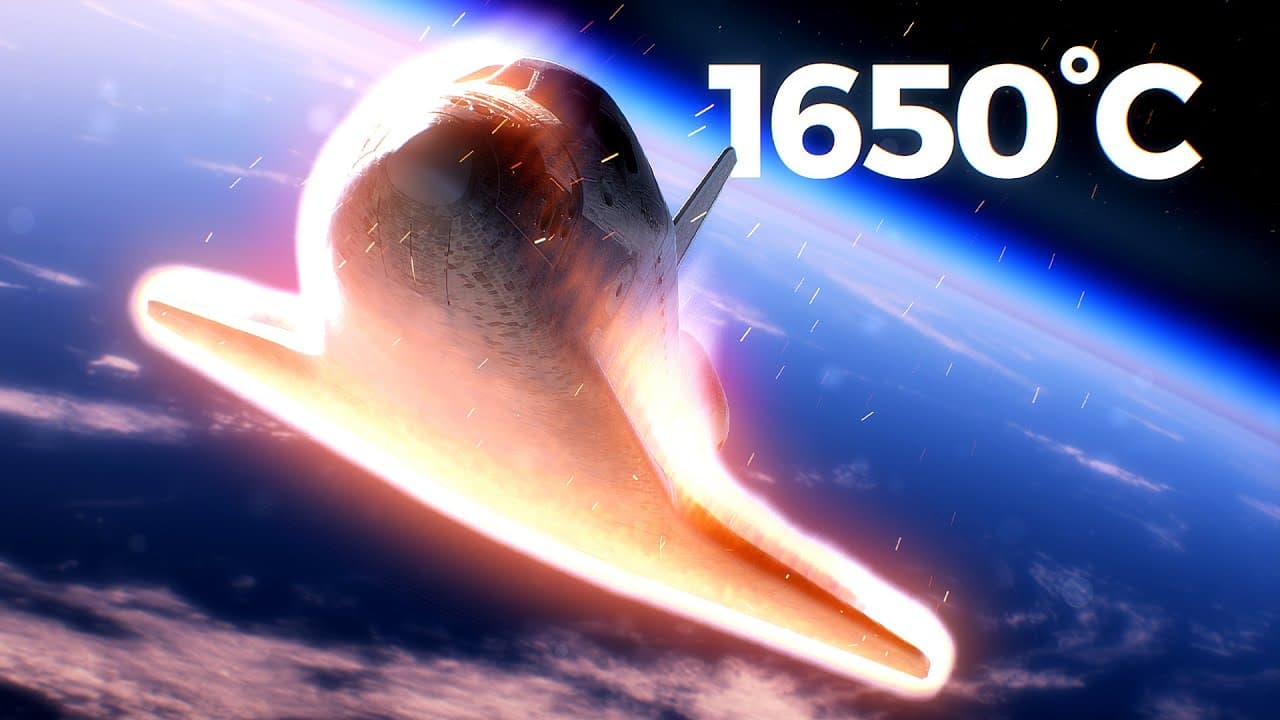
- To withstand re-entry temperatures reaching 1650°C, the shuttle uses reinforced carbon-carbon composites and silica tiles, which are lightweight and provide excellent insulation.
- The shuttle's re-entry path involves a 40-degree angle of attack and complex banking maneuvers to manage its trajectory and landing, illustrating the challenges of controlling a glider from orbit.
- Communication blackouts occur during re-entry due to ionized plasma, leaving the shuttle reliant on its onboard systems for guidance until contact is re-established.
- The shuttle's heat management includes black and white tiles to balance heat emission and solar radiation reflection, crucial for both re-entry and prolonged space missions.
- The shuttle's landing requires precise energy management, as it operates as an unpowered glider. Training aircraft were used to simulate these conditions for pilot preparation.
- Air Force requirements significantly influenced the shuttle's design, necessitating larger wings for increased crossrange capability, allowing it to return to its launch site after one orbit.
Install to Summarize YouTube Videos and Get Transcripts
Explore YouTube Video Summarizer or Get YouTube Transcript Extractor
Questions & Answers
Q: What is the primary challenge of the Space Shuttle's re-entry?
The primary challenge of the Space Shuttle's re-entry is managing the extreme heat generated as it travels through the Earth's atmosphere at hypersonic speeds. This requires precise speed adjustments to avoid overheating or overshooting the landing site, and the spacecraft must endure temperatures up to 1650°C.
Q: How does the shuttle manage thermal protection during re-entry?
The shuttle manages thermal protection through the use of reinforced carbon-carbon composites on the leading edges and silica tiles on its surface. These materials provide excellent insulation and withstand the high temperatures experienced during re-entry, while the tiles' design ensures minimal heat transfer to the underlying structure.
Q: What role does the shuttle's angle of attack play during re-entry?
The shuttle's angle of attack, maintained at approximately 40 degrees, is crucial for controlling its descent and managing the heat load during re-entry. This angle helps balance the aerodynamic forces and thermal protection, allowing the shuttle to safely navigate through the atmosphere while maintaining stability.
Q: Why does the shuttle experience communication blackouts during re-entry?
Communication blackouts occur during re-entry due to the ionized plasma that forms around the shuttle at high speeds. This plasma interferes with electromagnetic signals, temporarily cutting off communication with ground control and requiring the shuttle to rely on its onboard systems for guidance.
Q: How do the shuttle's wings contribute to its landing capability?
The shuttle's wings, influenced by Air Force requirements for crossrange capability, provide the necessary lift for maneuvering during re-entry. They allow the shuttle to adjust its trajectory and manage its descent, crucial for landing as an unpowered glider with only one chance to touch down safely.
Q: What training did pilots undergo to prepare for landing the shuttle?
Pilots underwent intensive training using modified Gulfstream jets designed to simulate the shuttle's flight characteristics. These aircraft mimicked the shuttle's drag and lift conditions, allowing pilots to practice energy management and precision landing techniques essential for the shuttle's safe return.
Q: How does the shuttle's design reflect its dual role as a spacecraft and glider?
The shuttle's design reflects its dual role by combining features necessary for surviving re-entry heat and aerodynamic flight. Its heat-resistant materials and aerodynamic shape enable it to transition from space travel to gliding through the atmosphere, demonstrating a unique engineering feat.
Q: What was the impact of Air Force requirements on the shuttle's design?
Air Force requirements significantly impacted the shuttle's design, particularly the need for larger wings to achieve greater crossrange capability. This allowed the shuttle to return to its launch site after a single orbit, a feature intended for potential military applications and rapid mission turnarounds.
Summary & Key Takeaways
-
The video delves into the engineering marvel of the Space Shuttle's re-entry process, highlighting the precision required to adjust its speed and trajectory for a safe descent. It discusses the unique design challenges of combining spacecraft and glider features to withstand extreme temperatures.
-
Re-entry involves managing a 40-degree angle of attack and complex banking maneuvers to control the shuttle's descent. The use of reinforced carbon-carbon composites and silica tiles is crucial for thermal protection, while communication blackouts pose additional challenges.
-
The shuttle's design was heavily influenced by Air Force requirements for crossrange capability, necessitating larger wings. The landing process requires careful energy management, with pilots trained on modified aircraft to simulate the shuttle's unique flight characteristics.
Read in Other Languages (beta)
Share This Summary 📚
Summarize YouTube Videos and Get Video Transcripts with 1-Click
Try YouTube Summary with ChatGPT & Claude or YouTube Transcript Generator
Explore More Summaries from Real Engineering 📚



Summarize YouTube Videos and Get Video Transcripts with 1-Click
Try YouTube Summary with ChatGPT & Claude or YouTube Transcript Generator