Creep calculations - application of Norton's power law
TL;DR
This video explains the calculations for Norton's creep law parameters using experimental data.
Transcript
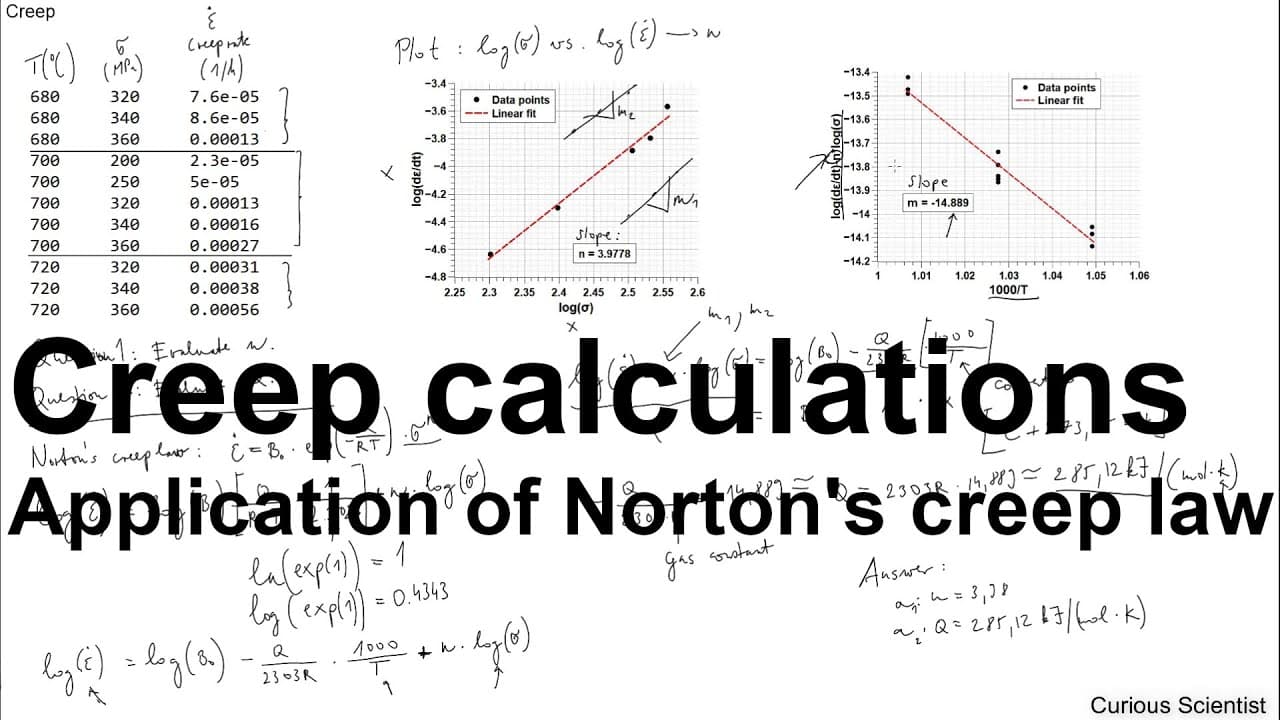
welcome everyone in this video we are going to do some calculations for creep so as you can see I put some numbers on the screen there are three columns the first is the temperature given in Celsius degrees and then we have stress in the middle column in given in mega Pascal and we have the creep rate or epsilon dot given in one per hour units and ... Read More
Key Insights
- ✋ Norton's creep law provides a model for understanding material deformation under stress over time, especially in high-temperature environments.
- 💁 The transformation of the creep equation into logarithmic form significantly simplifies the calculation process, making it easier to analyze experimental data.
- 👮 Accurate unit conversion, particularly to Kelvin, is critical for validity in creep law calculations.
- ☠️ The relationship between stress and creep rate can be graphically represented to intuitively assess material behavior.
- 🤶 Experimental data analysis must include careful plotting and slope assessment to derive meaningful M and Q parameters.
- 👮 Understanding natural versus base-10 logarithms is necessary for correctly manipulating equations in creep law applications.
- ✋ Creep behavior assessments can have considerable implications for engineering design, safety, and material selection in high-performance applications.
Install to Summarize YouTube Videos and Get Transcripts
Explore YouTube Video Summarizer or Get YouTube Transcript Extractor
Questions & Answers
Q: What is Norton's creep law, and why is it significant in materials science?
Norton's creep law describes the time-dependent deformation of materials under constant stress, especially at high temperatures. It provides a practical framework for predicting material behavior under long-term loading conditions, which is crucial in fields like aerospace, civil engineering, and materials development.
Q: How are the M and Q parameters derived from the data?
The M and Q parameters are derived by manipulating Norton's creep law into a logarithmic form. By plotting log epsilon dot against log stress (Sigma), the slope of the resulting linear relationship yields the M value. From the slope obtained in another analysis, Q is calculated using the gas constant and temperature in Kelvin.
Q: What are common errors to watch out for when using Norton’s law?
Common errors include neglecting to convert temperature from Celsius to Kelvin, incorrectly handling logarithmic transformations, and miscalculating the parameters due to rounding errors in data. It’s essential to maintain accuracy in unit conversions and ensure proper variable definitions.
Q: Can these calculations be applied to other materials?
Yes, the calculations and methodologies outlined can be adapted for various materials. However, it’s essential to consider the unique properties and characteristics of each material to obtain valid M and Q values that accurately reflect their creep behavior.
Summary & Key Takeaways
-
The video discusses Norton's creep law, focusing on evaluating the M and Q parameters based on provided temperature and stress data.
-
It outlines the process of converting the non-linear equation into a logarithmic form to facilitate calculations and plotting of data points.
-
Key calculations include determining M as approximately 3.98 and Q as 285.12 kJ/mol·K, emphasizing the importance of temperature conversion to Kelvin.
Read in Other Languages (beta)
Share This Summary 📚
Summarize YouTube Videos and Get Video Transcripts with 1-Click
Try YouTube Summary with ChatGPT & Claude or YouTube Transcript Generator
Explore More Summaries from Curious Scientist 📚


![Building a coil winder [Part 6] - A few improvements thumbnail](/_next/image?url=https%3A%2F%2Fi.ytimg.com%2Fvi%2F3eyxG_g2iUA%2Fhqdefault.jpg&w=750&q=75)
![Building a Peltier cooler-based cooling box - First iteration, improvements [Part 2/6] thumbnail](/_next/image?url=https%3A%2F%2Fi.ytimg.com%2Fvi%2F0YlNw0EGnzI%2Fhqdefault.jpg&w=750&q=75)


Summarize YouTube Videos and Get Video Transcripts with 1-Click
Try YouTube Summary with ChatGPT & Claude or YouTube Transcript Generator