How Do Majorana Zero Modes Enable a Quantum Chip?
TL;DR
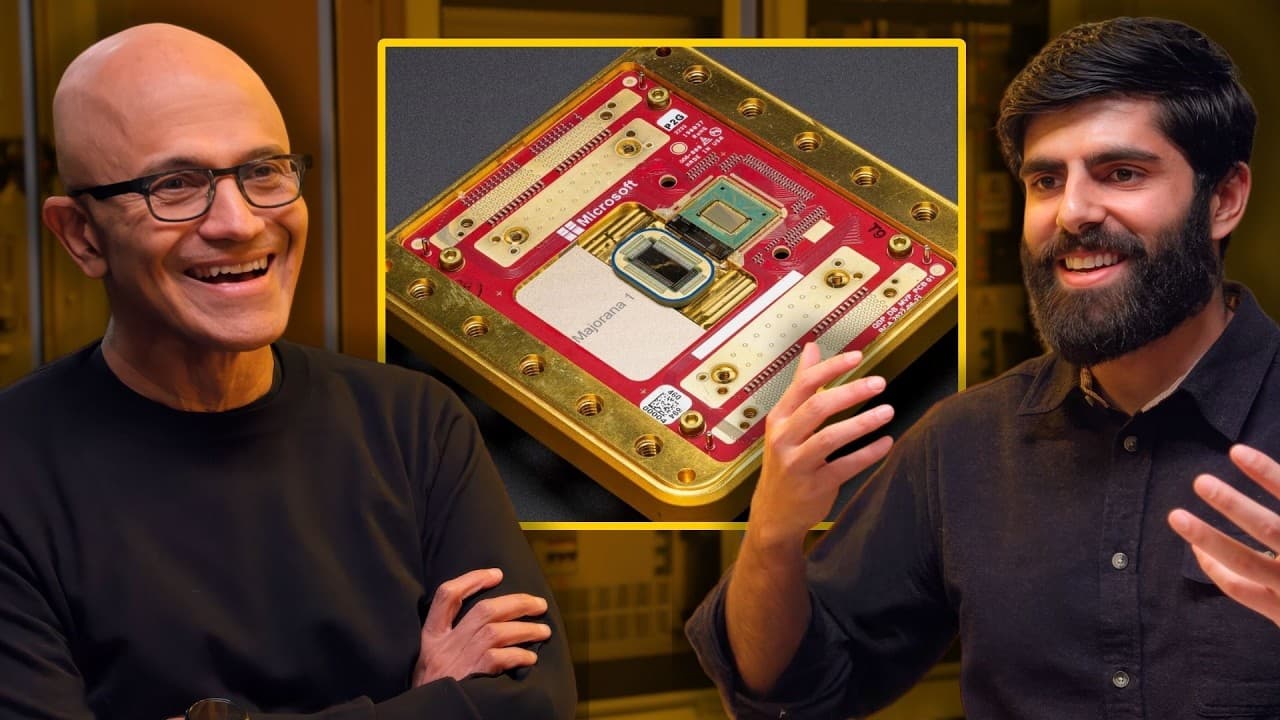
Majorana zero modes offer a more reliable qubit by encoding information in a topological phase, enabling a fabrication breakthrough that could yield a million cubits on a single chip. The discussion outlines a path from a physics breakthrough to a practical, scalable quantum computer, with timelines hinting at years 27 to 29 for initial demonstrations.
Transcript
I believe this is it right here that is it yeah yes I mean to think of the the fact that we were able to build a million uh Cubit quantum computer in a thing of this size is just unbelievable like I mean that and and that's I think the Crux of it right which is unless and until we could do that you can't dream of building a utility scale quantum co... Read More
Key Insights
- The breakthrough is the existence proof of Majorana zero modes in a new topological phase, which enables more reliable qubits that are easier to fabricate and measure.
- The core claim is that a million cubits on a chip are feasible due to the topological protection of information and a scalable fabrication technique.
- The discussion frames this moment as a transistor-like milestone for quantum computing, signaling a shift to practical, utility-scale machines.
- The roadmap includes first a fall tolerant quantum computer, then thousands of logical qubits with error correction, and finally a usable quantum computer on a larger scale.
- The timeline discussed ranges roughly from now toward 27, 28, or 29 for building the first integrated circuit with Majorana qubits.
- The integration of AI, HPC, and quantum is presented as a combined toolset for simulating and advancing chemistry and physics using quantum hardware.
- The speaker emphasizes that quantum computing will complement rather than replace classical computing, excelling in exploration-heavy, data-light scenarios.
- The concept of using AI to generate synthetic data for training quantum-informed models is proposed as an immediate synergy even before full scale quantum advantage.
Install to Summarize YouTube Videos and Get Transcripts
Explore YouTube Video Summarizer or Get YouTube Transcript Extractor
Questions & Answers
Q: How do Majorana zero modes change the approach to building a quantum computer?
Majorana zero modes provide a more reliable and stable way to store quantum information because they live in a topological phase that helps hide and protect the quantum state. This makes fabrication and measurement more feasible, enabling a scalable path from chip-level qubits to large, fault-tolerant quantum systems. The implication is that with this physics breakthrough, building a million-qubit chip becomes a practical, not a speculative, goal.
Q: What is the envisioned milestone for scaling up to a million cubits on a chip?
The envisioned milestone is to fabricate a Majorana-based chip, referred to as a potential first device in the line that could support a million physical qubits. Achieving this would lay the groundwork for thousands of logical, error-corrected qubits and set the stage for real utility-scale quantum computing. The path hinges on a robust fabrication technique and reliable qubit operation.
Q: Why is the transistor moment used as an analogy in the discussion?
The transistor moment analogy is used to describe a fundamental shift where a new phase of matter and its reliable qubits enable scalable quantum computation much like the invention of the transistor enabled scalable classical computing. It signals the transition from niche demonstrations to practical hardware capable of running useful quantum algorithms and supporting large-scale architectures.
Q: What role does the physics breakthrough play in this plan?
The physics breakthrough, namely the realization of Majorana zero modes in a topological phase, provides the fundamental protection and reliability needed for scalable qubits. Without this breakthrough, the project would struggle with error rates and instability, making million-qubit scale and practical usage unlikely.
Q: How do the speakers view the relationship between AI and quantum computing?
AI is viewed as an emulator and a data generator that can be used today to model and simulate quantum systems. Quantum computing and AI are seen as complementary, with quantum hardware potentially generating synthetic data that AI models can use to improve chemistry and physics simulations, guiding future experiments and software development.
Q: What timeline is suggested for getting the first practical integrated circuit with Majorana qubits?
The discussion suggests a timeline of progressively building toward the first integrated circuit with Majorana qubits within a few years, followed by scaling to hundreds or thousands of logical qubits and implementing error correction. The goal is to move from a single gate demonstration to a full, usable quantum computer.
Q: How does the conversation describe the interaction between quantum and classical computing?
The speakers emphasize that quantum computing will complement classical computing rather than replace it. Quantum is expected to excel in exploration-heavy, data-light tasks such as certain simulations, while classical systems will remain essential for data processing, control, and operations that involve large data throughput and well-established algorithms.
Q: What is the expected impact on chemistry and physics simulations mentioned in the talk?
The talk highlights chemistry and physics as key domains that could benefit from quantum computing, using quantum hardware to generate synthetic data and train AI models to better simulate molecular behavior and complex physical processes. This cooperative approach could accelerate discovery in materials science and drug design by enabling more accurate and efficient modeling.
Summary & Key Takeaways
-
Summary point 1: The episode argues that achieving a million cubits on a single chip is possible if Majorana zero modes are realized, representing a fundamental physics and fabrication breakthrough that can redefine quantum hardware.
-
Summary point 2: The speakers compare the potential of Majorana topological qubits to a transistor moment for quantum computing, signaling a shift to a more reliable and scalable quantum architecture.
-
Summary point 3: The conversation describes a staged plan from chip level to large-scale, fault-tolerant quantum systems, emphasizing that initial gates on a chip lead to subsequent logical qubits and practical utility.
Read in Other Languages (beta)
Share This Summary 📚
Summarize YouTube Videos and Get Video Transcripts with 1-Click
Try YouTube Summary with ChatGPT & Claude or YouTube Transcript Generator
Explore More Summaries from Dwarkesh Patel 📚






Summarize YouTube Videos and Get Video Transcripts with 1-Click
Try YouTube Summary with ChatGPT & Claude or YouTube Transcript Generator