How did Vanguard launch the first index fund for investors
TL;DR
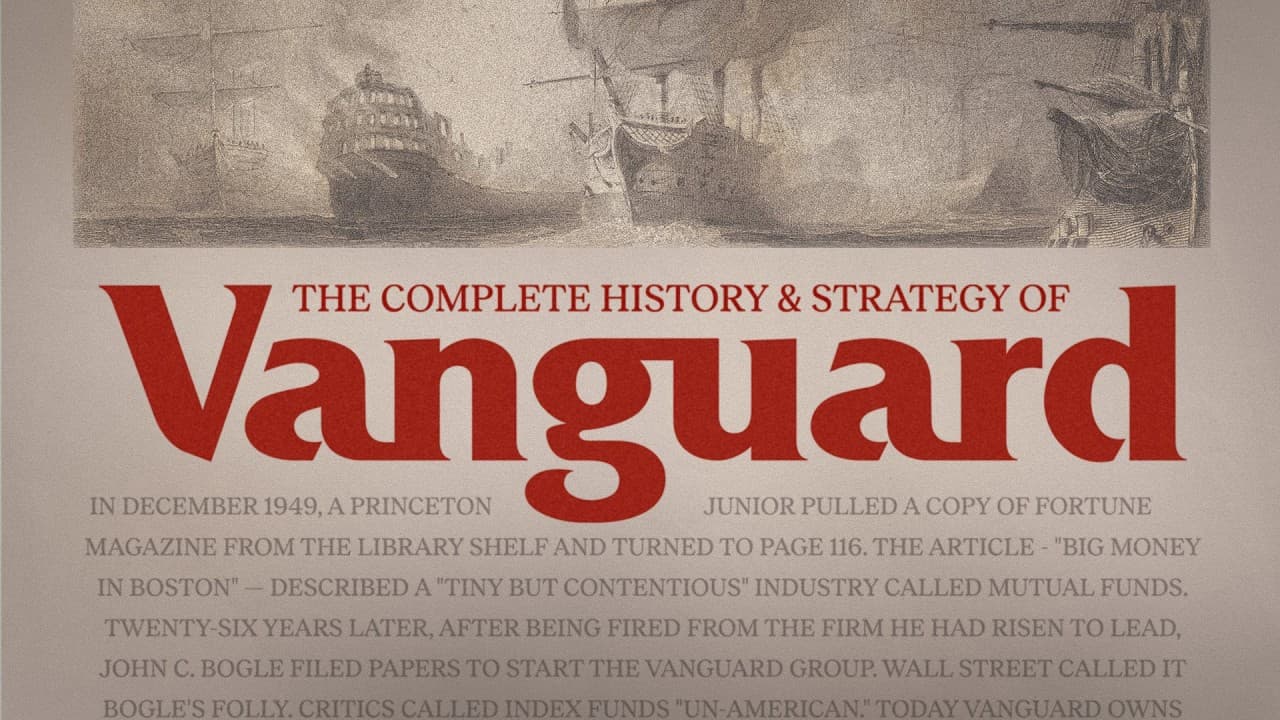
Vanguard created the first index fund for individual investors and built a customer owned structure that returns money to clients through lower fees. By today it manages over 10 trillion in passive funds, becoming the largest owner of many US companies alongside other index funds, which pushed industry wide fee reductions totaling roughly a trillion dollars in savings.
Transcript
I was telling my wife, you know, I think I'll be able to do bedtime tonight, maybe maybe even dinner. And she was like, "Whoa, whoa, whoa, don't get ahead of yourself. Let's not go crazy here." >> [laughter] >> How complicated could it be? It's index funds. And active funds, and money market, and brokerage, and advisory, and Yeah, yeah, yeah. But r... Read More
Key Insights
- Vanguard created the first index fund for individual investors in 1975, a turning point for retail investing.
- Vanguard is owned by its customers, not publicly traded, making it a distinct form of capitalism.
- The company manages over 10 trillion dollars in passive index funds, giving it wide influence over many US corporations.
- Vanguard and similar funds collectively own about 24 percent of the US stock market.
- Vanguards relentless cost cutting and fee reductions have saved investors over 500 billion dollars in fees and trading costs since its founding.
- The Bogle Effect pressured the rest of the industry to cut fees, adding another 500 billion in savings over time.
- Vanguards unique structure has led some to describe its capitalism as communist in spirit, due to absence of external shareholders.
- Jack Bogles leadership and philosophy underpin the firms mission to prioritize client interests over profits for outsiders.
Install to Summarize YouTube Videos and Get Transcripts
Explore YouTube Video Summarizer or Get YouTube Transcript Extractor
Questions & Answers
Q: A real search query question about the video (e.g. 'How to...', 'What is...', 'Why does...', 'When should...'). Question 1
Vanguard created the first index fund for individual investors in 1975, and its influence can be seen in how the company focused on low fees and minimal costs for fund holders. The structure of Vanguard is customer owned rather than privately held by outside shareholders, which shaped its decision making and long term strategy to maximize returns for clients.
Q: Question 2
The firm today manages over 10 trillion dollars in passive index funds, making it a dominant force in the investment landscape. This level of assets under management amplifies its influence on markets and on the companies it owns through its funds, contributing to the broader shift toward passive investing and greater cost efficiency for investors.
Q: Question 3
Vanguard is described as being owned by its customers and not publicly traded, with even the CEO holding no external equity. This ownership model aligns Vanguard’s interests with its clients and supports a philosophy of prioritizing client benefits over external investor pressure, which in turn reinforces a focus on low fees and efficient fund management.
Q: Question 4
The podcast notes that Vanguard and other index funds own a substantial share of the market, collectively owning a significant portion of many US companies. This ownership structure reflects the rise of passive investing, where large institutions hold shares across the market, influencing corporate governance and capital allocation over time.
Q: Question 5
Vanguard has reportedly saved investors over 500 billion dollars in fees and trading costs since its founding in 1975, due to relentless cost cutting and low fees. This savings figure underscores the practical impact of Vanguards pricing strategy on individual investors, retirement portfolios, and long term wealth accumulation.
Q: Question 6
The Bogle Effect is described as pushing the rest of the asset management industry to reduce their fees, resulting in another roughly 500 billion dollars in savings for investors over time. This illustrates how Vanguard catalyzed a broader market shift toward lower costs, benefiting a wide base of investors beyond Vanguard itself.
Q: Question 7
The narrative frames Vanguard as embodying communist capitalism in the sense that it serves its customers without outside shareholders, returning margins to clients via lower fees. This description highlights a philosophical contrast with traditional profit driven firms, emphasizing a model where customer value is built into structure and operations.
Q: Question 8
Jack Bogle, the founder featured in the story, grew up in a challenging environment with a family that faced financial hardship. His early life included scholarships to Blair Academy and a sense of obligation to his family, which later translated into a career focused on protecting investors through low fees and a customer centric business model.
Summary & Key Takeaways
-
Vanguard started as a revolutionary fund structure that is owned by its customers and operates without outside shareholders, emphasizing cost efficiency and aligned interests. This episode traces the origins with Jack Bogle and the early 1970s reforms that led to the first index fund for individuals. It highlights the long term impact on fees and market behavior.
-
The narrative covers Vanguard’s growth into a giant in passive investing, its unique corporate form, and the broader shift it catalyzed in the asset management industry. It also reflects on the personal story of Jack Bogle, his family background, and the moral dimensions of wealth transfer from Wall Street to investors.
-
Ultimately the story frames Vanguard as communist capitalism, where customer interests drive strategy, not profits for external stockholders, and credits the firm with reshaping American investing by dramatically lowering costs for millions of people.
Read in Other Languages (beta)
Share This Summary 📚
Summarize YouTube Videos and Get Video Transcripts with 1-Click
Try YouTube Summary with ChatGPT & Claude or YouTube Transcript Generator
Explore More Summaries from Acquired 📚


Summarize YouTube Videos and Get Video Transcripts with 1-Click
Try YouTube Summary with ChatGPT & Claude or YouTube Transcript Generator