The Absurdity of Detecting Gravitational Waves
TL;DR
Detecting gravitational waves required measuring space-time distortions as small as one part in 10 to the 21. LIGO used four-kilometer interferometer arms, 40-kilogram mirrors, a laser stabilized to one part in 10 to the 20, one megawatt of laser power, and two distant detectors to separate signals from local noise. Read on to see how engineers made the tiniest measurement described in the transcript.
Transcript
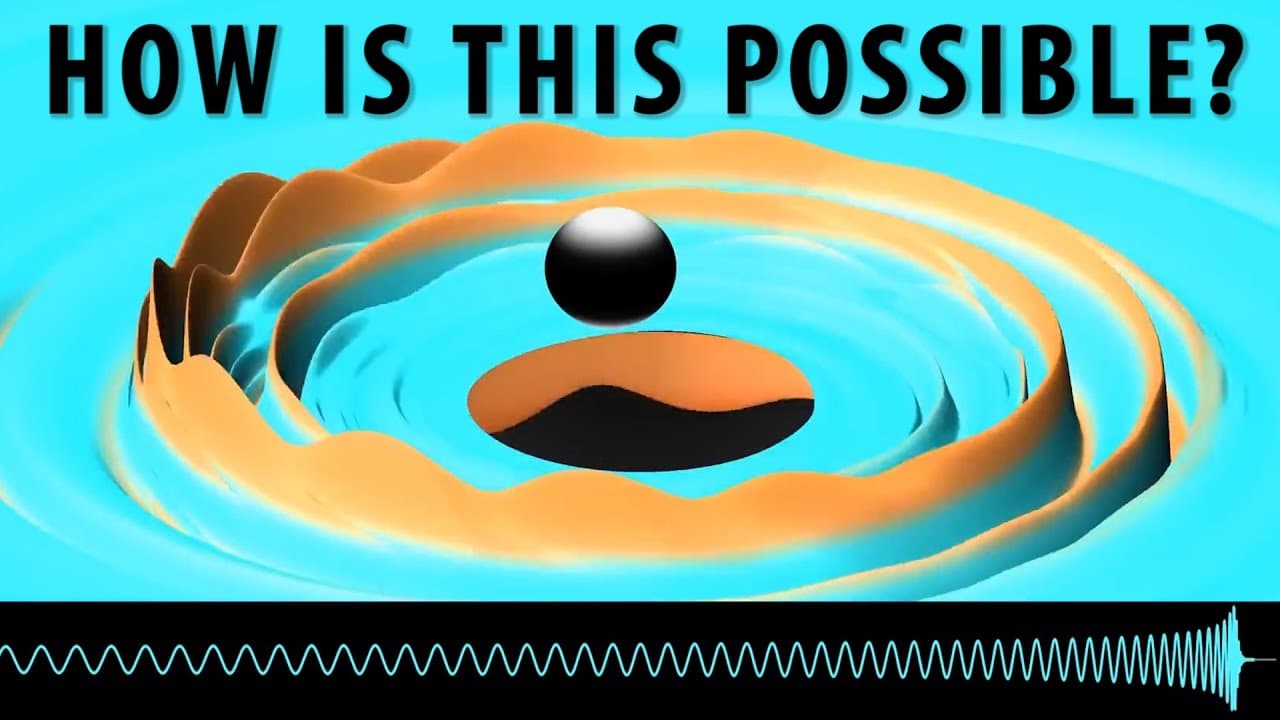
1.3 billion years ago in a galaxy far, far away two black holes merged As they violently spiraled into each other They created traveling distortions in the fabric of space-time gravitational waves in the last tenth of a second the energy released in these waves was 50 times greater then the energy being released by everything else in the observable... Read More
Key Insights
- 🫤 Gravitational waves were detected by measuring tiny distortions in space-time caused by a black hole collision 1.3 billion years ago.
- 👋 The detection of gravitational waves required unprecedented engineering precision to detect minute changes in the interferometer arms.
- 🪩 Stable lasers with a constant wavelength and ultra-smooth mirrors were essential for reliable measurements.
- 💯 The detection process involves creating a vacuum chamber, eliminating noise sources, and pumping out enough air to create an almost perfect vacuum.
- 🙂 Gravitational waves stretch light as well, adding another complexity to the detection process.
- 🦾 Quantum mechanics imposes limits on the sensitivity of detectors, requiring engineers to minimize uncertainty by focusing on measuring only one aspect.
Install to Summarize YouTube Videos and Get Transcripts
Explore YouTube Video Summarizer or Get YouTube Transcript Extractor
Questions & Answers
Q: Why is detecting gravitational waves so difficult?
The detected waves stretched and squeezed space by only one part in 10 to the 21. Even across LIGO’s four-kilometer arms, the length changed by at most 10 to the minus 18 meters, just 1/10,000 the width of a proton.
Q: How did LIGO detect gravitational waves?
LIGO sent light beams through perpendicular interferometer arms and monitored their interference. When a gravitational wave stretched and squeezed space, it changed the arms’ lengths slightly and put the two beams out of step.
Q: What event produced the gravitational waves described here?
Two black holes merged 1.3 billion years ago after violently spiraling into each other. During the final tenth of a second, the waves released 50 times more energy than everything else in the observable universe combined was releasing.
Q: Why are LIGO’s interferometer arms four kilometers long?
A gravitational wave produces an extremely small distortion, so the measurement must be made across as large a distance as possible. Four-kilometer arms make the resulting length variation more measurable, although it is still at most 10 to the minus 18 meters.
Q: How does LIGO prevent environmental noise from mimicking gravitational waves?
Its 40-kilogram, or 90-pound, mirrors are suspended by silica threads only twice the thickness of a hair to isolate them from environmental vibrations. Two detectors were also built far apart so local noise would appear at only one site, while a gravitational wave would pass through both almost simultaneously.
Q: Why must LIGO’s laser be exceptionally stable?
Interference measurements depend on a consistent wavelength; a changing wavelength would be like measuring with a ruler that constantly changes length. At least three-quarters of the equipment in the described setup helps stabilize the laser to one part in 10 to the 20.
Q: Why does LIGO use one megawatt of laser power?
Light arrives in discrete photons, and quantum uncertainty causes the number striking the mirrors at any instant to vary by an amount proportional to the square root of the total. Using more photons reduces that uncertainty as a fraction of the total, so the laser power in the arms reaches one megawatt.
Q: Why are LIGO’s interferometer arms kept in a near-perfect vacuum?
Anything the light hits, including air, can interfere with the measurement. The arms took 40 days to reach a trillionth of atmospheric pressure, and enough air was removed to fill two and a half million footballs.
Summary & Key Takeaways
-
1.3 billion years ago, two black holes merged, generating gravitational waves that travelled through space and were detected on Earth.
-
Detecting gravitational waves is challenging due to their tiny magnitude, requiring measurements on a scale equivalent to the width of a human hair.
-
The detection process involves using long interferometer arms, ultra-smooth mirrors, stable lasers, vacuum chambers, and minimizing noise from the environment.
Read in Other Languages (beta)
Share This Summary 📚
Summarize YouTube Videos and Get Video Transcripts with 1-Click
Try YouTube Summary with ChatGPT & Claude or YouTube Transcript Generator
Explore More Summaries from Veritasium 📚



Summarize YouTube Videos and Get Video Transcripts with 1-Click
Try YouTube Summary with ChatGPT & Claude or YouTube Transcript Generator