How to Implement Soft Actor Critic in PyTorch
TL;DR
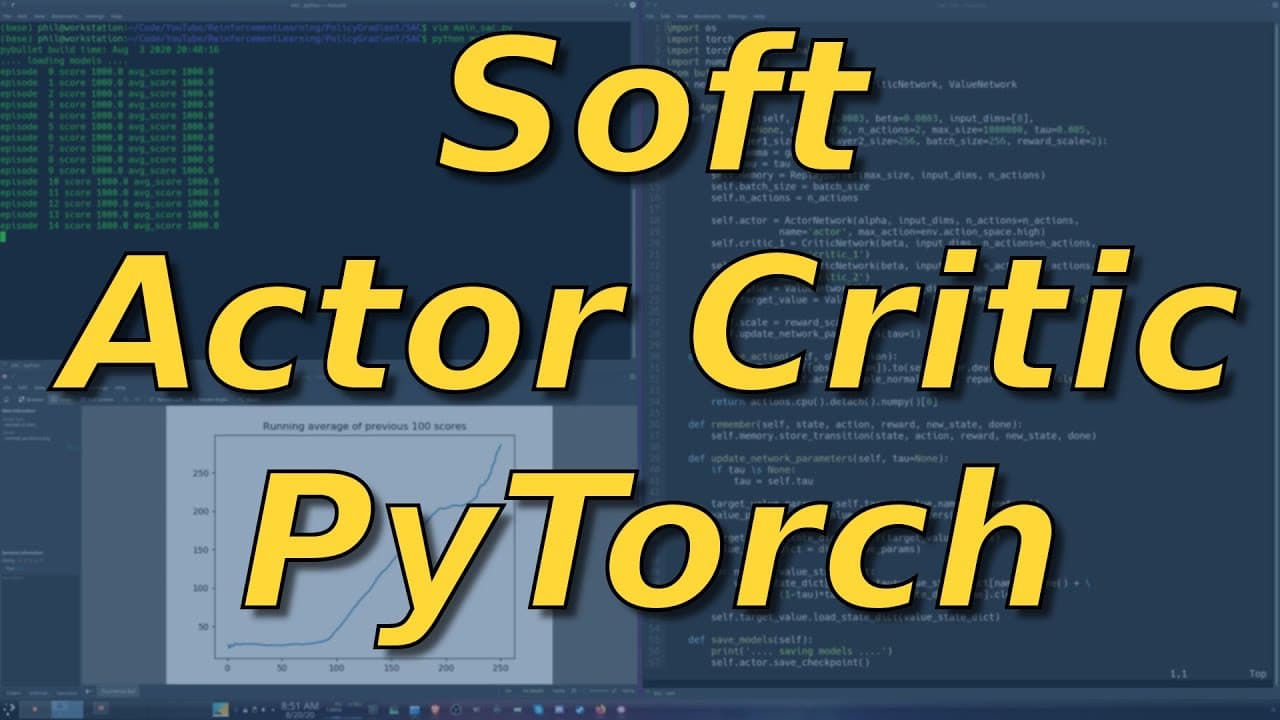
To implement a Soft Actor Critic agent in PyTorch, begin by creating a memory buffer using numpy arrays to store experiences. Define and initialize the actor, critic, and value networks, with configurations for their respective parameters. This setup allows the agent to handle continuous action spaces effectively and encourages exploration through a reward scaling factor.
Transcript
in this deep reinforcement learning tutorial you are going to learn how to code a soft actor critic agent in the pytorch framework starting from scratch let's get started before we get a brief announcement this uh content comes from my course on udemy on actor critic methods which is presently on sale if you're also looking for how to learn deep q ... Read More
Key Insights
- 🏪 The memory buffer is essential for storing and replaying transitions for training the agent's neural networks.
- 👾 The Soft Actor Critic algorithm encourages exploration in continuous action spaces, making it suitable for a wide range of environments.
- 🤩 The value network, critic network, and actor network are the key components of the Soft Actor Critic agent.
- 👻 The agent's neural networks are implemented using the PyTorch framework, allowing for efficient training and optimization.
- 🧑🏭 The reward scaling factor is a crucial parameter that influences the agent's exploration and exploitation tendencies.
- 😒 The Soft Actor Critic algorithm aims to reduce overestimation bias through the use of two critic networks and taking the minimum of the estimated action values.
- 🌸 The agent's neural networks are updated using backpropagation and optimization algorithms such as mean squared error loss and stochastic gradient descent.
Install to Summarize YouTube Videos and Get Transcripts
Explore YouTube Video Summarizer or Get YouTube Transcript Extractor
Questions & Answers
Q: What is the purpose of the agent's memory buffer?
The memory buffer stores transitions of states, actions, rewards, and next states for the agent, which are used for training the neural networks.
Q: How are transitions stored in the agent's memory buffer?
Transitions are stored in numpy arrays within the memory buffer class, and the buffer is updated using the store_transition() function.
Q: Why is the Soft Actor Critic algorithm used for learning in continuous action space environments?
Soft Actor Critic algorithm uses the maximum entropy framework to encourage exploration, making it more robust and stable for continuous action space environments.
Q: How are actions selected using the Soft Actor Critic algorithm?
Actions are selected by sampling from a probability distribution defined by the actor network's output, which consists of mean and standard deviation values.
Summary & Key Takeaways
-
The tutorial covers how to code a Soft Actor Critic agent in PyTorch, focusing on the agent's memory buffer using numpy arrays.
-
The agent's memory buffer is instantiated with parameters such as maximum size, input shape, and number of actions.
-
The agent's neural networks, including the actor, critic, and value networks, are defined and initialized in the PyTorch framework.
Read in Other Languages (beta)
Share This Summary 📚
Summarize YouTube Videos and Get Video Transcripts with 1-Click
Try YouTube Summary with ChatGPT & Claude or YouTube Transcript Generator
Explore More Summaries from Machine Learning with Phil 📚



Summarize YouTube Videos and Get Video Transcripts with 1-Click
Try YouTube Summary with ChatGPT & Claude or YouTube Transcript Generator