How to Get Unstuck with a 10 Minute System
TL;DR
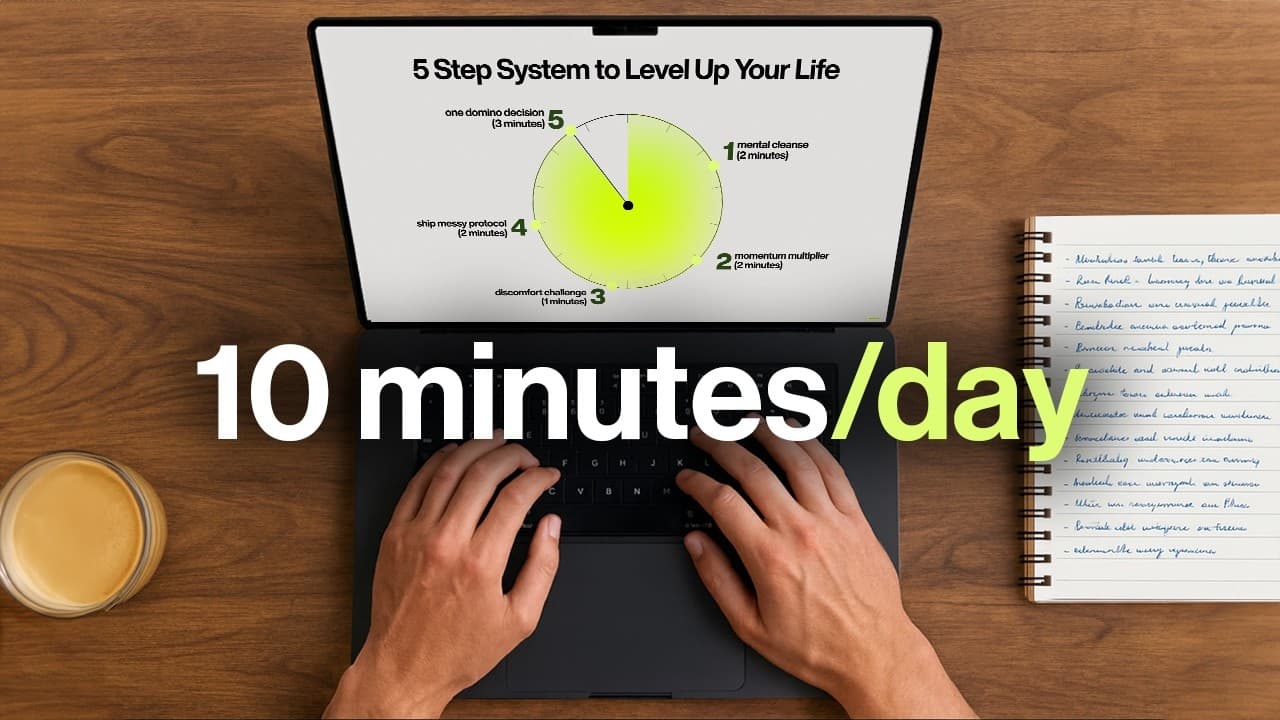
The core idea is that a 10 minute daily system can break inertia. Start with a 2 minute mental cleanse to clear thoughts and pick the smallest next action, then repeat with a momentum multiplier, a 5 second rule style discomfort push, and finally ship messy prototypes to learn quickly. This cadence compounds momentum over time.
Transcript
What if I told you that the only thing you need to get unstuck and make progress faster than 99% of people is a simple 10-minute system? This system took me from trapped in a cycle of burnout and procrastination to being able to work 4 hours a day building a portfolio of online businesses from anywhere in the world. So, here's my simple five-step s... Read More
Key Insights
- The two minute mental cleanse clears mental static by writing down unfinished tasks.
- The momentum multiplier relies on small wins to grow long term momentum.
- The discomfort challenge uses a five second rule to trigger immediate action.
- The ship messy protocol advocates launching at 70 percent readiness to learnfast.
- The system emphasizes defining a minimum viable value before launch.
- The 70 percent rule balances speed and quality to avoid delays.
- The process recommends embracing feedback and iterating quickly.
- The overall strategy is to move fast and break things to stay competitive.
- More videos from this channel:
- More from this channel: Matt Gray
Install to Summarize YouTube Videos and Get Transcripts
Explore YouTube Video Summarizer or Get YouTube Transcript Extractor
Questions & Answers
Q: How does the two minute mental cleanse help you get unstuck?
The two minute mental cleanse works by writing down everything causing mental static, which reduces cognitive load and makes the next action visible. It leverages the idea that starting is the hardest part, so small, defined writing tasks get you moving and create immediate forward momentum that compounds over time.
Q: What is meant by the momentum multiplier in the system?
The momentum multiplier is about creating a tiny win every day, such as writing a single joke or publishing a small piece of content. These small consistent actions accumulate to significant progress, helping you bridge gaps between your current state and long term goals by maintaining daily momentum.
Q: What is the discomfort challenge and how is it applied?
The discomfort challenge uses a five second rule to prompt immediate action when a task comes to mind. By counting down 5, 4, 3, 2, 1 and then acting, you bypass hesitation and train your brain to seek progress over perfection, reducing procrastination and increasing consistent output.
Q: Explain the ship messy protocol and its purpose?
Ship messy protocol encourages releasing work at around 70 percent completion rather than waiting for perfection. This reduces launch anxiety, accelerates feedback loops, and enables rapid iteration. The idea is to get something out there, learn from real user responses, and improve through subsequent versions.
Q: What is the minimum viable value concept in this system?
Minimum viable value is the smallest piece of output that delivers usable value to users, allowing you to launch sooner. By defining this, you set a clear target for early delivery and create opportunities for feedback, which then informs faster iterations and better alignment with audience needs.
Q: How should one use the 70 percent rule in practice?
The 70 percent rule suggests launching when the project is 70 percent complete, not waiting until it is perfect. This balances speed and risk, reduces the chance of missed opportunities, and provides a concrete trigger to ship, gather feedback, and iterate based on real data.
Q: What role does feedback play in this system?
Feedback is central to the system; after shipping, you invite user input, analyze responses, and incorporate improvements in subsequent iterations. This loop accelerates learning, helps refine the offering, and reinforces momentum by turning real world usage into actionable insights.
Q: Why is speed important according to this method?
Speed is important because it creates competitive advantage in a fast moving environment. By shipping early and iterating quickly, you reduce perceived risk, accelerate learning, and keep momentum high, enabling you to build and scale online businesses from anywhere more effectively.
Summary & Key Takeaways
-
This summary outlines a practical, repeatable five step routine designed to overcome burnout and procrastination. It starts with a quick mental cleanse to free the mind, then emphasizes small wins to build momentum, embraces discomfort to push through barriers, and ends with launching imperfect but functional work to iterate rapidly.
-
The system relies on short, repeatable micro-actions and requires minimum viable effort that scales. It encourages shipping early, learning from feedback, and progressively expanding capabilities while maintaining momentum and focus across days and tasks.
-
The approach highlights that momentum is created by action, not intention, and that structured, time bound habits can transform daily productivity into a scalable process for online business growth.
Read in Other Languages (beta)
Share This Summary 📚
Summarize YouTube Videos and Get Video Transcripts with 1-Click
Try YouTube Summary with ChatGPT & Claude or YouTube Transcript Generator
Explore More Summaries from Matt Gray 📚
Summarize YouTube Videos and Get Video Transcripts with 1-Click
Try YouTube Summary with ChatGPT & Claude or YouTube Transcript Generator