7.4.7 R7. Visualization - Video 6: Scales
TL;DR
Visualizations have scale problems, making data appear distorted and misleading.
Transcript
In this video, we're going to look at scales. This first plot shows the average height of a 21-year-old male in centimeters. The x-axis is time, starting in 1871, and ending in 1975. Each person represents the height, at a different point in time, and the points are evenly spaced in time, so the x-axis is OK. The y-axis ranges from just under 160 t... Read More
Key Insights
- ⌛ Inaccurate scale representations can distort the perceived changes in data over time.
- 💁 Inconsistent gaps and scales in visualizations make it challenging to interpret accurate information.
- 👯 Misleading combinations of different units, such as dollars and people, can create false impressions.
- #️⃣ The accuracy and consistency of numbers within visualizations are crucial for proper understanding and analysis.
- ☠️ Visualizations that fail to represent relative changes and growth rates can hinder effective data interpretation.
- 📈 Absolute numbers can provide a different perspective on trends compared to relative representations.
- 🎨 Clarity and consistency in visualization design are essential for accurate communication of data.
Install to Summarize YouTube Videos and Get Transcripts
Explore YouTube Video Summarizer or Get YouTube Transcript Extractor
Questions & Answers
Q: What are the issues with the first plot showing the average height of 21-year-old males over time?
The first plot inaccurately represents height changes by scaling the width of each person, making it seem like people have not only doubled in height but also doubled in width. This distorts the visualization's representation of actual growth.
Q: How does the second plot suffer from scale problems and misleading representations?
The second plot presents a narrow range but with all data falling within a slightly larger range. If the y-axis was scaled from 0% to 10%, it would give the impression that nothing is changing. In addition, the inconsistent gaps between markers create confusion in interpreting the data accurately.
Q: Why does the third plot fail to meaningfully portray the breakdown of teachers by race?
The third plot suffers from various issues, including truncating the Caucasian bar, inconsistent scales for each bar, and rounding numbers. Consequently, the visual representation becomes meaningless and raises doubts about the accuracy of the numbers.
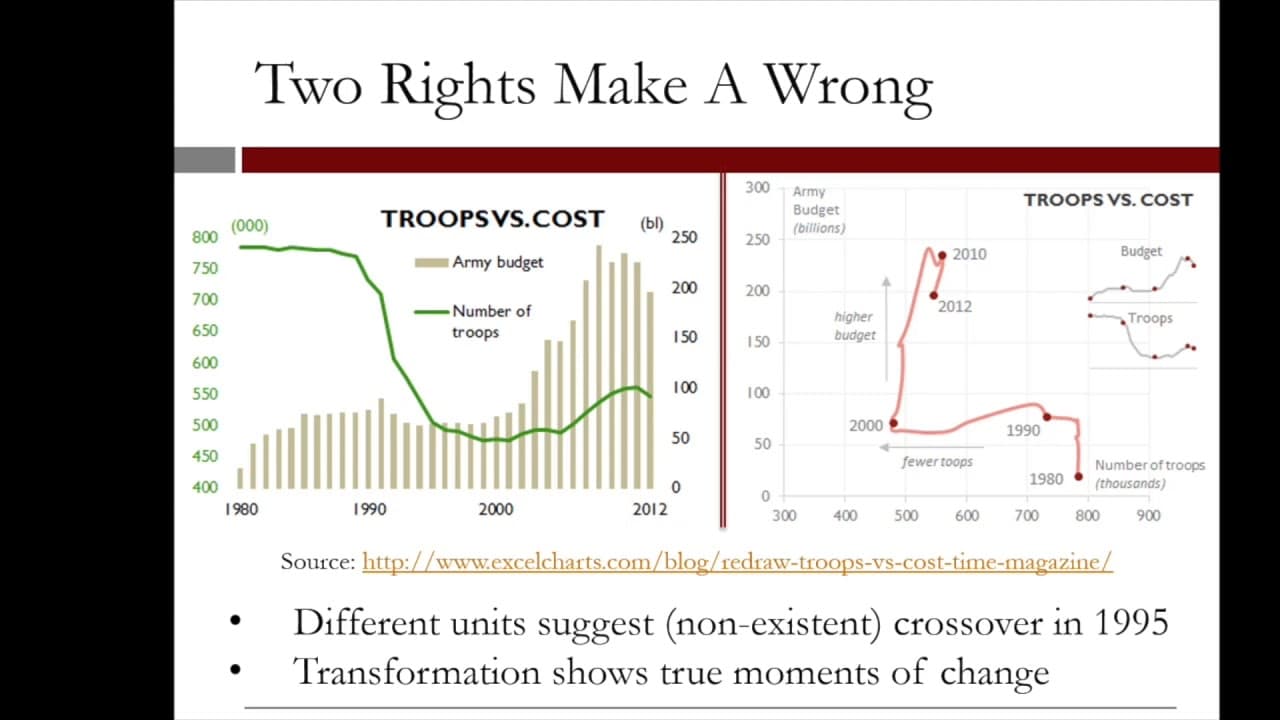
Q: How does the combination of different units mislead in the first version of the military expense visualization?
By mixing dollars and troop count on different axes, the visualization creates a false impression of a crossover point in 1995 that does not exist. This misrepresentation occurs due to the improper combination of two different units.
Q: How does the second version of the military expense visualization improve upon the first one?
The second version arranges the data with troops on the x-axis and dollars on the y-axis, allowing for a clearer representation of changes over time. This enables the viewer to observe moments of change, such as decreases in troop count and increases in spending, accurately.
Q: What is the main issue with the visualization of household types over time?
The x-axis in the visualization is inconsistent, making it difficult to compare rates of change across different years. The gaps between columns are not uniform, leading to confusion when trying to analyze the growth or decline of specific household types.
Q: Can absolute numbers provide a different perspective on the trends shown in the household visualization?
Yes, when considering absolute numbers, the total number of couples married with children might remain constant, while the number of other household types has increased. This emphasizes the importance of considering absolute numbers when interpreting the overall trends.
Summary & Key Takeaways
-
The first plot exaggerates the change in height over time due to inaccurate representation of the men's bodies.
-
The second plot misrepresents the data range and relative locations, making it difficult to interpret any meaningful conclusions.
-
The third plot fails to accurately portray the breakdown of teachers by race, with inconsistent scales and rounded numbers.
Read in Other Languages (beta)
Share This Summary 📚
Summarize YouTube Videos and Get Video Transcripts with 1-Click
Try YouTube Summary with ChatGPT & Claude or YouTube Transcript Generator
Explore More Summaries from MIT OpenCourseWare 📚


Summarize YouTube Videos and Get Video Transcripts with 1-Click
Try YouTube Summary with ChatGPT & Claude or YouTube Transcript Generator