What Are Particle Decays and Why Do They Matter?
TL;DR
Particle decays play a crucial role in understanding forces and particles in physics. They provide insights into the properties, lifetimes, and interactions of unstable particles, as well as fundamental aspects of quantum mechanics like the uncertainty principle. Analyzing decay rates and branching fractions, especially in examples like the Higgs boson, reveals the complexity and significance of these processes.
Transcript
MARKUS KLUTE: Hello. So in the last video, we looked at ranges of forces. So we already saw one aspect, and wanted to learn about what kind of interaction happens when you study a specific force. You learn about the force carrier from noting the range in which forces interact. In this class, we talk about decays. But in more general terms, when we ... Read More
Key Insights
- 🧡 Decays provide valuable information about the range of forces and the mass of bound states.
- ☠️ Decay rates and widths of unstable particles are related to their lifetimes and can be determined experimentally.
- ☠️ Reaction rates expressed as cross sections are another way to measure properties of forces.
- 🥺 Uncertainty principle in quantum mechanics leads to the quantization of the width of unstable particles.
- 📳 Multiple decay modes can complicate the analysis, requiring the calculation of partial widths and branching fractions.
- 📳 The Higgs boson serves as an example to illustrate the concepts discussed, with specific decay modes and branching ratios.
- 📳 The b quark decay mode is the most prominent for the Higgs boson, but other decay modes are also possible.
Install to Summarize YouTube Videos and Get Transcripts
Explore YouTube Video Summarizer or Get YouTube Transcript Extractor
Questions & Answers
Q: How can the study of decays help in understanding forces in particle physics?
By analyzing decays, we can learn about the range of forces, study the mass of bound states, and measure the decay rates of unstable particles.
Q: What is the relationship between the decay rate and the lifetime of a particle?
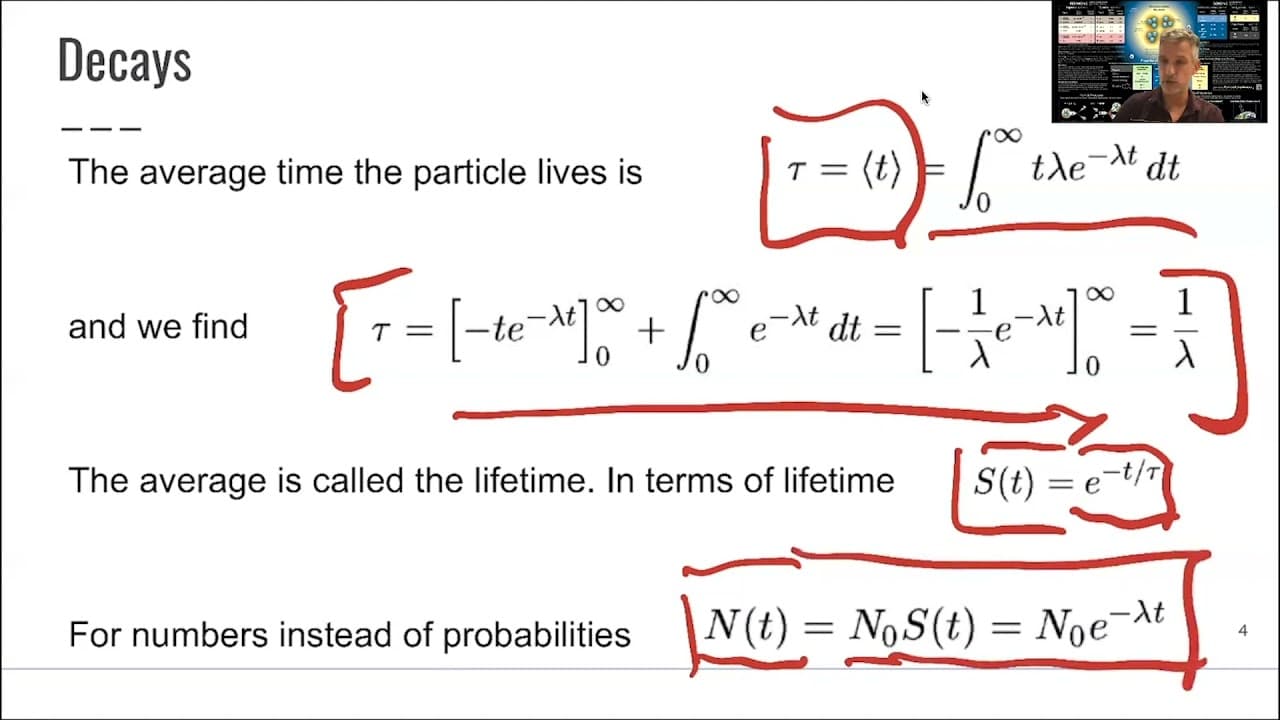
The lifetime of a particle is related to its decay rate in quantum mechanics. The decay rate determines the probability that a particle will survive until a given time.
Q: How can the average lifetime of a particle be calculated?
The average lifetime of a particle can be calculated by taking the inverse of the decay rate. It is given by the integral of the decay rate distribution over time.
Q: What is the half-life of a particle and how is it related to its lifetime?
The half-life of a particle is the time it takes for half of the particles to decay. It is related to the lifetime of the particle with a factor of about 2/3.
Summary & Key Takeaways
-
Forces can be studied by analyzing decays, understanding the range in which they occur, and measuring the masses of bound states.
-
Decay rates and widths of unstable particles provide insights into quantum mechanics and the lifetime of particles.
-
Reaction rates expressed as cross sections can also be used to measure properties of forces.
Read in Other Languages (beta)
Share This Summary 📚
Summarize YouTube Videos and Get Video Transcripts with 1-Click
Try YouTube Summary with ChatGPT & Claude or YouTube Transcript Generator
Explore More Summaries from MIT OpenCourseWare 📚


Summarize YouTube Videos and Get Video Transcripts with 1-Click
Try YouTube Summary with ChatGPT & Claude or YouTube Transcript Generator