How to Use Bayes Rule for Binary Signal Detection
TL;DR
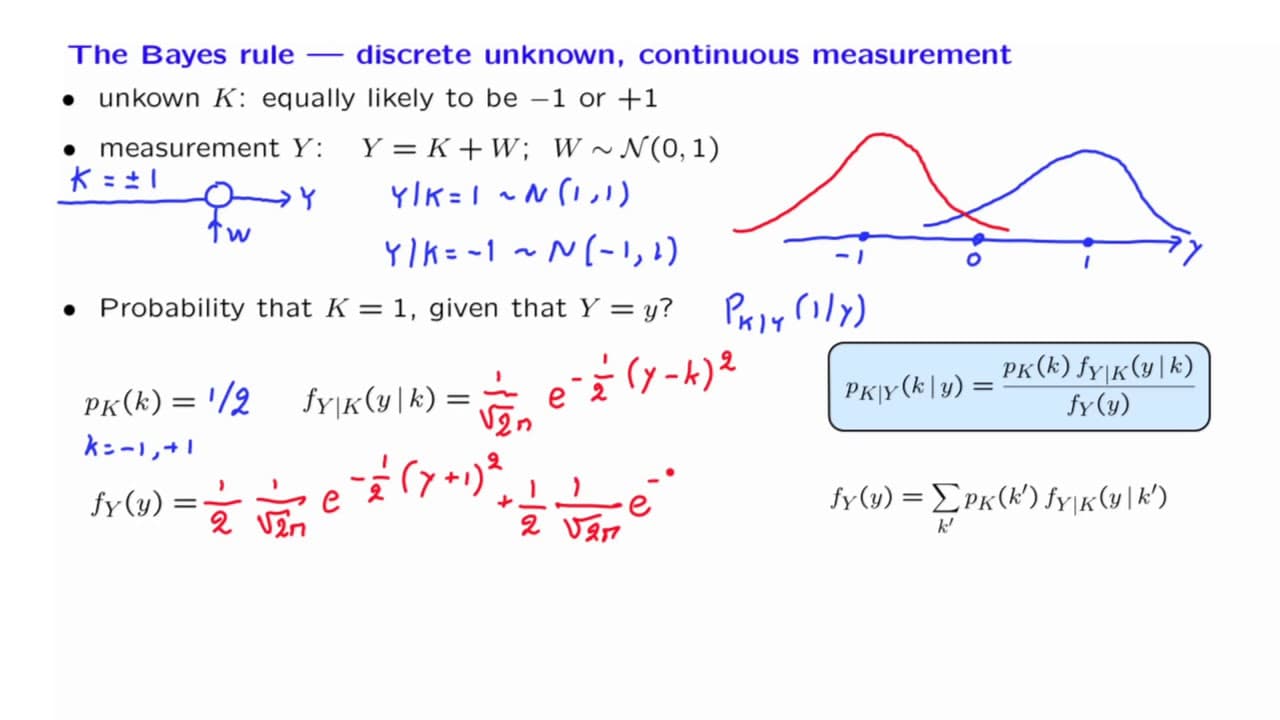
To detect which binary signal was sent in a digital communication system, apply Bayes rule to calculate the conditional probability. Given observations affected by noise, the formula reveals that as the noise measurement increases, the likelihood of a '1' being sent increases, while a very negative measurement indicates a higher chance of a '−1' being sent.
Transcript
We will now use the Bayes rule in an important application that involves a discrete unknown random variable and a continuous measurement. Our discrete unknown random variable will be one that takes the values plus or minus 1 with equal probability. And the measurement will be another random variable, Y, which is equal to the discrete random variabl... Read More
Key Insights
- 🫦 Bayes rule is applicable in communication systems to determine the probability of a certain bit being sent.
- 👻 The assumption of a standard normal random variable for the noise allows for the calculation of conditional densities.
- 🍉 The prior probability, conditional density, and denominator terms are necessary to calculate the conditional probability using Bayes rule.
- 🫦 By plotting the conditional probability as a function of the observed value, we can observe how the likelihood of a certain bit being sent changes.
Install to Summarize YouTube Videos and Get Transcripts
Explore YouTube Video Summarizer or Get YouTube Transcript Extractor
Questions & Answers
Q: What is the purpose of using the Bayes rule in communication systems?
The Bayes rule allows us to determine the probability that a certain bit was sent based on the observed measurement, considering the presence of noise in the communication channel.
Q: How is the prior probability of the unknown variable determined?
In this scenario, the prior probability is equal to 1/2 for each possible value of the unknown variable, since they are assumed to be equally likely.
Q: How is the conditional density of the observed variable calculated?
The conditional density of the observed variable depends on the value of the unknown variable. If it is +1, the observed variable is a normal distribution with a mean of +1. If it is -1, the observed variable is a normal distribution with a mean of -1.
Q: What does the final expression obtained using Bayes rule represent?
The final expression, 1 divided by 1 plus e to the minus 2y, represents the probability that a +1 bit was sent given the observed value of y.
Summary & Key Takeaways
-
The content discusses the application of Bayes rule in a communication system where a discrete unknown random variable is corrupted by additive noise.
-
The goal is to guess which bit was sent based on the observed measurement, and the assumption is made that the noise is a standard normal random variable.
-
The content explains how to calculate the conditional probability of the unknown variable given the observed value using the prior probability, conditional density, and denominator terms in the Bayes rule formula.
Read in Other Languages (beta)
Share This Summary 📚
Summarize YouTube Videos and Get Video Transcripts with 1-Click
Try YouTube Summary with ChatGPT & Claude or YouTube Transcript Generator
Explore More Summaries from MIT OpenCourseWare 📚


Summarize YouTube Videos and Get Video Transcripts with 1-Click
Try YouTube Summary with ChatGPT & Claude or YouTube Transcript Generator