Lecture 1 Part 2: Derivatives as Linear Operators
TL;DR
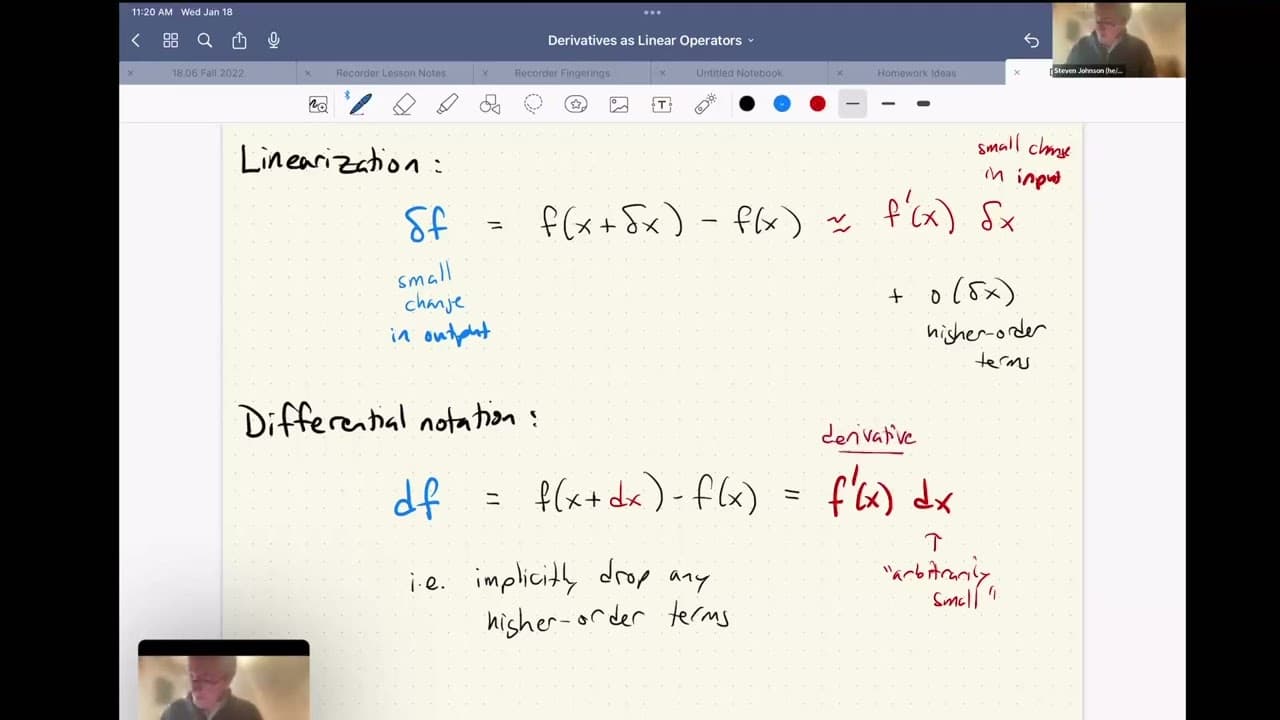
The video discusses the concept of derivatives and linear operators, exploring their definitions, properties, and applications.
Transcript
[SQUEAKING] [RUSTLING] [CLICKING] STEVEN G. JOHNSON: So I want to revisit the things that Alan talked about, but just a little bit more slowly and a bit more-- just try and lay out the rules for you as clearly as I can. And what we're going to try and do is, again, just revisit the notion of a derivative to try and write it in a way that we can gen... Read More
Key Insights
- 🫥 Derivatives are the slopes of tangent lines and linear approximations of functions.
- ✋ Higher order terms become less significant as the change in the input gets smaller.
- 👾 Linear operators can generalize derivatives to different vector spaces.
- 🫡 The gradient provides the rate of change of a scalar function with respect to a vector input.
Install to Summarize YouTube Videos and Get Transcripts
Explore YouTube Video Summarizer or Get YouTube Transcript Extractor
Questions & Answers
Q: What is the definition of a derivative?
A derivative is the linear approximation of a function, representing the change in the output for a small change in the input. It is the slope of the tangent line and can be calculated using the formula f'(x) = Δf/Δx.
Q: How are higher order terms represented in asymptotic notation?
Higher order terms are denoted by the symbol little o of delta x. It represents functions that go to zero faster than linear, such as delta x squared or delta x cubed. These terms become progressively less significant as delta x becomes smaller.
Q: How does the video generalize derivatives using linear operators?
The video discusses how derivatives can be represented as linear operators in different vector spaces. By using dot products and transpose operations, linear operators can be defined for various types of inputs and outputs, extending the concept of derivatives.
Q: What is the significance of the gradient in the context of derivatives?
The gradient represents the derivative of a scalar function of a vector input. It is the row vector that, when multiplied by a small change in the input, gives the corresponding change in the output. The gradient is crucial for understanding the rate of change of a scalar function.
Summary & Key Takeaways
-
The video introduces the concept of a derivative as the slope of the tangent line and the linear approximation of a function.
-
The video discusses higher order terms and introduces the asymptotic notation as a way to represent terms that become negligible as the parameter approaches zero.
-
The video explains how derivatives can be generalized to other objects using linear operators and illustrates this concept with examples from linear algebra.
Read in Other Languages (beta)
Share This Summary 📚
Summarize YouTube Videos and Get Video Transcripts with 1-Click
Try YouTube Summary with ChatGPT & Claude or YouTube Transcript Generator
Explore More Summaries from MIT OpenCourseWare 📚


Summarize YouTube Videos and Get Video Transcripts with 1-Click
Try YouTube Summary with ChatGPT & Claude or YouTube Transcript Generator