5. Amortization: Amortized Analysis
TL;DR
Amortized analysis simplifies algorithm efficiency by focusing on overall costs rather than individual operations.
Transcript
Read and summarize the transcript of this video on Glasp Reader (beta).
Key Insights
- Amortization in computer science is adapted from financial analysis to focus on the total running time of an algorithm rather than worst-case scenarios for individual operations.
- The aggregate method calculates the amortized cost by dividing the total cost of operations by the number of operations, useful when operations are homogenous.
- The accounting method involves maintaining a bank account where operations store or withdraw credits, ensuring the balance never goes negative.
- The charging method allows operations to charge their costs retroactively to past operations, ensuring each operation ultimately pays for its charges.
- The potential method uses a potential function to measure the 'badness' of a data structure state, allowing costly operations to be charged to a decrease in potential.
- Binary counters demonstrate constant amortized cost by focusing on the number of 1 bits, avoiding costly bit flips.
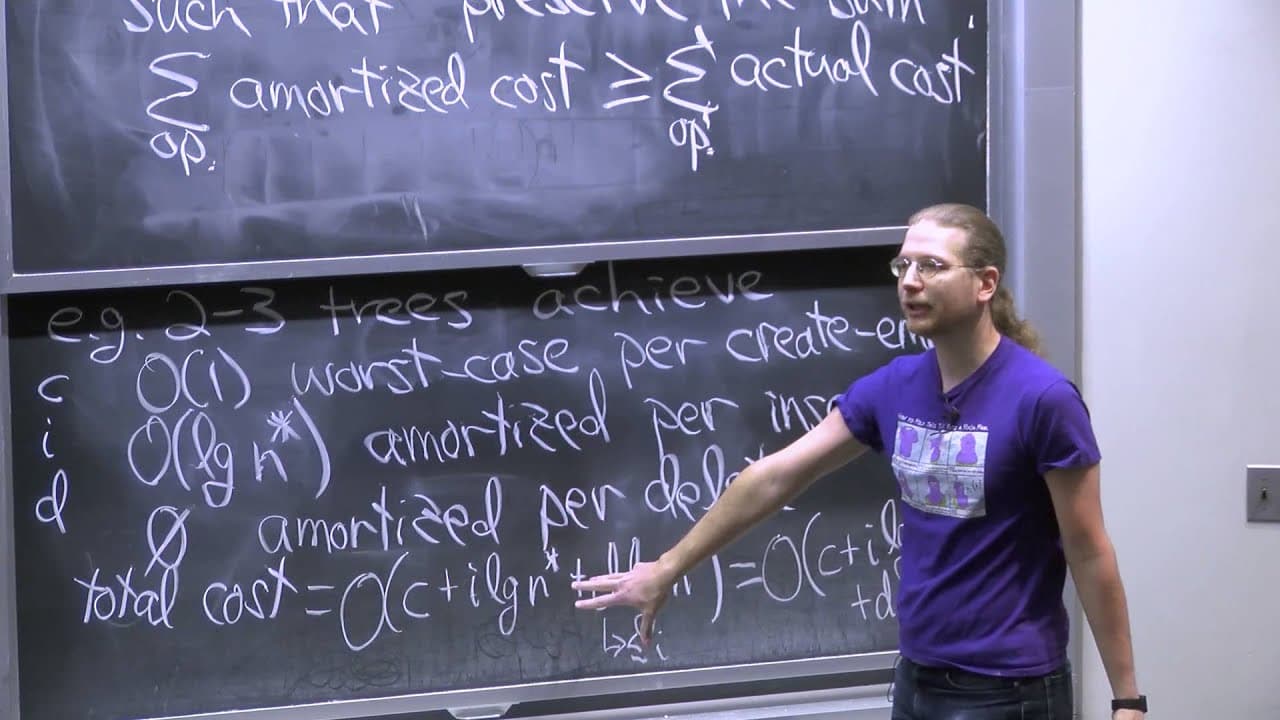
- 2-3 trees can achieve constant amortized cost for insertions by focusing on the number of 3 nodes, but not for both insertions and deletions.
- 2-5 trees improve upon 2-3 trees by allowing constant amortized costs for both insertions and deletions, beneficial in parallel processing environments.
Install to Summarize YouTube Videos and Get Transcripts
Explore YouTube Video Summarizer or Get YouTube Transcript Extractor
Questions & Answers
Q: What is the main purpose of amortized analysis in computer science?
The main purpose of amortized analysis in computer science is to provide a way to analyze the average performance of an algorithm over a sequence of operations, rather than focusing on the worst-case performance of individual operations. This approach helps in understanding the overall efficiency and performance of data structures and algorithms in practical scenarios.
Q: How does the accounting method work in amortized analysis?
The accounting method involves maintaining a conceptual bank account where operations can deposit or withdraw credits. Each operation can store credits in the account to pay for future operations, ensuring that the balance never goes negative. This method allows for a clear understanding of how costs are distributed among operations and ensures that the total cost remains within acceptable bounds.
Q: What is the potential method in amortized analysis?
The potential method defines a potential function that measures the 'badness' or inefficiency of the current state of a data structure. This function helps in amortized analysis by allowing costly operations to be charged to a decrease in potential. The key is to ensure the potential function remains non-negative and that it accurately reflects the additional work required by the data structure in its current state.
Q: Why are 2-5 trees more efficient than 2-3 trees in certain scenarios?
2-5 trees are more efficient than 2-3 trees in scenarios where both insertions and deletions are frequent, as they maintain a constant amortized cost for both operations. This efficiency is particularly beneficial in multi-threaded environments where changing the data structure is more costly than searching, as 2-5 trees minimize the need for costly splits and merges at the root level.
Q: What challenges arise when using the potential method?
The main challenge in using the potential method is defining an appropriate potential function that accurately measures the inefficiency or 'badness' of a data structure's state. Finding the right potential function requires insight into the data structure's behavior and can be complex, especially for intricate data structures and operations. However, once defined, it provides a powerful tool for analyzing amortized costs.
Q: How does the charging method differ from the accounting method?
The charging method differs from the accounting method by allowing operations to charge their costs retroactively to past operations, rather than maintaining a bank account for future operations. This approach is akin to blaming past operations for current costs and ensures that each operation ultimately pays for its charges. It provides a different perspective on distributing costs and can simplify analysis in certain cases.
Q: What is the significance of the aggregate method in amortized analysis?
The aggregate method is significant in amortized analysis because it provides a straightforward approach to calculating the amortized cost by dividing the total cost of a sequence of operations by the number of operations. This method is effective when operations are homogenous and helps in understanding the overall efficiency of an algorithm without focusing on individual operation costs.
Q: Can you explain the concept of table doubling with amortized analysis?
Table doubling is a technique used in data structures like hash tables to maintain efficient operations. When a table becomes full, its size is doubled, which involves copying all elements to a new table. Although this operation is costly, amortized analysis shows that the average cost per insertion remains constant because the costly doubling operation is distributed over many insertions, ensuring overall efficiency.
Summary & Key Takeaways
-
Amortized analysis is a technique in algorithms that focuses on the average cost of operations over time, rather than individual worst-case costs. It is particularly useful in data structures where operations vary widely in cost.
-
The lecture covers several methods of amortized analysis: aggregate, accounting, charging, and potential. Each method offers a different perspective on how to distribute costs across operations to simplify analysis.
-
Examples such as binary counters, 2-3 trees, and 2-5 trees illustrate how amortized analysis can lead to more efficient algorithms by focusing on overall efficiency rather than individual operation costs.
Read in Other Languages (beta)
Share This Summary 📚
Summarize YouTube Videos and Get Video Transcripts with 1-Click
Try YouTube Summary with ChatGPT & Claude or YouTube Transcript Generator
Explore More Summaries from MIT OpenCourseWare 📚



Summarize YouTube Videos and Get Video Transcripts with 1-Click
Try YouTube Summary with ChatGPT & Claude or YouTube Transcript Generator