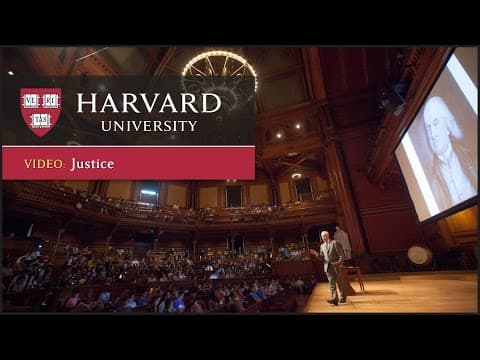
Justice: What's The Right Thing To Do? Episode 11: "THE CLAIMS OF COMMUNITY"

Transcript
[MUSIC PLAYING] SPEAKER: Funding for this program is provided by-- Additional funding provided by-- MICHAEL SANDEL: Today, we turn to Kant's reply to Aristotle. Kant thinks that Aristotle just made a mistake. It's one thing, Kant says, to support a fair framework of rights within which people can pursue their own conceptions of the good life. It's ... Read More
Install to Summarize YouTube Videos and Get Transcripts
Explore YouTube Video Summarizer or Get YouTube Transcript Extractor
Summary
This video discusses the differences between the ideas of Aristotle and Kant regarding the role of law and justice in society. It also explores the communitarian critique of the individualist or voluntarist view of the self and the concept of obligations of solidarity or membership. The argument centers around whether justice is purely based on individual rights or if it also includes obligations to one's community and traditions.
Questions & Answers
Q: How does Kant's view differ from Aristotle's when it comes to the purpose of law and the role of a constitution?
Kant believes that laws and constitutions should not promote any particular way of life, but rather provide a fair framework of rights within which citizens can pursue their own conceptions of the good. Aristotle, on the other hand, sees the purpose of law and the constitution as shaping character, cultivating virtue, and creating conditions for a good way of life.
Q: What is Kant's notion of freedom?
Kant views freedom as acting autonomously and according to self-imposed laws. He believes that true freedom comes from following a law that one gives oneself, rather than being constrained by external forces or obligations.
Q: How do communitarian critics view Kant's notion of freedom as autonomy?
Communitarian critics argue that Kant's view of freedom as autonomy overlooks the importance of moral ties and obligations that are not based on individual consent. They believe that freedom and moral obligations are intertwined with the history, traditions, and communities to which one belongs.
Q: What is Alasdair MacIntyre's narrative conception of the self?
MacIntyre argues that individuals are essentially storytelling creatures and that their moral decisions can only be made within the context of the narrative they find themselves a part of. This means that one's moral obligations and sense of identity are shaped by the history, traditions, and communities they belong to.
Q: How do communitarians view obligations of membership and solidarity?
Communitarians argue that obligations of membership and solidarity are separate from natural duties and voluntary obligations. They believe that membership in a community or group creates specific obligations that arise from shared history, traditions, and narratives, rather than individual choice.
Q: How do communitarians respond to the objection that obligations of solidarity may conflict with universal moral principles?
Communitarians recognize that obligations of solidarity can sometimes conflict with universal moral principles. However, they argue that loyalty and commitment to a particular community or group are important values that should not be easily dismissed. They believe that the tension between different obligations should be resolved through moral judgement and a deeper understanding of one's values and moral commitments.
Q: Can patriotism be seen as an example of an obligation of membership or solidarity?
Yes, patriotism can be seen as an example of an obligation of membership or solidarity. The idea of patriotism involves a sense of loyalty, pride, and commitment to one's country or community. However, the extent and nature of patriotic obligations can vary, and different individuals may have different interpretations of what it means to be patriotic.
Q: How do critics argue against the idea of obligations of membership or solidarity?
Critics argue that obligations of membership or solidarity can be arbitrary and may lead to conflicting obligations. They believe that moral obligations should be based on individual choice, consent, or reciprocity rather than being determined by one's membership in a community or group.
Takeaways
The video raises important questions about the nature of justice and the role of community in moral obligations. While Kantian and liberal views emphasize individual autonomy and consent, communitarian critics argue that moral obligations are intertwined with one's history, traditions, and community. The tension between individual rights and communal obligations is a complex issue that challenges our understanding of justice and the limits of autonomy. It calls for careful reflection on how we define moral obligations and the role of community in shaping our identities and values.
Read in Other Languages (beta)
Share This Summary 📚
Summarize YouTube Videos and Get Video Transcripts with 1-Click
Try YouTube Summary with ChatGPT & Claude or YouTube Transcript Generator
Explore More Summaries from Harvard University 📚





Summarize YouTube Videos and Get Video Transcripts with 1-Click
Try YouTube Summary with ChatGPT & Claude or YouTube Transcript Generator