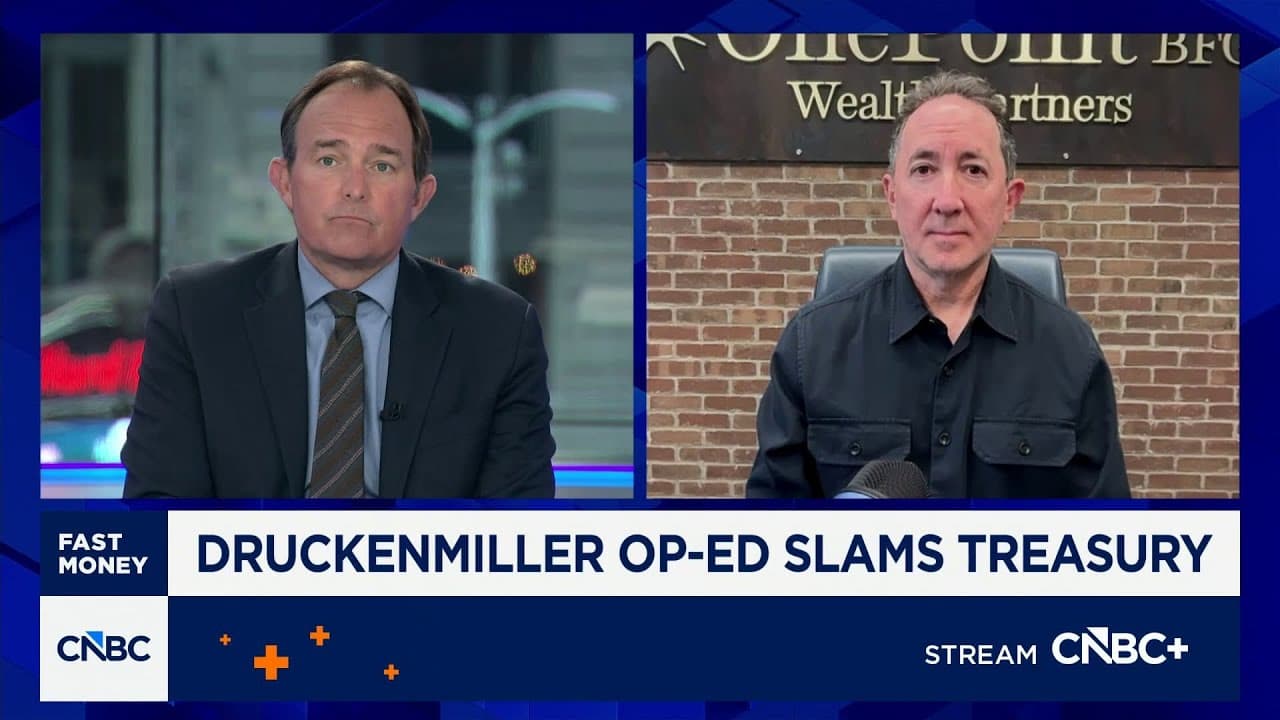
How did Druckenmiller critique Bessent’s bond moves and the Fed’s influence
TL;DR
Druckenmiller argues the Fed should not fix the price of bonds and let the market determine yields. Bessent’s short term debt moves raise policy sensitivity to funding costs and could affect the cost of capital if rates rise. The debate centers on market dynamics vs government intervention and credibility concerns among key figures.
Transcript
NOTEWORTHY BECAUSE BESSENT WORKED FOR DRUCKENMILLER, THEY BOTH WORKED, ACTUALLY FOR GEORGE SOROS AND DRUCKENMILLER KIND OF MENTORED SLASH BOSS. WHATEVER. SCOTT BEST. LET'S BRING IN CNBC CONTRIBUTOR PETER BOOCKVAR, WHO'S CHIEF INVESTMENT OFFICER, AT ONE POINT BFG WEALTH PARTNERS. YEAH I GUESS AND ALSO BY THE WAY, THERE'S SO THERE'S A LOT OF RELATION... Read More
Key Insights
- Druckenmiller argues that government actions to fix bond prices fail against market forces, emphasizing the market’s power to price capital. The insight is that letting markets set yields can lead to more accurate cost of capital signals.
- The discussion notes that the yield curve should respond to changes in oil prices, and that market dynamics drive long end yields more effectively than policy actions, highlighting the relationship between macro indicators and interest rates.
- Bessent’s strategy is framed as potentially increasing policy sensitivity to short term bond issuance, which could raise the cost of capital if rate hikes become necessary due to persistent inflation.
- Warsh’s stance is referenced as being more accepting of market-driven rate setting, creating a tension line with Bessent’s approach and the broader policy framework.
- The credibility question centers on whether aggressive actions by a former protege can undermine trust in independent policy implementation and market signals.
- The panel suggests that a continued rise in the ten year yield or an accelerated pace of issuance could erode Bessent’s credibility if market pricing diverges further.
- The overall theme is a debate about the independence of policy actions from market forces and whether officials or traders control the cost of capital in real time.
- More videos from this channel:
- More from this channel: CNBC Television
Install to Summarize YouTube Videos and Get Transcripts
Explore YouTube Video Summarizer or Get YouTube Transcript Extractor
Questions & Answers
Q: A real search query question about the video (e.g. 'How to...', 'What is...', 'Why does...', 'When should...'). Question 1
Druckenmiller’s critique centers on the idea that attempting to set or fix bond prices through policy tools ultimately yields outcomes that are outperformed by the market. He argues that the market will price yields according to supply, demand, and macro signals, making government attempts to control prices risky and likely to fail in preserving credibility.
Q: Question 2
The discussion explains that the yield curve should move in response to changes in fundamental drivers like oil prices, as these affect inflation and long term rate expectations. When oil declines, long end yields tend to fall, illustrating the market’s responsiveness to real economic pressures rather than purely policy-driven actions.
Q: Question 3
Bessent’s use of short term bills is presented as a potential lever to finance purchases, which could heighten the sensitivity of Fed policy to funding considerations. If this path is pursued, it could complicate rate decision making and raise concerns about the cost of capital for the government.
Q: Question 4
The transcript suggests Warsh may have internal disagreement with Bessent, given his prior statements about the market doing more of the work in setting the cost of capital. This hints at a broader debate inside the policy community about balance between market pricing and official policy.
Q: Question 5
Credibility is a central theme, with the concern that aggressive bond market actions by a prominent figure could undermine trust if the ten year yield resumes an upward trend or if policy pacing accelerates beyond market tolerance. Independence and credibility are weighed against influence and policy outcomes.
Q: Question 6
The conversation notes that letting the market price the level of rates is a recurring principle for some policymakers, implying that market-driven pricing is favored by some officials over direct attempts to fix yields or dictate capital costs.
Q: Question 7
A key point is that the market is described as much larger than any single actor, suggesting that efforts to bully or strongly influence the market may be ineffective compared to the market’s aggregate power and liquidity, which can overwhelm individual interventions.
Q: Question 8
The overall exchange frames a tension between independent market dynamics and policy actions, exploring how much influence officials should exert over the cost of capital and what signals are most reliable for long term investment in a volatile environment.
Summary & Key Takeaways
-
Druckenmiller advocates allowing the market to price yields rather than government intervention, highlighting the market’s size and responsiveness. The discussion suggests that price setting by officials tends to be counterproductive and that market forces should lead rate levels.
-
Bessent’s actions are framed as a bid to influence the yield curve through short term bills, which could increase sensitivity of Fed policy to funding needs and complicate rate decisions if inflation remains an issue.
-
The panel questions credibility and independence among key players, including Warsh, Druckenmiller, and Bessent, suggesting internal tensions about who sets the cost of capital and how much influence policymakers have over market pricing.
Read in Other Languages (beta)
Share This Summary 📚
Summarize YouTube Videos and Get Video Transcripts with 1-Click
Try YouTube Summary with ChatGPT & Claude or YouTube Transcript Generator
Explore More Summaries from CNBC Television 📚
Summarize YouTube Videos and Get Video Transcripts with 1-Click
Try YouTube Summary with ChatGPT & Claude or YouTube Transcript Generator