How to fix AI sales problems, says Palantir CEO
TL;DR
The main issue is enterprise distrust around data safety and ownership when AI is sold with tokens. Karp argues for an architecture that combines an application layer, compute, and open control of weights to protect alpha. Trust must be rebuilt by clarifying data ownership, data location, and prompt security across deployments.
Transcript
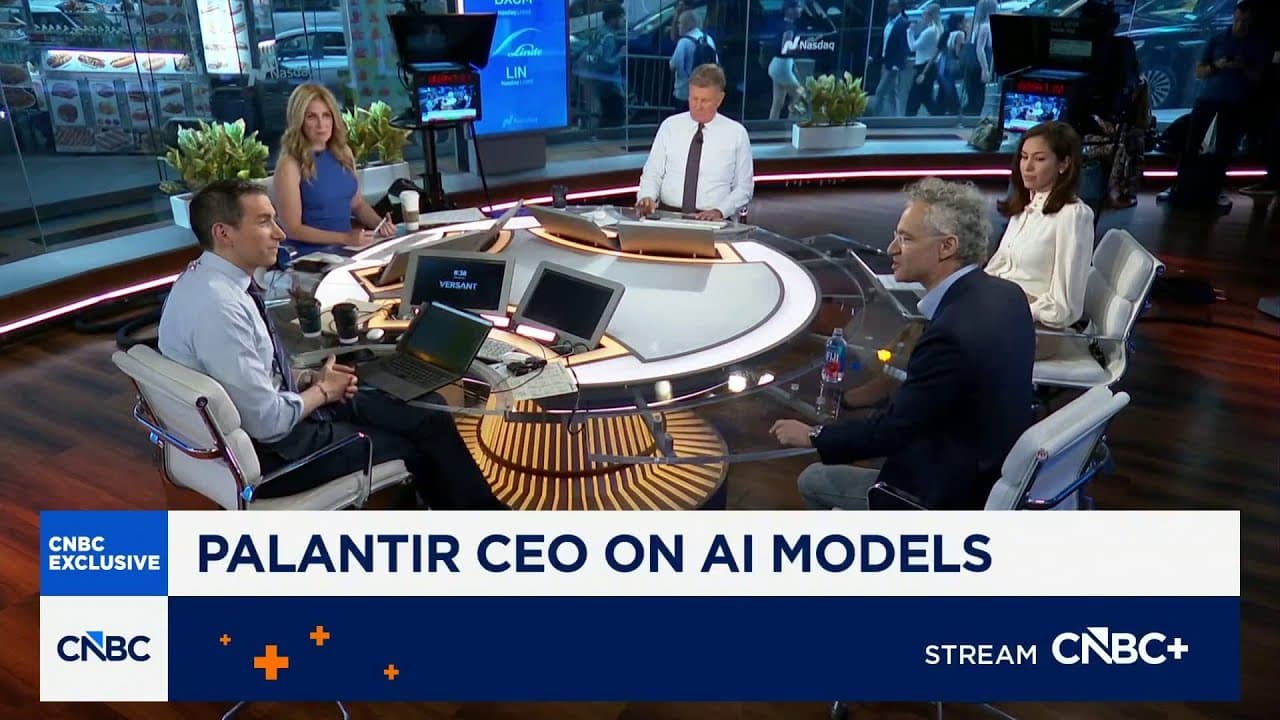
BUILD CUSTOM AI SYSTEMS FOR THE U.S. GOVERNMENT. THAT STOCK SHOOTING UP. IT'S UP AGAIN THIS MORNING UP ALMOST 6% THIS WEEK. AND JOINING US RIGHT NOW EXCLUSIVELY AT THE TABLE, ALEX KARP, PALANTIR'S CO-FOUNDER AND CEO. AND CNBC'S SEEMA MODY, WHO COVERS PALANTIR, JOINS US. AND TELL US ABOUT TELL US ABOUT THE DEAL WITH. THERE'S SO MANY THINGS I THINK W... Read More
Key Insights
- Palantir argues that data ownership and model weights must remain under client control to protect business alpha and prevent data leakage.
- The keynote highlights the need for an application layer built on Ontology to make LLMs safe, useful, and compliant with sensitive data.
- Enterprise mistrust of frontier AI arises from concerns about token-based costs that do not reflect true value or protect intellectual property.
- Karp describes a three-part stack—model, compute, and application layer—that must be integrated to deliver value while keeping control with clients.
- The talk emphasizes the importance of an agnostic deployment model that can switch between different models without transferring alpha.
- There is a call for greater transparency and accountability in how data is stored, cached, and governed during AI deployments.
- Karp warns that selling AI as a universal solution without safeguards could become a wealth tax on risk-averse enterprises.
- The conversation highlights a potential shift in the market toward open, secure, and locally governed AI ecosystems rather than centralized, opaque services.
- More videos from this channel:
- More from this channel: CNBC Television
Install to Summarize YouTube Videos and Get Transcripts
Explore YouTube Video Summarizer or Get YouTube Transcript Extractor
Questions & Answers
Q: What is the central problem Palantir CEO identifies with current AI sales?
The central problem identified is that enterprises feel exposed when AI is sold with tokens and external models, risking their data and intellectual property. Alex Karp argues that value comes from the combination of model control, an application layer, and compute, not from token costs alone. This distrust stems from concerns about data being cached, transferred, or misused and about who owns the weights and the means of production.
Q: How does Karp suggest AI should be deployed to protect alpha and data?
Karp proposes a deployment model where the client retains ownership of critical assets, including data and model weights, while the AI solution provides a secure application layer and compute. This approach would allow customers to switch models without losing control of their alpha or sensitive information, reducing risk for regulated and critical infrastructure contexts.
Q: What role does Ontology play in Palantir’s vision for AI?
Ontology is described as an application layer that makes large language models safe, precise, and useful by preventing data leakage and ensuring data is not cached or transferred in ways that expose IP. It acts as the governance and safety mechanism around the underlying models, enabling enterprise-grade reliability and control.
Q: Why is there anger about current AI sales practices according to the interview?
The anger stems from experiences where enterprises feel they are paying for ineffective token-based usage that yields little value while exposing their data and weights to external parties. Karp emphasizes that this practice monetizes risk without delivering secure, durable competitive advantage, which frustrates businesses that rely on AI as a strategic asset.
Q: What three components does Palantir say are needed for valuable AI, and why?
Palantir argues for the combination of a model, an application layer (Ontology), and compute as the core to delivering value. The model provides capability, the application layer ensures safety and governance, and compute delivers performance. Together, they keep alpha secure while enabling practical enterprise deployment.
Q: How does the discussion address trust in AI for critical infrastructure?
Trust is framed around ownership and control. The interview emphasizes that critical infrastructure users must know who owns the data, where it is stored and cached, and whether prompts are secure. By aligning on data governance and keeping weights in client control, trust can be reestablished in AI deployments for sensitive environments.
Q: What is the concern about exporting warfare-related AI capabilities, according to Karp?
Karp raises concerns about exporting AI that could transfer alpha to third parties or adversaries, particularly in classified or defense contexts. The implication is that without robust guardrails, AI tools could undermine national security or strategic advantages, underscoring the need for secure, auditable, and controlled deployments.
Q: What market shift does the interview imply for AI products and governance?
The interview implies a shift from token-based, opaque sales toward transparent, auditable AI ecosystems where clients own data, weights, and the means of production. This would favor products that are model-agnostic, secure, and capable of operating across different models while preserving client control and value.
Summary & Key Takeaways
-
Palantir’s approach centers on secure, auditable data handling and the need to keep data and weights under client control, not in the hands of vendors. This stance highlights a demand for transparency and control in enterprise AI deployments and suggests a shift toward operator-led compute and governance.
-
A major theme is the value of an application layer built on ontology that ensures safety and usefulness without compromising data. The discussion shows how control over data, models, and alpha differentiates trusted enterprise AI ecosystems from oversold, token-based sales.
-
The interview frames a broader critique of current AI sales practices, urging a move away from token-centric models toward architecture that preserves client ownership and reduces risk when deploying AI in critical infrastructure and regulated contexts.
Read in Other Languages (beta)
Share This Summary 📚
Summarize YouTube Videos and Get Video Transcripts with 1-Click
Try YouTube Summary with ChatGPT & Claude or YouTube Transcript Generator
Explore More Summaries from CNBC Television 📚






Summarize YouTube Videos and Get Video Transcripts with 1-Click
Try YouTube Summary with ChatGPT & Claude or YouTube Transcript Generator