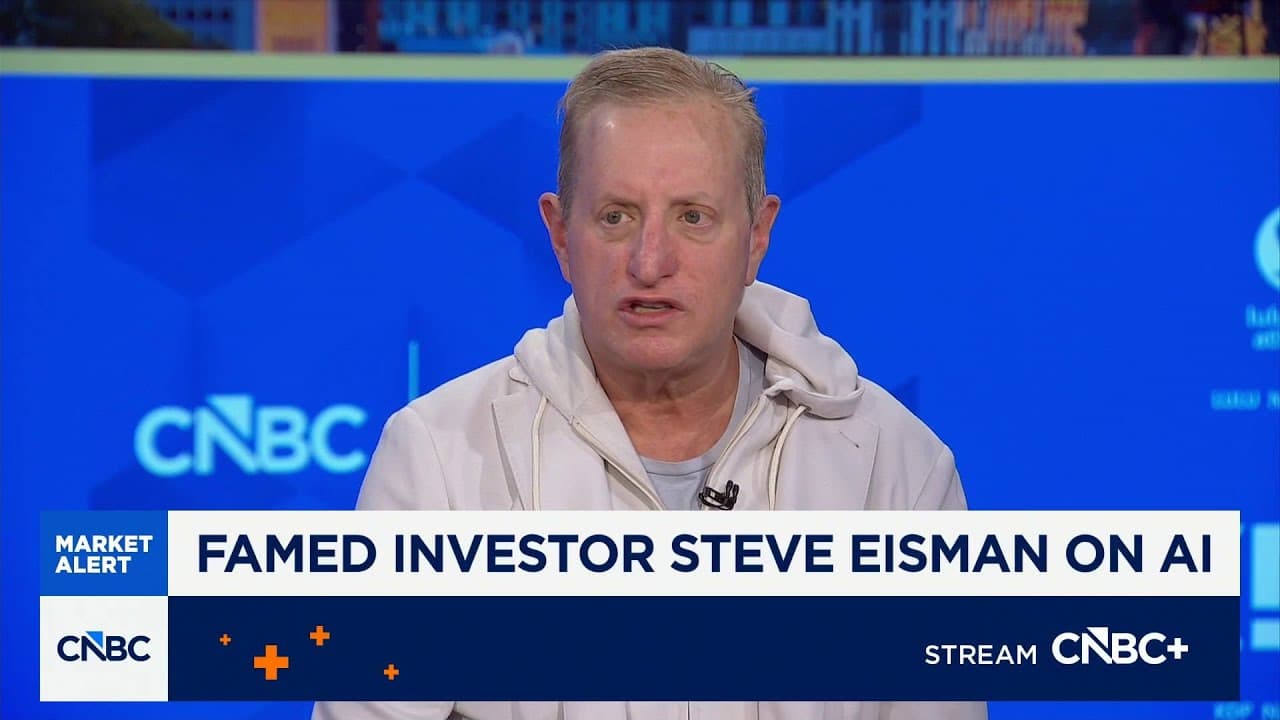
How to evaluate AI hype and regulation with Eisman
TL;DR
AI fears may be overstated, but there may be market concerns about the regulation and duopoly structure. Eisman argues that token mixing may be over and that open models could take market share, while safety narratives could be used to influence regulation. The future depends on OpenAI and Anthropic, with regulatory dynamics shaping the path.
Transcript
OF AMERICA CEO BRIAN MOYNIHAN SAID A DECLINE IN FIXED INCOME TRADING WOULD LIKELY TRANSLATE TO WHAT HE CALLED, QUOTE, RELATIVELY FLAT TRADING REVENUE FOR THE QUARTER. >> ALL RIGHT. JOINING US NOW IS STEVE EISMAN, A HOST OF THE REAL EISMAN PLAYBOOK PODCAST AND A FORMER SENIOR PORTFOLIO MANAGER AT NEUBERGER BERMAN. AND IF YOU'VE WATCHED STEVE'S APPEA... Read More
Key Insights
- AI fears may be overstated, yet regulatory narratives could shape market dynamics.
- OpenAI and Anthropic are pivotal to the AI ecosystem and the health of the AI investment chain.
- Token mixing and open weight models are viewed as shifting market shares away from traditional AI players.
- Companies may attempt to manufacture a crisis to gain regulatory advantages and MOATS.
- There is skepticism about artificial general intelligence and its near term impact on markets.
- Regulatory frameworks could lead to a duopoly that benefits the remaining large players.
- Open AI’s IPO timing and the relative strength of its competitors are seen as critical risks for the AI stack.
- Liability questions around AI agents are discussed, with emphasis on existing accountability for malfunctions.
- More videos from this channel:
- More from this channel: CNBC Television
Install to Summarize YouTube Videos and Get Transcripts
Explore YouTube Video Summarizer or Get YouTube Transcript Extractor
Questions & Answers
Q: A real search query question about the video (e.g. 'How to...', 'What is...', 'Why does...', 'When should...'). Question 1
How does Eisman view the AI hype cycle and the potential for regulation to shape market structure? He argues that there is no evidence of artificial general intelligence and that the industry may be attempting to create a crisis to influence regulation and build duopolies around moats, with the AI value chain depending on OpenAI and Anthropic.
Q: What does Eisman say about the role of OpenAI and Anthropic in the AI ecosystem?
Eisman states that the future health of the entire AI chain depends on OpenAI and Anthropic because a large percentage of the chain relies on them; if something happens to one of these two companies, the chain could fall apart, making their relative strength crucial for investors.
Q: Why does Eisman think the fear of AI is being exaggerated?
He suggests that the terminator narrative is nonsensical and that there is no evidence of artificial general intelligence currently, with the possibility that the concerns are being used to manipulate regulation and create strategic advantages rather than reflect imminent danger.
Q: What does Eisman say about token mixing versus open weight models?
He notes that token mixing is potentially over and that open weight models are taking big market share, implying a shift away from traditional AI architectures and affecting competitive dynamics within the AI sector.
Q: How does Eisman describe the potential regulatory strategy of AI companies?
He describes a scenario where companies manufacture a crisis to drive regulation that would create moats and a duopoly, thereby solidifying competitive advantages and long term control over AI markets.
Q: Does Eisman support slowing down AI development for safety reasons?
He suggests a cautious approach by recommending postponing an IPO rather than a blanket slowdown, indicating that while safety concerns exist, the immediate action is to delay financial moves to reassess risk and regulation.
Q: What implication does Eisman make about liability for AI agents?
He argues that liability exists now for human-like failures and questions why AI agents would be treated differently, implying that accountability should apply to AI actions if they cause harm or malfunction.
Q: What is the broader market risk in the AI stack according to Eisman?
The broader risk is that the entire AI chain depends on the health of major players like OpenAI and Anthropic; regulatory changes or failures at those firms could cause the ecosystem to weaken, affecting investments and market stability.
Summary & Key Takeaways
-
Eisman's take centers on the idea that AI fears are potentially overblown and that regulatory narratives may be manufactured to create moats. The discussion highlights the importance of the OpenAI and Anthropic duo in the AI ecosystem and the potential implications for market structure and investment risk.
-
The conversation examines safety concerns, regulatory capture, and the possibility that companies may use safety talk to influence policy while pursuing duopolistic control over AI markets.
-
A broader market view is presented, suggesting that the AI chain is sensitive to the health of the major players and that investors should consider how regulatory steps could alter competition and long term profitability.
Read in Other Languages (beta)
Share This Summary 📚
Summarize YouTube Videos and Get Video Transcripts with 1-Click
Try YouTube Summary with ChatGPT & Claude or YouTube Transcript Generator
Explore More Summaries from CNBC Television 📚
Summarize YouTube Videos and Get Video Transcripts with 1-Click
Try YouTube Summary with ChatGPT & Claude or YouTube Transcript Generator