How to Build Generative AI Skills from Scratch
TL;DR
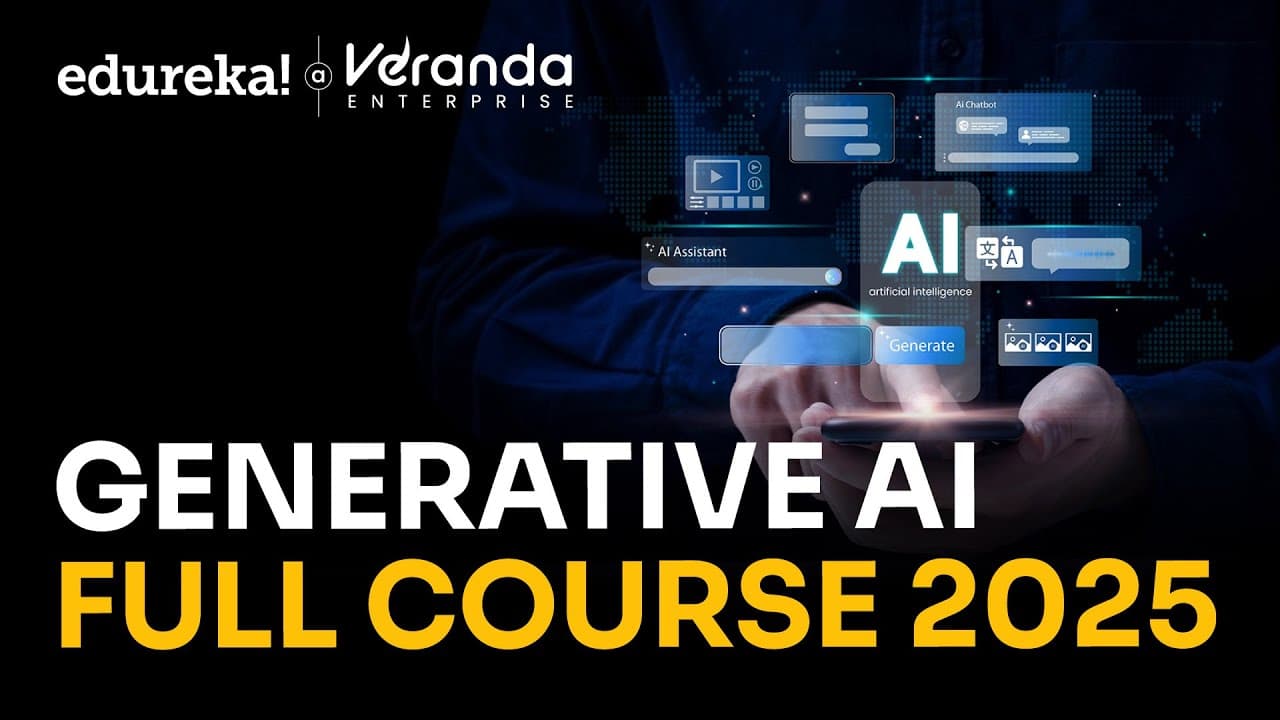
Generative AI creates new text, images, code, audio, and other content by learning patterns from prepared data. A practical learning path starts with AI, machine learning, and deep learning fundamentals, then progresses through neural networks, transformers, large language models, prompt engineering, LangChain, RAG, APIs, model evaluation, deployment, and hands-on application development.
Transcript
Hello everyone and welcome to the generative AI full course. Your comprehensive guide to mastering the future of artificial intelligence. In this course, you will dive deep into the rapidly evolving world of generative AI. Learning how machines create text, images, code, audio, and more. We will begin with the core concepts of AI, machine learning ... Read More
Key Insights
- Generative AI is a type of artificial intelligence that produces new content across formats such as text, images, code, audio, and music. Its practical uses include article generation, summarization, translation, writing improvement, coding assistance, personalized recommendations, business analysis, and automated customer support.
- A generative AI development cycle begins by defining a clear objective, gathering and preprocessing suitable data, and selecting an appropriate model. The remaining stages include training, evaluation, refinement, validation, deployment, and continued iteration based on new data and user feedback.
- Deep learning foundations are part of the path toward understanding generative AI. The course connects artificial intelligence and machine learning concepts with TensorFlow, convolutional neural networks, artificial neural networks, recurrent neural networks, Keras, large language models, GANs, and transformer-based generation.
- Prompt engineering is a practical method for directing generative models toward a desired result. The curriculum covers general prompting, prompts for code generation, prompt-engineering career preparation, and chatbot development, positioning clear instructions as an important part of building useful AI applications.
- Retrieval-augmented generation is included alongside LangChain as an application-development topic. The course places these subjects after large language models, transformers, prompt engineering, chatbots, and GitHub Copilot, establishing them as part of a broader workflow for constructing generative AI systems.
- The YouTube summarizer works by retrieving an available transcript, combining its individual text segments, and sending the resulting text to a generative model with a summarization instruction. The demonstrated prompt requests no more than 250 words and asks the model to highlight key points.
- The project environment uses Python 3.10, an isolated environment, an environment file, a requirements file, and an app.py file. Its listed dependencies support transcript extraction, a Streamlit interface, Google Gemini access, environment-variable loading, and improved path management.
- Generative AI adoption spans healthcare, education, marketing, technology, consulting, and other workplaces. The course anticipates continued growth in AI-assisted creativity, personalized experiences, real-time generation, architectural design, human-AI collaboration, and increasingly advanced models, while emphasizing continued refinement after deployment.
Install to Summarize YouTube Videos and Get Transcripts
Explore YouTube Video Summarizer or Get YouTube Transcript Extractor
Questions & Answers
Q: What is generative AI and what can it create?
Generative AI is a type of artificial intelligence that creates new content after learning patterns from data. The formats described in the course include text, articles, summaries, images, art, code, audio, music, and translations. It can also support writing improvement, business insights, automated assistance, personalized healthcare recommendations, educational experiences, marketing strategies, and other creative or productivity-focused tasks.
Q: How does the generative AI development process work?
The process starts with a clearly defined objective, such as generating text, creating images, or assisting with code. Developers then gather and preprocess data, choose or design an appropriate model, train it to learn patterns, and evaluate its output. After refinement, they test and validate performance against the objective, deploy the system, and continue improving it with feedback and additional data.
Q: What should beginners study before large language models?
Beginners can start with the fundamental relationships among artificial intelligence, machine learning, and deep learning. The course then introduces TensorFlow, convolutional neural networks, artificial neural networks, recurrent neural networks, and Keras before reaching large language models. This sequence provides background in model structures and deep learning tools before moving into GANs, transformers, prompting, retrieval, and application development.
Q: Which generative AI tools and frameworks does the course cover?
The course introduces ChatGPT, Midjourney, GitHub Copilot, DALL-E 3, GPT models, LangChain, RAG, Streamlit, the YouTube Transcript API, Google Gemini access, and the OpenAI API using Python. It also mentions Grammarly for writing support and H2O.ai as a platform that gives users access to machine learning models without requiring deep expertise.
Q: How can a YouTube video summarizer be built with generative AI?
A YouTube summarizer can be built by accepting a video URL, extracting its video identifier, and using the YouTube Transcript API to retrieve an available transcript. The application combines the transcript segments into one string, sends that text to a generative model with a summarization prompt, and displays the resulting summary through a user-friendly Streamlit interface.
Q: What setup is required for the YouTube summarizer project?
The demonstrated setup creates an isolated environment with Python 3.10 and adds an environment file, requirements.txt, and app.py. The requirements include the YouTube Transcript API, Streamlit, Google generative AI access, Python environment-variable handling, and a path-management library. A Google API key is created through the shown interface, stored as an environment variable, and loaded by the application.
Q: What is prompt engineering used for in generative AI?
Prompt engineering is used to communicate the required task and output expectations to a generative model. The course applies it to general model interaction, code generation, chatbot construction, and transcript summarization. In the summarizer example, the prompt asks for a summary in 250 words or less while highlighting key points, giving the model both a content goal and a length constraint.
Q: Where can generative AI be applied in real-world work?
Generative AI can support healthcare, education, marketing, technology, consulting, coding, writing, translation, music creation, architecture, and business operations. Examples include tailoring healthcare recommendations from individual patient data, creating personalized learning experiences, generating marketing content, assisting developers with code suggestions, improving grammar and tone, automating support, making business insights accessible, and helping architects with design and material optimization.
Summary & Key Takeaways
-
Generative AI can produce text, images, code, audio, music, translations, summaries, and business insights. Its applications include writing assistance, coding support, personalized healthcare, education, marketing, architecture, and automated support. The course presents these capabilities as tools for improving creativity, personalization, communication, productivity, and decision-making across multiple industries.
-
The course progresses from artificial intelligence fundamentals to deep learning technologies such as TensorFlow, convolutional neural networks, artificial neural networks, recurrent neural networks, and Keras. It then covers large language models, GANs, transformers, prompt engineering, GitHub Copilot, LangChain, RAG, image generation, Midjourney, the OpenAI API using Python, and marketing applications.
-
A hands-on project builds a YouTube summarizer with Python, Streamlit, the YouTube Transcript API, and Google Gemini access. The workflow creates an isolated environment, stores the API key in an environment file, installs required packages, extracts a video identifier, retrieves and combines transcript segments, prompts the model to summarize the transcript, and presents the result through an interface.
Read in Other Languages (beta)
Share This Summary 📚
Summarize YouTube Videos and Get Video Transcripts with 1-Click
Try YouTube Summary with ChatGPT & Claude or YouTube Transcript Generator
Explore More Summaries from edureka! 📚


![AWS Full Course - Solutions Architect [12 Hours] | AWS Certified Solutions Architect [2024] |Edureka thumbnail](/_next/image?url=https%3A%2F%2Fi.ytimg.com%2Fvi%2F5gnoVjpfWxU%2Fhqdefault.jpg&w=750&q=75)
Summarize YouTube Videos and Get Video Transcripts with 1-Click
Try YouTube Summary with ChatGPT & Claude or YouTube Transcript Generator