How to Write Better Prompts for Claude Fable
TL;DR
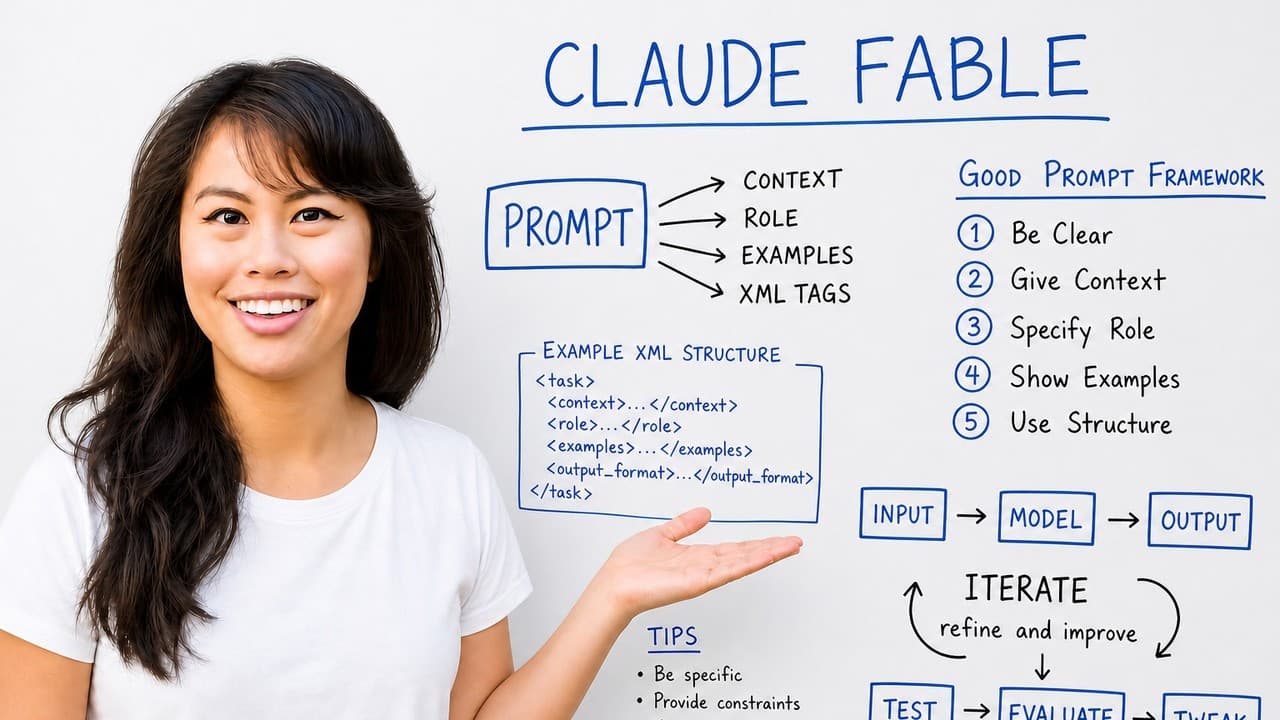
Give Claude Fable a clear goal, the reason behind the task, and explicit boundaries instead of prescribing a long sequence of steps. State what the output must accomplish, who it serves, what constraints apply, when the model should act, and where it must stop, allowing the model to reason while keeping its work focused and controlled.
Transcript
I'm going to show you three prompt tips for Claude Fable, Anthropic's smartest AI model ever. I sold my AI company for millions at 30, so I've spent a decade learning how to work with AI. And here's the twist with Fable, the best prompts are not what you think. Starting with number one, give Fable your goal, not the steps. Okay, so last week for ex... Read More
Key Insights
- Goal-based prompting gives Claude Fable freedom to choose its own method. The presenter reports that deleting 12 of 14 instructions from a content-pipeline prompt and retaining only the goal and constraints produced a better result than the original detailed version.
- Excessive procedural instructions can limit output to the user's preconceived solution. The recommended alternative is to describe the problem, define the desired outcome, and specify necessary limits without scripting every reasoning step the model should follow.
- Task context helps the model determine which information matters. A request should explain the larger assignment, identify the audience, and state what the resulting work must enable before presenting the specific action the model needs to perform.
- Audience and purpose can transform a generic summary into a targeted deliverable. In the presenter's example, context about a five-minute investor update caused the model to select three relevant statistics, surface one important risk, and omit unrelated details.
- A reusable context structure connects a request to its practical purpose. The proposed pattern states the larger task, names the audience, explains what that audience needs the output to enable, and then gives the specific request.
- A stop line explicitly defines work the model must not perform. For an investigation, the prompt can request diagnosis and findings while prohibiting code changes until the user reviews the evidence and approves a proposed fix.
- A go line prevents unnecessary planning and option overload. It tells the model to proceed once it has enough information and to provide one recommendation rather than returning a broad survey of every alternative it considered.
- Clear boundaries define the model's job without removing its reasoning freedom. Combining a goal, relevant context, constraints, a stop condition, and an action threshold helps focus the work while reducing unwanted refactoring or overly broad changes.
Install to Summarize YouTube Videos and Get Transcripts
Explore YouTube Video Summarizer or Get YouTube Transcript Extractor
Questions & Answers
Q: How should I prompt Claude Fable for better results?
State the outcome you want, explain why the task matters, and identify the constraints that must be respected. Avoid dictating a long series of intermediate reasoning steps. Include the larger task, the intended audience, and what the output should enable. Then add boundaries describing when the model may act and what it must not do without further approval.
Q: Why can shorter prompts work better with Claude Fable?
Shorter prompts can work better when they remove unnecessary procedures but preserve the goal, context, and constraints. The presenter reports that a detailed content-pipeline prompt containing 14 steps performed worse than a version retaining only two lines. The explanation offered is that rigid instructions restrict the model to the user's planned method instead of allowing it to determine an effective approach.
Q: What does giving Claude Fable the goal instead of the steps mean?
Giving the goal means describing the problem to solve and the result that must be achieved without prescribing every intermediate action. For example, the prompt can request a fix for crashes involving uploads over 100 megabytes, require a small change, and ask for a test. The model remains responsible for determining how to investigate and complete that bounded task.
Q: Why should a prompt explain the reason behind a request?
The reason tells the model which details deserve attention and which can be omitted. Without that context, the model may attempt to cover everything and produce a generic response. When the presenter framed a report summary as a five-minute update for non-technical investors evaluating funding, the result emphasized three relevant statistics, highlighted one important risk, and removed less useful material.
Q: What context template can make an AI request more specific?
The proposed template begins by stating the larger task, then identifies the audience and explains what the output must help that audience do. The specific request comes afterward. Applied to a report, the context could describe preparation for a five-minute update, name non-technical investors as the audience, state that they need to make a funding decision, and finally request the summary.
Q: What is a stop line in a Claude Fable prompt?
A stop line is an explicit boundary that prevents the model from taking actions beyond the current assignment. If the task is to investigate a login problem, the prompt can ask for a diagnosis and a report while stating that no code may be changed until approval is given. This separates evidence gathering from implementation and keeps the user in control of consequential changes.
Q: What is a go line in a Claude Fable prompt?
A go line tells the model when it has enough information to move forward and what kind of result to deliver. The video's example instructs the model to provide one recommendation once sufficient information has been collected, rather than listing every possible option. This reduces prolonged planning while still leaving the model free to investigate before reaching its conclusion.
Q: How can I prevent Claude Fable from changing too much code?
Narrow the requested scope and explicitly separate diagnosis from implementation. Ask the model to investigate the specific bug, report its findings, and wait for approval before modifying code. Add constraints such as keeping any eventual change small, and include a go line requesting one recommendation when enough evidence exists. These instructions limit unrequested refactoring without prescribing the entire technical method.
Summary & Key Takeaways
-
Effective prompts for Claude Fable focus on the desired result and essential constraints rather than prescribing every intermediate step. The presenter reports that replacing a detailed content-production prompt with only its goal and limits produced better output, arguing that excessive instructions can restrict the model to the user's planned approach.
-
Useful context explains the larger task, identifies the intended audience, and states what decision or action the output should support. In the report example, mentioning a five-minute update for non-technical investors led the model to prioritize three relevant statistics, highlight one important risk, and remove material that did not serve that purpose.
-
Explicit boundaries control an agentic model's tendency either to keep planning or to expand the task. A stop line can require diagnosis without modification until approval, while a go line can instruct the model to act once it has enough information and return one recommendation instead of surveying every possible option.
Read in Other Languages (beta)
Share This Summary 📚
Summarize YouTube Videos and Get Video Transcripts with 1-Click
Try YouTube Summary with ChatGPT & Claude or YouTube Transcript Generator
Explore More Summaries from Sabrina Ramonov 🍄 📚






Summarize YouTube Videos and Get Video Transcripts with 1-Click
Try YouTube Summary with ChatGPT & Claude or YouTube Transcript Generator