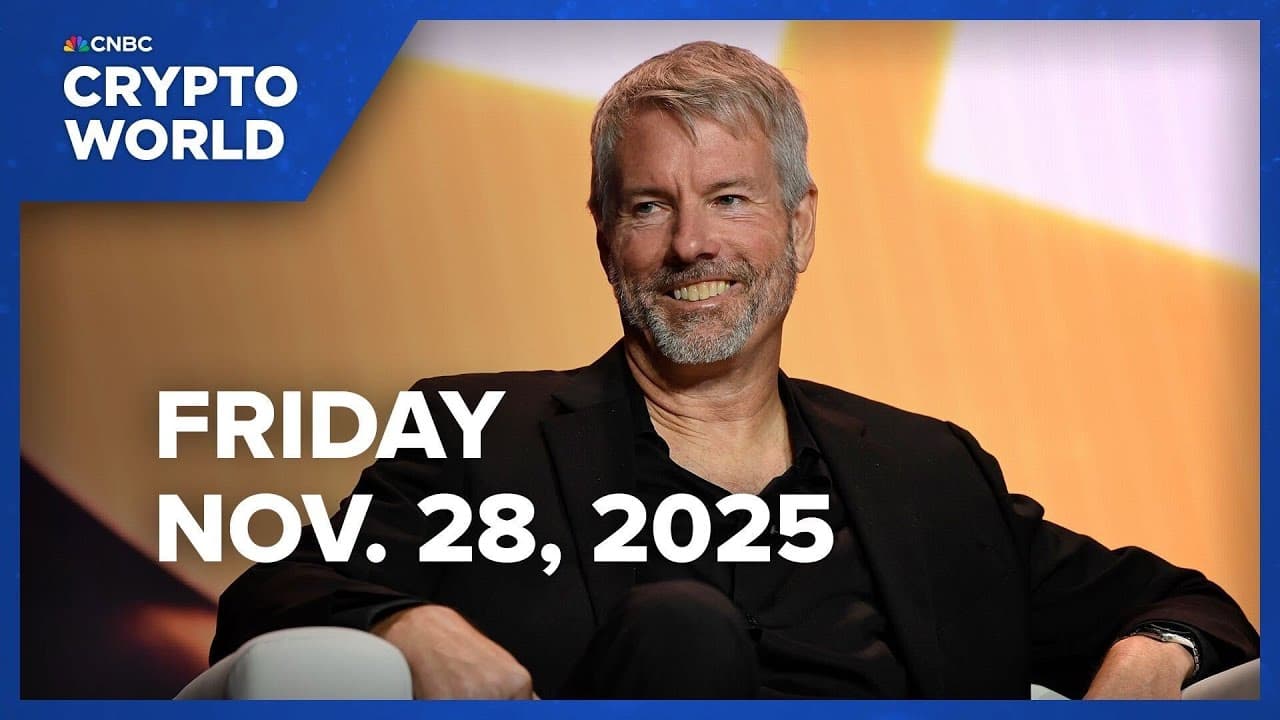
Michael Saylor on Whether Bitcoin's Four-Year Cycle Is Dead
TL;DR
The four-year Bitcoin cycle no longer drives the market because the supply impact of each halving is now tiny relative to daily trading liquidity. Saylor argues the real drivers are structural: banks custodying Bitcoin and extending credit against it, loosened derivatives rules, and traditional finance embracing the asset heading into 2026.
Transcript
Today's strategies Michael Sailor provides his outlook for Bitcoin in 2026. Welcome to CNBC's Crypto World. I'm Talia Kaplan. Crypto investors are taking advantage of the last few trading days in November. By noon Eastern, cryptocurrency prices were mixed as we come off the Thanksgiving holiday here in the US. As we look at the week, Bitcoin and Et... Read More
Key Insights
- Saylor's outlook for Bitcoin in 2026 is bullish, driven mainly by bank acceptance and credit development within the banking network rather than by supply mechanics.
- The four-year cycle is losing relevance because the amount of Bitcoin removed from supply at each halving is now immaterial compared with the volume Bitcoin trades in a single day.
- Structural demand is the primary driver: banks extending credit against IBIT, and the SEC loosening derivatives restrictions, sharply expanded open interest and institutional exposure.
- Digital credit is the emerging story, where Bitcoin serves as digital capital backing credit instruments, and Saylor's firm positions itself as a leading issuer in that market.
- Only a small number of treasury companies issue digital credit, while the large majority simply hold crypto assets; Saylor names Strive and MetaPlanet as fellow digital-credit issuers.
- Regulatory and political support in 2025, including backing from the SEC, CFTC, Treasury, and the President, reduced the risk that made public companies previously hesitant to hold Bitcoin.
- Fair value accounting was a pivotal reform, letting companies mark Bitcoin gains up on their balance sheets instead of only recording losses, creating a competitive advantage to holding it.
- The digital assets industry splits into two hemispheres: Bitcoin-based digital capital with digital credit as its killer app, and digital finance built on tokenized currencies, securities, and assets.
Install to Summarize YouTube Videos and Get Transcripts
Explore YouTube Video Summarizer or Get YouTube Transcript Extractor
Questions & Answers
Q: Is Bitcoin's four-year cycle dead according to Michael Saylor?
Saylor largely agrees it is fading. He explains the four-year cycles are based on the Bitcoin halving, which mattered greatly in the asset's early years because the supply being cut was material relative to market demand. Today, with Bitcoin trading enormous volumes in a single day, the halving's supply impact is minor, ranking as roughly a third-order issue rather than a primary driver of price.
Q: What is Michael Saylor's outlook for Bitcoin in 2026?
His outlook is bullish. He says the exciting developments are bank acceptance and credit development within the banking network. Many large US banks have started extending credit against IBIT, and firms including Charles Schwab and City have announced plans to custody Bitcoin and extend credit against it in the first half of 2026. He believes this banker acceptance, willingness to custody, trade, and lend against Bitcoin should catapult the asset class to new levels.
Q: What are the primary drivers of Bitcoin's price now if not the halving?
Saylor says the primary drivers are structural developments in the market. Banks extending large amounts of credit dwarf the supply impact of the halving. He notes that when the SEC loosened restrictions on derivatives trading on IBIT, open interest expanded dramatically in a matter of weeks, reflecting substantial demand rooted in the traditional finance establishment embracing the asset, supported by regulatory changes that enhance that support.
Q: How does Saylor view other digital asset treasury companies copying his strategy?
He does not see them as a threat and welcomes them. Saylor is a proponent of any company holding Bitcoin as digital capital and balance-sheet reserve, calling it good for the company, for Bitcoin, and for the crypto economy. Since his firm has evolved into issuing digital credit against underlying Bitcoin, more companies buying Bitcoin benefits both Bitcoin and his business, so he treats the many followers as helpful rather than competition.
Q: What is digital credit and why does Saylor emphasize it?
Digital credit uses Bitcoin as digital capital to back credit instruments. Saylor frames the perfect product as a bank account paying far more than money-market rates, offering meaningful additional yield over the risk-free rate in any major currency. He argues digital credit is several times more compelling than traditional credit instruments for people seeking fixed income, which is why he calls it the real story going forward and the market's most exciting idea.
Q: Why are so many companies adopting Bitcoin treasury strategies now?
Saylor attributes the surge to reduced uncertainty and a supportive environment. Before the political shift, many public companies feared entering the space. Now a supportive administration has designated Bitcoin as digital gold and voiced ambitions to be a crypto superpower, with backing from the SEC, CFTC, Treasury, and President. Combined with fair value accounting letting firms mark gains on their balance sheets, holding Bitcoin became a structural competitive advantage for risk-averse public companies.
Q: How did fair value accounting change Bitcoin adoption by companies?
Fair value accounting was a major reform, according to Saylor. It means that when a company generates gains on Bitcoin, it is allowed to mark them up on its balance sheet. Before that change, companies could only record losses and never recognize gains. Once accounting was reformed and regulators began supporting the asset, it became clear that holding Bitcoin gave public companies a structural competitive advantage, since Bitcoin has been growing strongly compared with slower-growing alternatives.
Q: Why invest in Strategy versus spot crypto ETFs like a Bitcoin ETF?
Saylor describes two hemispheres of the digital assets industry. His company sits on the Bitcoin side, offering digital capital and credit instruments. He says if you want to hold digital gold forever, or want amplified exposure through digital credit, you would buy his equity. The other hemisphere is digital finance, whose killer applications are tokenized currencies, securities, memes, and brands, an area that has expanded rapidly under a supportive crypto administration.
Summary & Key Takeaways
-
Saylor gives a bullish 2026 Bitcoin outlook, crediting bank acceptance and credit development as the exciting developments. Large US banks have begun extending credit against IBIT, and firms like Charles Schwab and City have announced plans to custody Bitcoin and extend credit against it in the first half of 2026.
-
He argues the four-year halving cycle is fading because the supply cut at the next halving is negligible against Bitcoin's daily trading liquidity. The real forces are structural: bank credit, loosened derivatives rules that expanded IBIT open interest, and broad traditional-finance embrace of the asset.
-
Saylor frames digital credit as the future story, with Bitcoin as digital capital powering credit instruments far more compelling than traditional fixed income. He splits the industry into Bitcoin-based digital capital and digital finance built on tokenized currencies, securities, and brands, both boosted by supportive regulation.
Read in Other Languages (beta)
Share This Summary 📚
Summarize YouTube Videos and Get Video Transcripts with 1-Click
Try YouTube Summary with ChatGPT & Claude or YouTube Transcript Generator
Explore More Summaries from CNBC Television 📚




Summarize YouTube Videos and Get Video Transcripts with 1-Click
Try YouTube Summary with ChatGPT & Claude or YouTube Transcript Generator