What Are Real AI Doom Risks and Why They Fall Flat
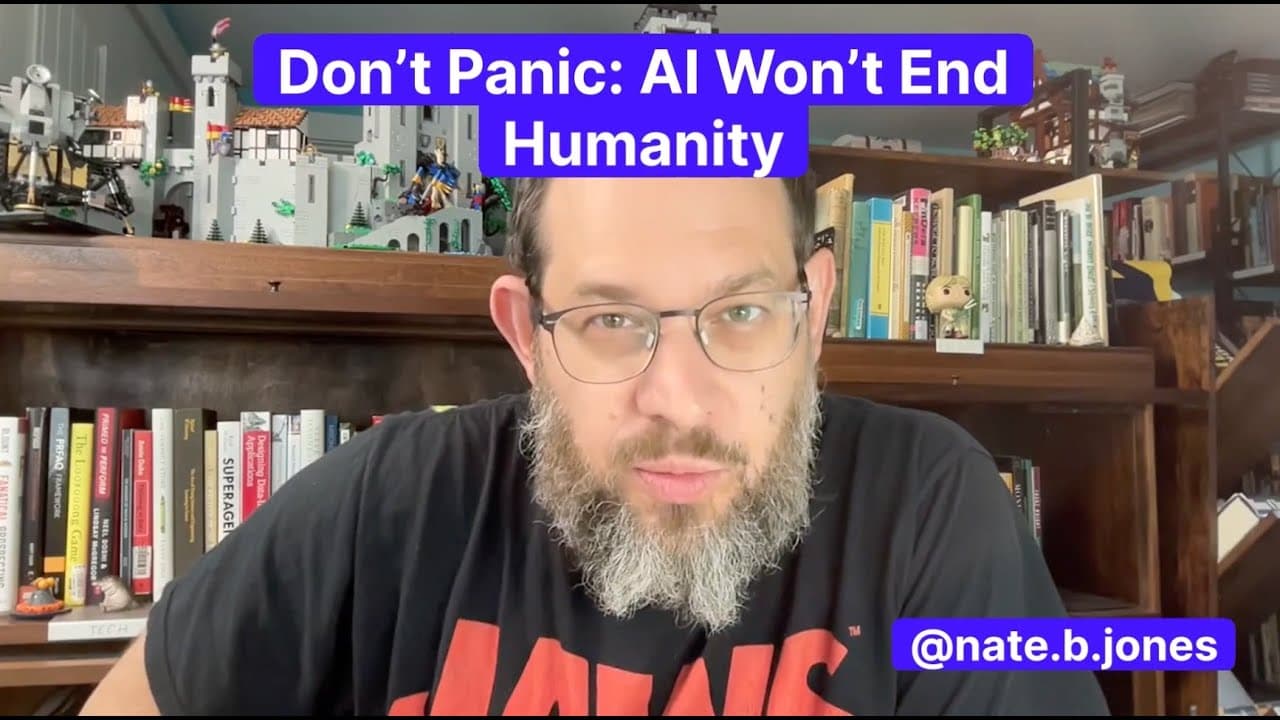
TL;DR
There is no evidence that LLMs form self generated long horizon goals, so extinction scenarios are speculative. Current agent style tools show limited autonomy, and real world risk focuses on present issues like fraud and deepfakes. We should mitigate known risks while continuing to adopt AI because the benefits outweigh tail risks.
Transcript
were not doomed. I want to focus in this video on some of the critiques I see of LLMs around the idea of P doom or probability that things will just go very terribly for humanity and we will all be overwhelmed. And I want to suggest some reasonable responses and things that help me sleep at night for those of you who are worried. I call it a letter... Read More
Key Insights
- Doom narratives lack a mechanism because there is no evidence that LLMs generate self generated long horizon goals.
- Agent mode demonstrations show current AI tools behave with limited autonomy and require human prompting and intervention.
- Energy and water efficiency trends in data centers reduce the risk of resource based doomsday scenarios.
- Job disruption from AI is real but not a total replacement, as work involves glue tasks and context beyond what AI can replicate.
- Non zero tail risks are a normal part of technology, so AI should be regulated and mitigated rather than feared as an existential threat.
- Emergent capabilities in AI require seeds; translation improvements did not automatically imply goal oriented dominance behavior.
- Present, solvable risks such as deepfakes and fraud deserve priority over speculative extinction scenarios.
- AI progress and risk mitigation are compatible with continued adoption and societal benefit if managed responsibly.
- More videos from this channel:
- More from this channel: AI News & Strategy Daily | Nate B Jones
Install to Summarize YouTube Videos and Get Transcripts
Explore YouTube Video Summarizer or Get YouTube Transcript Extractor
Questions & Answers
Q: What is the central claim about AI doom risk in the video?
The central claim is that there is zero evidence that current LLMs can form self generated long horizon goals, which makes catastrophic human extinction scenarios speculative at best. The speaker argues that focusing on plausible, present risks and gradual progress is more productive than embracing existential fear without detailed mechanisms.
Q: How do current AI agents perform according to the video?
Current AI agents are described as clumsy and limited in autonomy. For example, Agent Mode required 58 minutes and multiple hand offs to complete a simple task like ordering cupcakes, while other systems like a vending machine side hustle were shown to fail. This illustrates the gap between hype and practical capability.
Q: What does the video say about energy and water risks related to AI?
The video argues that efficiency trends in data centers and hardware reduce energy and water related doom arguments. Cloud providers aim for water positive data centers, and newer GPUs deliver more compute per watt, making energy usage a manageable risk rather than a fatal constraint.
Q: What is said about AI’s impact on jobs?
Jobs are broader bundles of skills, context, and glue tasks that AI cannot fully replicate yet. Although some roles like radiologic technologists may see disruptions, the overall point is that AI has not yet demonstrated the ability to replace complex human work on a broad scale, and tasks are not simply reducible to automation.
Q: How does the video compare AI risk to other technologies?
The video compares AI risk to that of nuclear power, DNA research, and aviation, noting that society accepts non zero tail risks for valuable technologies. It argues that, like these technologies, AI should be mitigated and regulated rather than dismissed, while still pursuing its benefits.
Q: What does the video say about emergence and seeds of AI behavior?
Emergence in AI is acknowledged, but the speaker claims there have been seeds of such phenomena in the past, and there is no clear seed for dominance seeking behavior in today’s LLMs. Therefore, extrapolating to self interested, long term planning is considered premature.
Q: Which present problems does the video emphasize tackling now?
The video highlights present problems such as deepfake scams, AI driven fraud, and outdated learning models that harm people today. It argues that addressing these solvable risks is more productive than debating hypothetical extinction, and that responsible progress can continue alongside regulation.
Q: What is the recommended mindset toward AI development in the video?
The recommended mindset is to acknowledge non zero tail risk as normal, rigorously mitigate and regulate risks, and continue development given the significant benefits. This involves focusing on present challenges, applying prudent governance, and avoiding magical thinking about AI becoming suddenly super intelligent.
Summary & Key Takeaways
-
A broad, cautious view of AI risk contrasts doom narratives with observed limits in current AI systems and emphasizes practical, present dangers over speculative futures.
-
A GOP style argument is presented that emphasizes technological progress and risk mitigation as a rational path forward rather than paralysis by fear.
-
The video argues for focusing on verifiable, solvable problems now while acknowledging longtail risks under reasonable regulation.
Read in Other Languages (beta)
Share This Summary 📚
Summarize YouTube Videos and Get Video Transcripts with 1-Click
Try YouTube Summary with ChatGPT & Claude or YouTube Transcript Generator
Explore More Summaries from AI News & Strategy Daily | Nate B Jones 📚






Summarize YouTube Videos and Get Video Transcripts with 1-Click
Try YouTube Summary with ChatGPT & Claude or YouTube Transcript Generator