What Is the Impact of Pacific Gas & Electric v. Drayage on Contract Law?
TL;DR
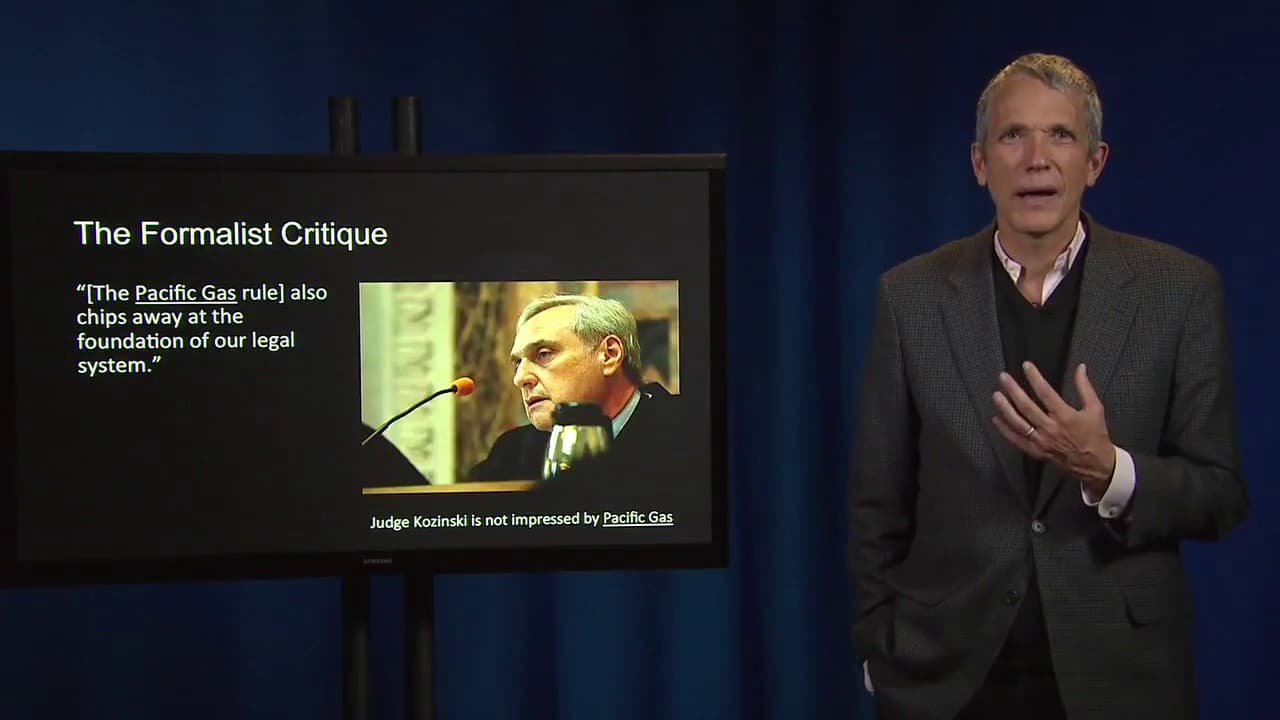
The Supreme Court of California ruled that extrinsic evidence is admissible to interpret a contract even if it appears unambiguous, provided the language is reasonably susceptible to different meanings. In the Pacific Gas & Electric v. Thomas Drayage case, the court reversed a lower court decision, emphasizing that the admissibility of such evidence is determined by its relevance in clarifying the contract's intent.
Transcript
congratulations on surviving the last lectures on the parole Evidence Rule today we're going to talk about contractual interpretation in Pacific Gas and Electric versus Thomas drayage a 1968 California Supreme Court case the parties disagreed about the meaning of a provision in the contract one side argued that the provision was clear from its plai... Read More
Key Insights
- 😀 In California, extrinsic evidence can be introduced to interpret a contract even if it appears unambiguous on its face.
- 👍 The admissibility of extrinsic evidence depends on whether it is relevant to prove a meaning that the language of the contract is reasonably susceptible to.
- 👻 Judge Alex Kozinski has criticized the Pacific Gas rule, arguing that it allows for attacks on contracts through self-serving testimony.
Install to Summarize YouTube Videos and Get Transcripts
Explore YouTube Video Summarizer or Get YouTube Transcript Extractor
Questions & Answers
Q: What was the main issue in the case of Pacific Gas and Electric vs. Thomas Drayage?
The main issue in the case was the interpretation of a contract provision regarding indemnification for property damage.
Q: How did the trial court initially rule in the case?
The trial court excluded the defendant's parole evidence and found in favor of the plaintiff.
Q: What was the Supreme Court of California's decision in the case?
The Supreme Court of California reversed the trial court's decision and held that the parole evidence was admissible.
Q: What did Chief Justice Roger Traynor state regarding the admissibility of extrinsic evidence?
Chief Justice Traynor stated that the test for admissibility of extrinsic evidence is whether it is relevant to prove a meaning to which the language of the contract is reasonably susceptible.
Summary & Key Takeaways
-
The case of Pacific Gas and Electric vs. Thomas Drayage involved a dispute over the interpretation of a contract provision regarding indemnification for property damage.
-
The trial court excluded the defendant's parole evidence and found in favor of the plaintiff, but the Supreme Court of California reversed the decision.
-
Chief Justice Roger Traynor, who wrote the court's decision, stated that the test for admissibility of extrinsic evidence is whether it is relevant to prove a meaning to which the language of the contract is reasonably susceptible.
Read in Other Languages (beta)
Share This Summary 📚
Summarize YouTube Videos and Get Video Transcripts with 1-Click
Try YouTube Summary with ChatGPT & Claude or YouTube Transcript Generator
Explore More Summaries from YaleCourses 📚

Summarize YouTube Videos and Get Video Transcripts with 1-Click
Try YouTube Summary with ChatGPT & Claude or YouTube Transcript Generator