Big Data Engineer Bootcamp Review: GCP and Azure
TL;DR
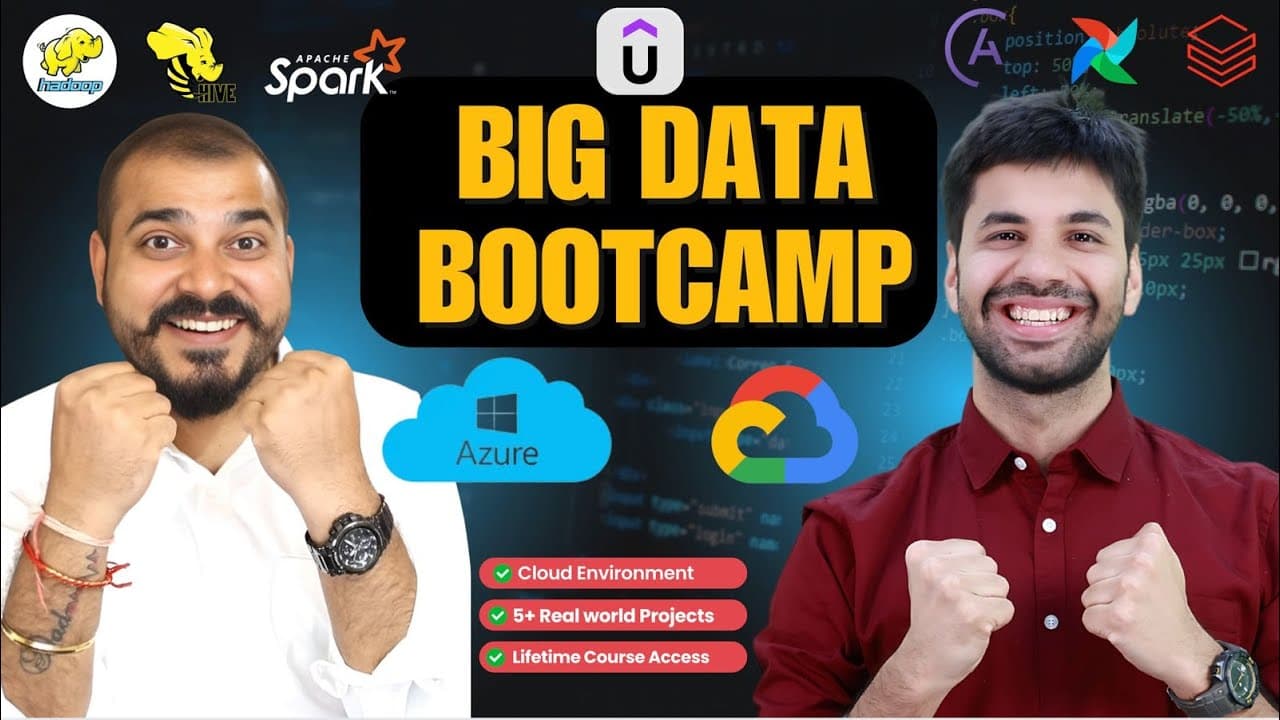
A new Udemy Big Data Engineering Bootcamp taught by Krish Naik and Mayank Aggarwal is live for 399 INR using coupon FEBRUARY01. It covers roughly 70 hours of content (expanding toward 100) spanning Python, SQL, Hadoop, Spark, Kafka, Airflow, Databricks, and Azure, with end-to-end projects practiced on Google Cloud.
Transcript
hello all my name is krishak and welcome to my YouTube channel so guys I am super pumped and super excited to announce the launch of our new udmi course that is big data engineering boot camp with gcp and Azure Cloud now this was one of the most requested batch by many of my students who are specifically in Udi and in my YouTube channel right and t... Read More
Key Insights
- The Big Data Engineering Bootcamp is designed for everyone, from freshers and college students to experienced professionals, and includes practical implementation and multiple end-to-end industry-grade projects rather than being limited to advanced learners.
- The course currently holds around 70 hours and 6 minutes of content, with more material planned to bring the total to approximately 100 hours, reflecting deep coverage of each technology.
- SQL and Python are the two core prerequisites, described as bread and butter for any data field, and both are taught from scratch, including data structures, logging, functions, database handling, and pandas.
- Apache Spark receives the most time in the course because it is one of the most important tools right now, and it is taught using PySpark, covering Spark tables, Spark SQL, and caching.
- Google Cloud is the chosen practice environment because it offers $400 of free credits and a 3-month trial, letting learners work at a production-ready level without spending money.
- A data engineer's role begins as soon as data starts flowing into a company, building ETL or ELT pipelines to extract, transform, and load raw data so it can be served to analysts, scientists, and stakeholders.
- Google Cloud Dataproc is the main service used to create production-level Hadoop clusters, with equivalents being EMR in AWS and HD Insight in Azure, though EMR setup is less straightforward.
- The curriculum spans a full big data stack including Hadoop architecture, HDFS, MapReduce, YARN, Spark, Hive, Kafka, Docker, Airflow ETL pipelines, Databricks, and Azure cloud use cases.
Install to Summarize YouTube Videos and Get Transcripts
Explore YouTube Video Summarizer or Get YouTube Transcript Extractor
Questions & Answers
Q: How much does the Big Data Engineering Bootcamp cost and how do I enroll?
The course is live on Udemy for 399 INR as an introductory offer. According to the description, it became available after 24 hours of review from the Udemy team, and learners can enroll through the provided Udemy course link. The coupon code FEBRUARY01 is applied to get the 399 INR price. The creators ask enrollees to leave 5-star ratings and reviews to support the course.
Q: Who teaches the Big Data Engineering Bootcamp?
The course is mentored by Krish Naik, who runs the YouTube channel making the announcement, and Mayank Aggarwal. The two have collaborated on multiple previous courses ranging from Big Data to Python with DSA. Mayank references extensive work experience at companies like OYO Rooms, Goldman Sachs, and Mindtree, as well as consulting for many startups, which informs the road map taught in the course.
Q: What topics does the Big Data Engineering Bootcamp cover?
The bootcamp begins with Python fundamentals, databases with Python, logging, and MySQL prerequisites. It then covers big data topics including Hadoop architecture, HDFS architecture, Hadoop Dataproc, Google Cloud Platform, Hadoop MapReduce, and YARN. A large portion is devoted to Apache Spark, followed by Spark tables, Spark SQL, and caching. It also includes Hive, Kafka, Docker, Airflow ETL pipelines, Databricks, and Azure cloud use cases with end-to-end projects.
Q: What are the prerequisites for becoming a big data engineer according to the course?
The two major prerequisites are SQL and Python. SQL is described as bread and butter for anyone working in a data field, since you connect with databases and data warehouses and must know how to query data. Python is important because Spark is taught using PySpark. The course covers both from scratch, including basics, internal data structures, logging, functions, database handling, and pandas, so learners can work with data independently.
Q: Why does the course use Google Cloud for practice instead of a local setup?
Big data cannot be handled on a local laptop because it deals with data far larger than MBs or GBs. Google Cloud is chosen because it gives $400 of free credits and a 3-month trial period, letting learners practice at a production-ready level without spending anything. The instructor notes that a local setup for big data is difficult and not even valid, since technologies should be practiced the way they are used in real life.
Q: What does a data engineer actually do?
A data engineer's role starts as soon as data begins flowing into a company. Companies have many data sources, and the engineer serves that data to end consumers such as data analysts, data scientists, and stakeholders. To do this they follow an ETL or ELT pipeline, extracting raw data, transforming it, and loading it into an internal database. The goal is ensuring raw data is served in a proper, usable manner.
Q: How much course content is included and how long is it?
The overall content is currently around 70 hours and 6 minutes, according to Krish Naik. He notes that additional content is planned that will bring the total to approximately 100 hours. A significant amount of time is spent explaining Apache Spark because it is one of the most important tools right now. The course also includes industry-grade projects, with one project running about 3 hours 24 minutes and another around 2 hours 25 minutes.
Q: How does Google Cloud compare to AWS and Azure for big data practice?
The main Google Cloud service used is Dataproc, where you can create a production-level Hadoop cluster. Similar technologies are EMR in AWS and HD Insight in Azure. However, setting up EMR is not that straightforward, and Azure typically provides only a 1-month trial period, which the instructor considers too short for the course's depth. Google Cloud was chosen because it is easiest to set up, gives $400 in credits, and offers a 3-month practice window.
Summary & Key Takeaways
-
Krish Naik announces the launch of a new Udemy course, the Big Data Engineering Bootcamp with GCP and Azure Cloud, co-taught with Mayank Aggarwal. It was one of the most requested batches by students and is built to serve freshers, college students, and experienced professionals through practical, project-based learning.
-
The content starts with Python fundamentals, databases, logging, and MySQL prerequisites, then moves into big data topics like Hadoop architecture, HDFS, Dataproc, MapReduce, YARN, and Apache Spark. Spark is emphasized heavily, followed by Spark tables, Spark SQL, caching, Hive, Kafka, Docker, Airflow, Databricks, and Azure.
-
Mayank explains the data engineer road map, showing how engineers build ETL or ELT pipelines to serve data to analysts and scientists. Google Cloud is used for practice because it gives $400 credits and a 3-month trial, enabling production-level work at no cost to the learner.
Read in Other Languages (beta)
Share This Summary 📚
Summarize YouTube Videos and Get Video Transcripts with 1-Click
Try YouTube Summary with ChatGPT & Claude or YouTube Transcript Generator
Explore More Summaries from Krish Naik 📚




Summarize YouTube Videos and Get Video Transcripts with 1-Click
Try YouTube Summary with ChatGPT & Claude or YouTube Transcript Generator