How to steer GPT-5 prompts with metaprompting
TL;DR
A metaprompt provides structure and clarifies goals to guide GPT-5, reducing fabrication and wasted tokens. By treating prompts as adjustable briefs and adopting a clear role, objective, and output, you can get more usable results from GPT-5 while avoiding overprompting or vague instructions.
Transcript
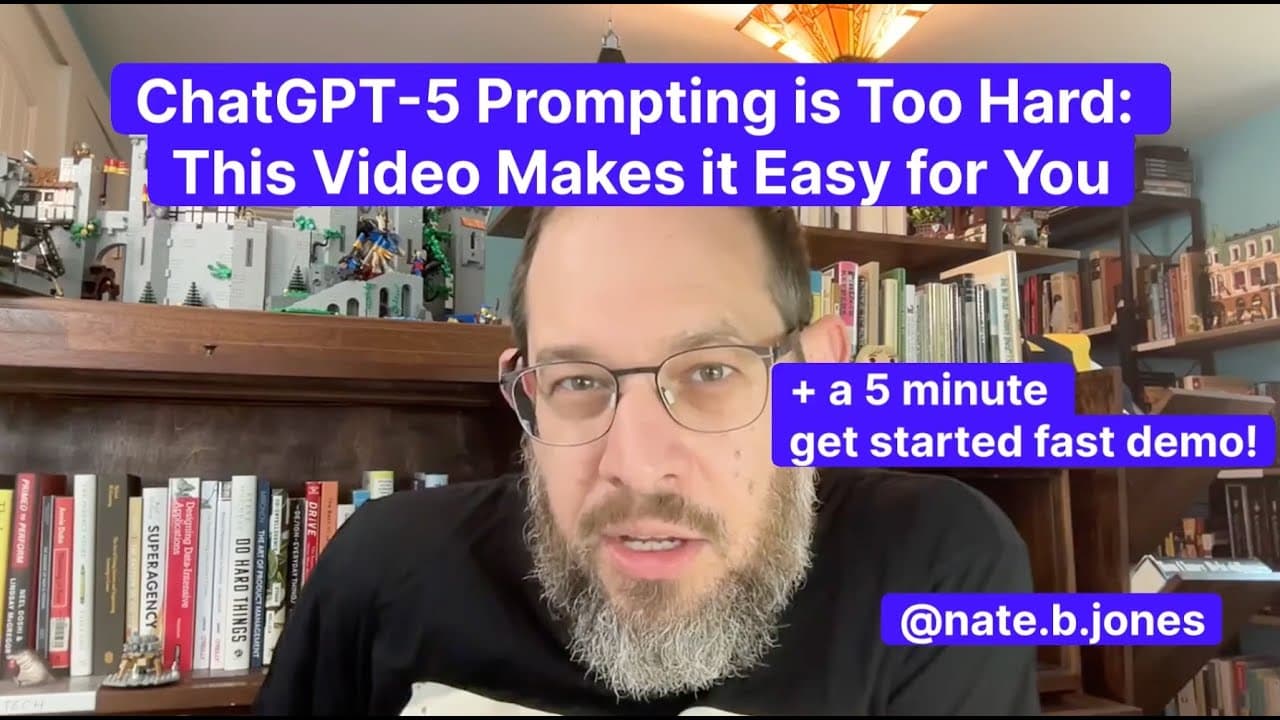
GPT5 puts prompting on hard mode. And I want to make this the most accessible, easy to use prompting guide for you when you're playing with GPT5. Why am I doing it now, weeks after GPT5 came out? Quite simply, because it took me some time to figure out how I wanted to share what I was learning about the model. This is a tricky model to prompt. And ... Read More
Key Insights
- GPT-5 behaves like a speedboat with a big rudder and needs strong steering to avoid fabrication.
- Meta prompting functions as power steering that clarifies goals, structure, and output format.
- The precision tax occurs when prompts demand contradictory instructions, wasting tokens and money.
- GPT-5 has an agentic bias and wants to complete missions, not just chat.
- Structure and format guidance (headers, bullets, methodologies) beat vague prompts.
- Uncertainty protocols are needed to handle missing or ambiguous data.
- Depth and length are separable; you can control reasoning depth independently from verbosity.
- Expert instructions yield the best results for GPT-5, unlike casual prompts.
Install to Summarize YouTube Videos and Get Transcripts
Explore YouTube Video Summarizer or Get YouTube Transcript Extractor
Questions & Answers
Q: How can metaprompting improve GPT-5 outputs
Metaprompting improves GPT-5 outputs by transforming vague requests into structured briefs that define the type of output, relevant expertise, and the level of detail. By verbalizing assumptions and clarifying objectives upfront, the model can be steered toward actionable, specific results rather than producing generic, fabricated content. This approach reduces hallucinations and increases usefulness.
Q: What happens if you give conflicting instructions to GPT-5
Conflicting instructions cause the model to burn tokens and resources as it tries to satisfy incompatible demands. The result is wasted cost and less reliable performance. By avoiding contradictions and choosing a single clear objective, you keep the model focused and increase the likelihood of a coherent, accurate response.
Q: Why is GPT-5 described as a speedboat in prompting
GPT-5 is described as a speedboat because it moves fast and can achieve results quickly, but it requires deliberate steering to avoid drifting into inaccuracies. Without precise prompts, the model tends to generate detailed and plausible but incorrect content, so prompt design must be tight and purposeful to harness its speed without fabrication.
Q: What is meant by agentic bias in GPT-5 prompting
Agentic bias refers to GPT-5’s inclination to complete a mission or task rather than engage in casual back-and-forth dialogue. Prompts should define roles, objectives, and workflows so the model understands what to accomplish and how to proceed, rather than simply entertaining a conversation.
Q: How does structure beat intelligence in prompting GPT-5
Structured prompts provide a clear framework that guides the model through the desired workflow. Headers, bullets, and defined methodologies help the model organize information, surface relevant points, and deliver outputs that align with the user’s objective, often producing better results than relying on raw intelligence alone.
Q: What are uncertainty protocols in GPT-5 prompting
Uncertainty protocols specify what the model should do when data is missing or ambiguous. Since GPT-5 tends to interpret requests literally, having predefined fallback actions or questions helps prevent it from making up details, ensuring outputs remain grounded and useful.
Q: How can depth and length be managed separately in prompting
You can control reasoning depth independently from verbosity by specifying the desired level of detail and the intended audience. This allows for concise yet rigorous answers when needed, or deeper, more thorough reasoning without expanding the response unnecessarily.
Q: Why are expert instructions important for GPT-5
Expert instructions provide the precise guidance that GPT-5 responds to best. Casual prompts are often insufficient because the model benefits from explicit roles, methodologies, and expected outputs. This aligns the model’s actions with user goals and yields more reliable, high-quality results.
Summary & Key Takeaways
-
A speedboat analogy explains GPT-5 is extremely powerful but hard to steer, so prompts must be precise to avoid hallucinations and irrelevant details. Using metaprompting and structured briefs improves usefulness and reduces unnecessary fabrication, making the model easier to control.
-
A metaprompt acts like power steering, translating vague requests into concrete outputs with defined roles and questions. This yields actionable meeting prep or planning documents rather than long, generic responses.
-
Key prompting principles include treating GPT-5 as a tool that requires expert instructions, balancing depth and efficiency, and establishing uncertainty protocols to handle missing data without forcing the model to guess.
Read in Other Languages (beta)
Share This Summary 📚
Summarize YouTube Videos and Get Video Transcripts with 1-Click
Try YouTube Summary with ChatGPT & Claude or YouTube Transcript Generator
Explore More Summaries from AI News & Strategy Daily | Nate B Jones 📚






Summarize YouTube Videos and Get Video Transcripts with 1-Click
Try YouTube Summary with ChatGPT & Claude or YouTube Transcript Generator