What Are DeepMind's Latest AI Breakthroughs?
TL;DR
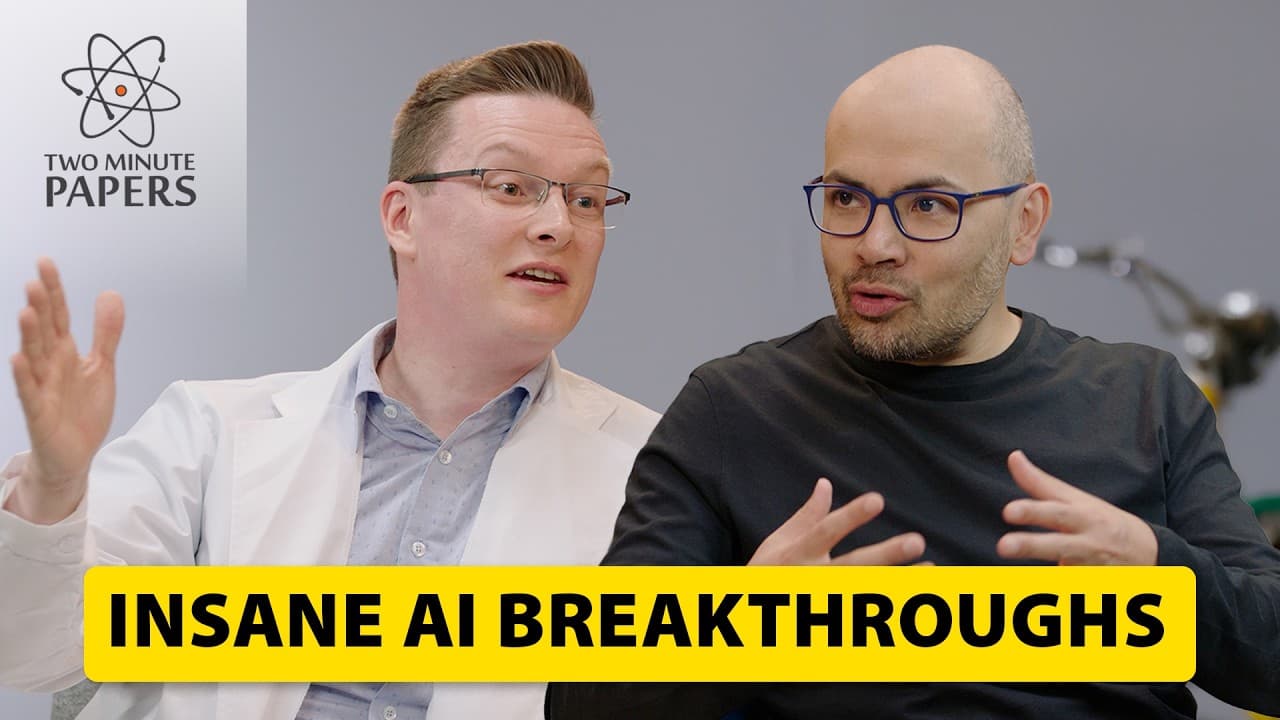
DeepMind's AI, including Gemini and Co-Scientist, is revolutionizing fields like healthcare and research. Gemini has been used to analyze medical data with impressive accuracy, while Co-Scientist assists in hypothesis generation and data analysis. These tools aim to speed up research and potentially transform drug discovery processes. The future of AI in science looks promising, with potential breakthroughs expected in the coming years.
Transcript
weak and easy questions. Please try to answer in one sentence, sometimes one word. >> Oh, wow. That's hard. Um, >> Fineman or Newton. >> Oh, wow. That's even harder. >> Dennis, I don't know if I told you, but my mother recently got some health scan results. It was a massive video file, and we had to wait for weeks for the evaluation, and we were re... Read More
Key Insights
- Gemini AI is being used to analyze medical data, providing accurate assessments that have been verified by doctors.
- Co-Scientist is a fine-tuned version of Gemini, designed to assist with hypothesis generation and data analysis in scientific research.
- DeepMind's AI tools are contributing to advancements in drug discovery, potentially speeding up the development of new treatments.
- AI-designed drugs could revolutionize the pharmaceutical industry, but regulatory processes need to adapt to these innovations.
- The integration of AI in games, like the partnership with EVO Night, offers a sandbox for testing AI interactions with complex systems.
- AI could help in automating lab processes, providing faster validation of scientific hypotheses and experiments.
- DeepMind's AI aims to replicate successes like AlphaFold in other areas, potentially leading to breakthroughs in multiple scientific domains.
- The future of AI in science is promising, with expectations of significant advancements and potential cures for diseases within the next decade.
Install to Summarize YouTube Videos and Get Transcripts
Explore YouTube Video Summarizer or Get YouTube Transcript Extractor
Questions & Answers
Q: How is DeepMind's Gemini AI used in healthcare?
Gemini AI is used to analyze medical data, such as health scans, providing accurate assessments that have been verified by doctors. This capability has been particularly beneficial in offering timely and precise evaluations, helping to alleviate patient anxiety and potentially saving lives by providing crucial health insights.
Q: What is the function of DeepMind's Co-Scientist AI?
Co-Scientist is a specialized version of Gemini AI, designed to assist researchers in hypothesis generation and data analysis. It acts as a research assistant, helping scientists to explore new areas, summarize literature, and generate new hypotheses, thus accelerating the research process and enhancing scientific discovery.
Q: How could AI impact drug discovery processes?
AI has the potential to revolutionize drug discovery by predicting protein interactions, absorption, and toxicity, which are critical steps in developing new drugs. By building models that simulate these processes, AI can expedite the drug development timeline, potentially leading to faster discovery and approval of new treatments.
Q: What challenges do AI-designed drugs face in regulatory processes?
AI-designed drugs face challenges in regulatory processes due to the need for extensive validation and testing. Regulatory bodies like the FDA require evidence of safety and efficacy, which can be a lengthy process. However, successful AI-designed drugs could eventually streamline these processes by providing reliable data and predictions.
Q: How is AI being integrated into gaming through DeepMind's partnership?
DeepMind's partnership with EVO Night involves integrating AI into gaming as both a participant and a game master. This collaboration creates a sandbox environment for testing AI interactions with complex systems, such as player alliances and in-game economies, offering insights into AI behavior in dynamic settings.
Q: What are the future prospects of AI in scientific research?
The future of AI in scientific research is promising, with expectations of significant advancements in areas like drug discovery, healthcare, and material science. AI tools are expected to lead to breakthroughs by automating complex processes, improving efficiency, and potentially discovering new scientific principles and cures for diseases.
Q: How does DeepMind's AI compare to previous scientific breakthroughs like AlphaFold?
DeepMind's AI aims to replicate the success of AlphaFold, which accurately predicted protein structures, in other scientific domains. By developing advanced models for various stages of drug discovery and other scientific processes, DeepMind hopes to achieve similar breakthroughs, accelerating research and discovery across multiple fields.
Q: What role could AI play in automating laboratory processes?
AI could play a significant role in automating laboratory processes by providing faster validation of scientific hypotheses and experiments. Automated labs using AI could streamline data collection and analysis, allowing researchers to focus on hypothesis generation and interpretation, thus enhancing the overall efficiency of scientific research.
Summary & Key Takeaways
-
DeepMind's AI, such as Gemini and Co-Scientist, is making significant strides in healthcare and research. Gemini has accurately analyzed medical scans, verified by doctors, showcasing its potential in medical diagnostics. Co-Scientist assists researchers in hypothesis generation and data analysis, enhancing scientific processes.
-
The integration of AI in drug discovery is poised to transform the pharmaceutical industry. AI tools could expedite the development of new treatments, though regulatory processes need to evolve to accommodate these innovations. DeepMind's AI aims to replicate the success of AlphaFold in other scientific areas.
-
AI's role in gaming, such as the partnership with EVO Night, provides a unique testing ground for AI interactions in complex systems. The future of AI in science looks promising, with potential breakthroughs expected in the coming years, possibly leading to cures for diseases within a decade.
Read in Other Languages (beta)
Share This Summary 📚
Summarize YouTube Videos and Get Video Transcripts with 1-Click
Try YouTube Summary with ChatGPT & Claude or YouTube Transcript Generator
Explore More Summaries from Two Minute Papers 📚


Summarize YouTube Videos and Get Video Transcripts with 1-Click
Try YouTube Summary with ChatGPT & Claude or YouTube Transcript Generator