How Did This Adorable Baby T-Rex AI Learn to Dribble? 🦖
TL;DR
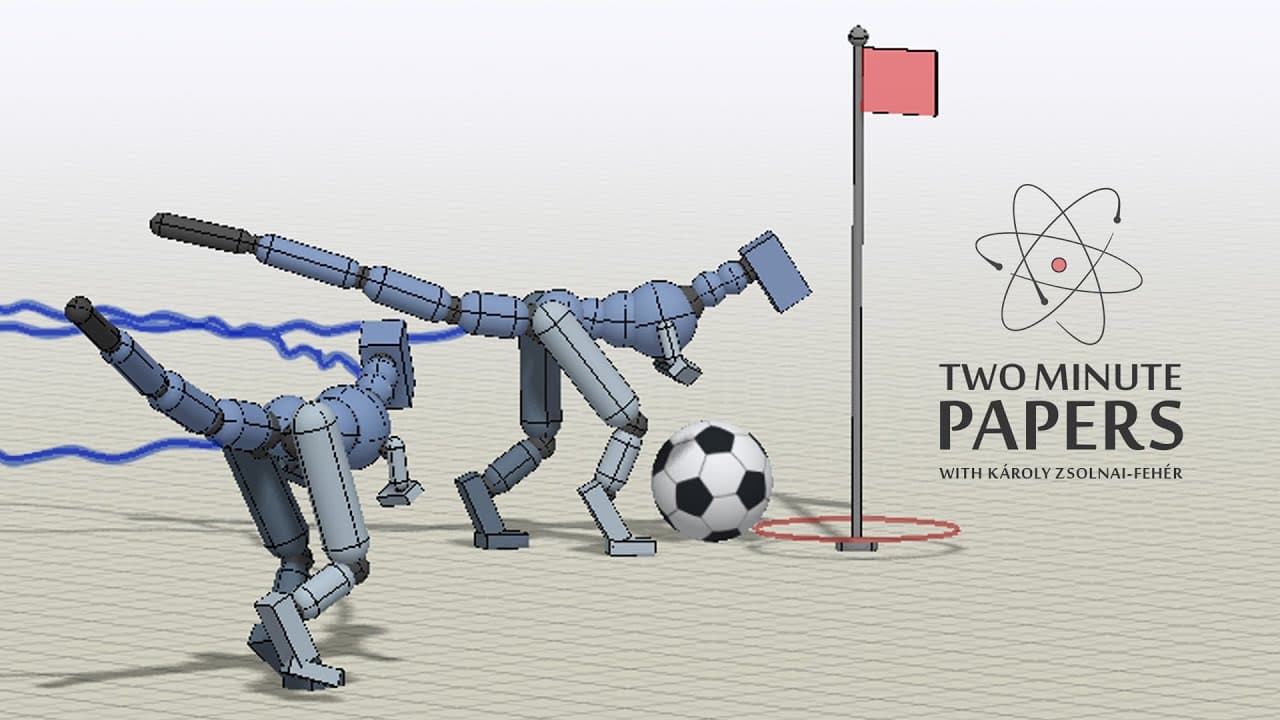
This adorable baby T-Rex AI learned to dribble by combining elementary movements through multiplicative composition policies. After characters learn reference motions from these reusable components, the components can be transferred to tasks such as carrying and stacking boxes, dribbling, and scoring a goal without training each character from scratch. Read on to discover how the technique works and why the paper’s 55-kilogram T-Rex is called a baby.
Transcript
Dear Fellow Scholars, this is Two Minute Papers with Károly Zsolnai-Fehér. About 350 episodes ago in this series, in episode number 8, we talked about an amazing paper in which researchers built virtual characters with a bunch of muscles and joints, and through the power of machine learning, taught them to actuate them just the right way so that th... Read More
Key Insights
- 🧑🏫 Machine learning can be used to teach virtual characters complex movements.
- 🍳 Multiplicative composition policies break down actions into elementary movements.
- 👻 Transferability of compositions allows for the reuse of movements in different scenarios.
- 🧑🏫 Virtual characters can be taught a variety of actions, including carrying and stacking boxes.
- 😌 This research lies at the intersection of computer graphics and machine learning.
- 💻 Linode offers GPU instances for AI, scientific computing, and computer graphics projects.
- 🏃 Linode provides a simple and reliable hosting service for running experiments and deploying works.
Install to Summarize YouTube Videos and Get Transcripts
Explore YouTube Video Summarizer or Get YouTube Transcript Extractor
Questions & Answers
Q: How did the adorable baby T-Rex AI learn to dribble?
The T-Rex learned through multiplicative composition policies that break complex actions into elementary movements. The learning technique finds useful combinations of these components, enabling the character to perform tasks such as dribbling.
Q: What are multiplicative composition policies?
They are policies for controlling virtual characters by breaking complex actions into elementary movements. The transcript compares these components to small Lego pieces that can be combined to build something much more complex.
Q: How are the elementary movements combined into useful actions?
The characters first learn to perform reference motions using combinations of elementary movement components. The learning process determines which components are used and when during the current movement pattern.
Q: Why are compositional movement policies useful?
Their key advantage is that the elementary movement components are simple enough to be transferred and reused for other movements. This lets a new agent or an existing character access previously learned components instead of being trained from scratch.
Q: What tasks can the virtual characters perform with this technique?
The footage shows a biped and a T-Rex carrying and stacking boxes, dribbling, and scoring a goal. Earlier approaches also taught virtual characters to walk, lift weights, jump high, and change their movements after surgery.
Q: How much does the baby T-Rex character weigh?
According to the paper as described in the transcript, the T-Rex weighs 55 kilograms, or 121 pounds. That relatively low stated weight is why the presenter calls it an adorable baby T-Rex.
Q: Does a character need to be trained from scratch for every new movement?
No. Because the elementary movement components are transferable, a new agent or an existing character can reuse them when learning new moves rather than starting from scratch.
Q: What research fields does this virtual-character technique combine?
The work sits at the intersection of computer graphics and machine learning. Machine learning teaches virtual characters how to actuate their muscles and joints to produce movements.
Summary & Key Takeaways
-
Researchers have made advancements in teaching virtual characters to learn movements like walking, lifting weights, and jumping through machine learning.
-
Complex actions are broken down into a sum of elementary movements, similar to building with lego pieces.
-
These compositions are transferable and can be reused for other types of movements, eliminating the need to train characters from scratch.
Read in Other Languages (beta)
Share This Summary 📚
Summarize YouTube Videos and Get Video Transcripts with 1-Click
Try YouTube Summary with ChatGPT & Claude or YouTube Transcript Generator
Explore More Summaries from Two Minute Papers 📚

Summarize YouTube Videos and Get Video Transcripts with 1-Click
Try YouTube Summary with ChatGPT & Claude or YouTube Transcript Generator