What Is Proximal Policy Optimization (PPO) and How Does It Work?
TL;DR
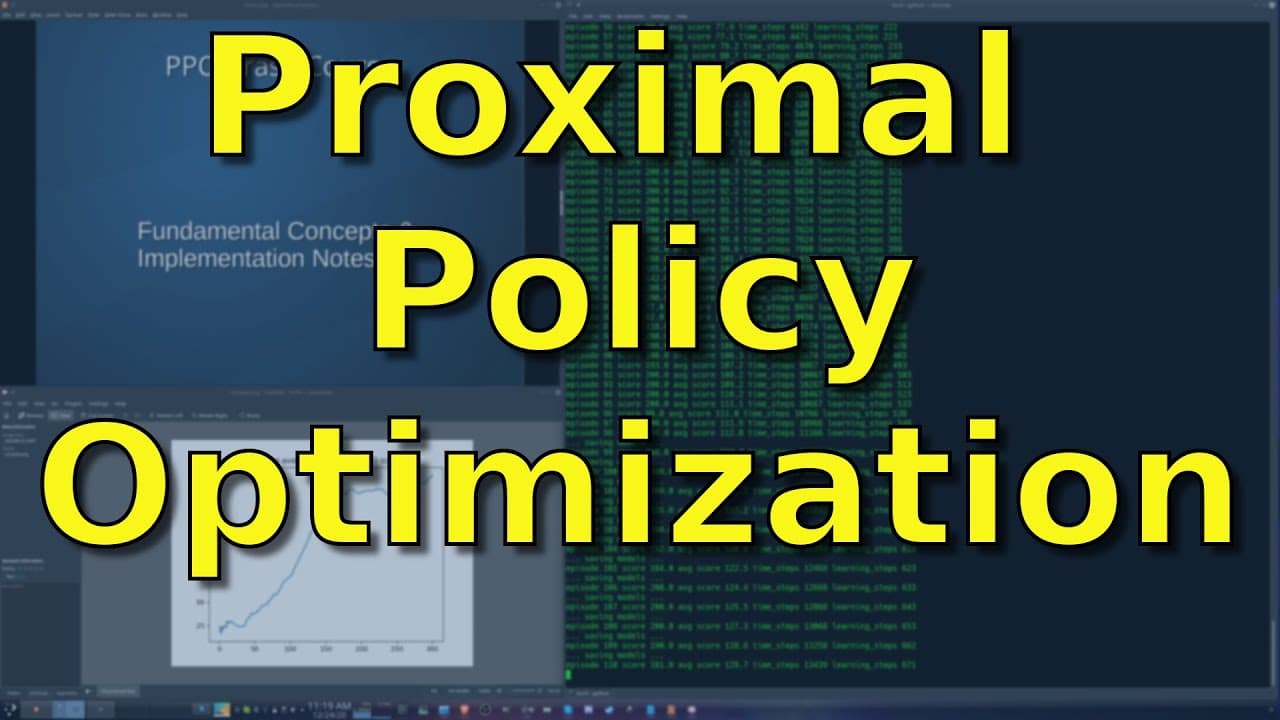
Proximal Policy Optimization (PPO) addresses performance degradation in actor-critic methods by limiting updates to the policy network and incorporating state advantages. It utilizes small fixed-length trajectory memory and multiple updates per data sample through mini-batch stochastic gradient descent while employing separate networks for the actor and critic, ensuring stable policy updates and improved learning efficiency.
Transcript
welcome to a crash course in proximal policy optimization before we begin a quick shameless plug my udemy courses on deep reinforcement learning specifically after critic methods and deep q learning are on sale right now learn how to turn papers into code link in the description below so proximal policy optimization or ppo for short was created for... Read More
Key Insights
- 🧑🏭 PPO addresses the performance degradation issue in actor critic methods by limiting updates to the policy network and considering the advantage of each state.
- 😒 PPO uses a small fixed-length trajectory memory and performs multiple network updates per data sample using mini-batch stochastic gradient descent.
- 🧑🏭 Two distinct networks are used for the actor and critic in PPO, with the actor selecting actions based on state probabilities and the critic evaluating states.
- 🥶 The update rule for the actor network involves constraining the ratio of the new policy to the old policy and clipping the loss function to prevent large parameter jumps.
Install to Summarize YouTube Videos and Get Transcripts
Explore YouTube Video Summarizer or Get YouTube Transcript Extractor
Questions & Answers
Q: Why do actor critic methods often experience a performance drop?
Actor critic methods are sensitive to small changes in neural network parameters, which can cause large jumps in policy space. This sensitivity leads to sudden drops in performance when updates are made to the neural network.
Q: How does PPO address the performance degradation issue in actor critic methods?
PPO limits the updates to the policy network by constraining the ratio of the new policy to the old policy within a specific range. It also takes into account the advantage of each state to select profitable states and clips the loss function to prevent excessive growth.
Q: How does PPO handle memory and network updates?
PPO uses a small fixed-length trajectory memory to store states, actions, rewards, and other information. It performs multiple network updates per data sample using mini-batch stochastic gradient descent to improve learning efficiency.
Q: What is the difference between the actor and critic networks in PPO?
The actor network selects actions based on the current state and outputs probabilities using a softmax activation. The critic network evaluates states and outputs the value of each state. PPO uses two separate networks for simplicity, but a shared input with multiple outputs can also be used.
Summary & Key Takeaways
-
PPO was developed to address the performance degradation issue in actor critic methods, where small changes in neural network parameters can cause a significant drop in performance. PPO limits updates to the policy network and utilizes the advantage of each state to select profitable states.
-
PPO uses a small fixed-length trajectory memory instead of randomly sampling from a large number of transitions. It also performs multiple network updates per data sample using mini-batch stochastic gradient descent.
-
PPO implements two distinct networks for the actor and critic, with the critic evaluating states and the actor selecting actions based on state probabilities.
-
The update rule for the actor network involves calculating the ratio of old policy to new policy and constraining it within a specific range to avoid large parameter jumps. The advantage of each state is taken into account and the loss function is clipped to prevent excessive growth. The critic network uses the mean squared error between the return and the critic value as its loss function.
Read in Other Languages (beta)
Share This Summary 📚
Summarize YouTube Videos and Get Video Transcripts with 1-Click
Try YouTube Summary with ChatGPT & Claude or YouTube Transcript Generator
Explore More Summaries from Machine Learning with Phil 📚

Summarize YouTube Videos and Get Video Transcripts with 1-Click
Try YouTube Summary with ChatGPT & Claude or YouTube Transcript Generator