How to Understand Artificial Intelligence and ML
TL;DR
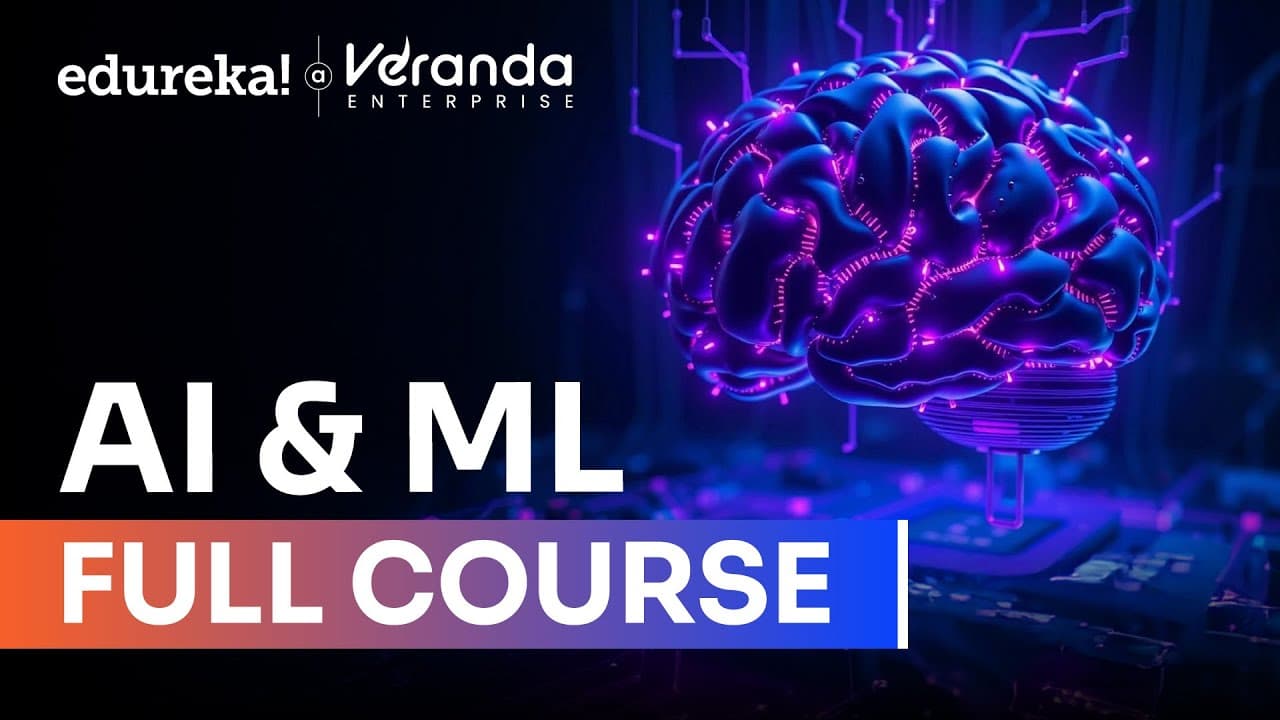
Artificial intelligence analyzes data, identifies patterns, improves through learning, and supports decisions, predictions, and automated tasks. Most current systems are narrow AI built for specific functions, while general and super intelligence represent broader stages discussed in the course. Effective AI development also requires attention to fairness, privacy, security, employment, control, and regulatory compliance.
Transcript
Hello everyone and welcome to the AI and machine learning full course. Your complete guide to understanding how intelligent systems learn from data and make decisions. This course will take you through the core concepts, algorithms, and tools that power today's AIdriven world. You will start by learning the fundamentals of artificial intelligence a... Read More
Key Insights
- Artificial intelligence is a branch of computer science focused on systems that perform tasks normally associated with human intelligence, such as understanding language, recognizing patterns, making decisions, learning from experience, detecting objects, and solving complex problems.
- The Turing test is a method proposed by Alan Turing in 1950 to examine whether a machine can display humanlike intelligence. A human evaluator communicates through text with a person and a machine, then judges whether their responses can be distinguished.
- Narrow AI is designed to perform a specific task or a narrowly defined group of functions. The course identifies Siri, Alexa, AlphaGo, Sophia, and self-driving cars as examples, and states that almost all AI systems built so far belong to this category.
- Artificial general intelligence is presented as a stage in which machines would possess intelligence comparable to humans. Such systems would be expected to solve problems, learn, plan for the future, and operate with capabilities extending beyond narrowly predefined tasks.
- AI works by analyzing large amounts of data to identify patterns and useful information. Learning from data allows systems to improve at tasks over time, make decisions, predict future events, and automate work that would otherwise require human intelligence.
- AI in cybersecurity can strengthen defenses but also creates risks involving false positives, alert fatigue, incomplete training data, privacy, and regulatory compliance. Attackers may exploit vulnerabilities in AI models, evade detection, and compromise security defenses.
- AI in entertainment supports content creation, personalization, and audience engagement across television, gaming, music, social media, and digital platforms. Recommendation systems used by services such as Netflix, Prime, Amazon, and Spotify can improve their suggestions over time.
- Responsible AI development is necessary because intelligent systems raise questions about fairness, employment, control, privacy, and harm. The course argues that rules and guidelines should help ensure AI benefits people while limiting damaging or unethical outcomes.
Install to Summarize YouTube Videos and Get Transcripts
Explore YouTube Video Summarizer or Get YouTube Transcript Extractor
Questions & Answers
Q: What is artificial intelligence and what can it do?
Artificial intelligence is the branch of computer science concerned with creating systems that perform tasks normally requiring human intelligence. These tasks include understanding natural language, recognizing patterns, detecting objects, making decisions, solving complex problems, and learning from experience. AI can also perform high-level computations, improve prediction accuracy, automate tasks, and help businesses and other organizations operate more efficiently.
Q: How does artificial intelligence learn from data?
Artificial intelligence learns by analyzing large amounts of data to discover patterns and useful information. As a system processes relevant examples, it can improve its performance on a task over time. That learning supports decisions, predictions about future events, and automated actions. The course also notes that some AI systems are rule-based and operate only under established rules and conditions.
Q: What is the difference between narrow AI and strong AI?
Narrow AI, also called weak AI, focuses on a specific task or a narrowly defined set of functions. Examples in the course include Siri, Alexa, AlphaGo, Sophia, and self-driving vehicles. Strong AI includes artificial general intelligence and artificial super intelligence. General intelligence would approach human capabilities in learning, planning, and problem-solving, while narrow systems lack independent thinking and follow limited functions.
Q: What is the Turing test and how does it work?
The Turing test was proposed by Alan Turing in 1950 to explore whether a machine could exhibit humanlike intelligence. A human evaluator communicates through a text interface with both another human and a machine. If the evaluator cannot distinguish the machine from the human based on their responses, the machine is said to have passed the test.
Q: What are the major historical milestones in artificial intelligence?
The course traces AI ideas from mechanical beings in Greek mythology to major modern milestones. Alan Turing proposed the Turing test in 1950, game AI emerged in 1951, and John McCarthy coined the term artificial intelligence in 1956. It also identifies the MIT AI laboratory, an industrial robot, Eliza, Deep Blue, Stanley, and Watson as significant developments.
Q: How is artificial intelligence used in cybersecurity?
Artificial intelligence can augment cybersecurity defenses as threats grow more complex and sophisticated. However, security applications may generate false positives that produce alert fatigue and reduce operational efficiency. AI models may also contain vulnerabilities that attackers can exploit to evade detection. Incomplete training data can lead to problematic outcomes involving private information, ethical concerns, and regulatory compliance.
Q: How is artificial intelligence used in entertainment?
Artificial intelligence supports content creation, personalization, and audience engagement in television, gaming, music, social media, and other digital platforms. A major use is personalized content recommendation. The course cites Netflix, Prime, Amazon, and Spotify as platforms associated with recommendation systems. These systems can improve their recommendations over time and help keep audiences engaged with relevant content.
Q: Why are ethics and responsible AI development important?
Responsible development matters because artificial intelligence raises questions about fairness, employment, privacy, control, and potential harm. Systems trained with incomplete data may produce problematic results, while security vulnerabilities can expose defenses and sensitive information. The course argues that developers and organizations need rules and guidelines so AI helps people, supports creativity, and avoids harmful or unfair outcomes.
Summary & Key Takeaways
-
Artificial intelligence is the field of creating computer systems that perform tasks associated with human intelligence, including language understanding, pattern recognition, decision-making, object detection, and complex problem-solving. AI combines ideas and methods from multiple academic disciplines, and its systems may learn from data or operate according to predefined rules and conditions.
-
The course distinguishes narrow AI from broader forms of intelligence. Narrow AI performs specific, predefined functions and includes assistants, game systems, and self-driving vehicles. Artificial general intelligence would have capabilities comparable to humans, while artificial super intelligence represents a further stage. Nearly all AI systems built so far are described as narrow AI.
-
AI has applications in cybersecurity and entertainment, but these uses introduce important risks and responsibilities. Security systems may suffer from false positives, incomplete training data, privacy concerns, model vulnerabilities, and compliance issues. Recommendation systems personalize content and improve over time, while responsible development must address fairness, jobs, control, and potential harm.
Read in Other Languages (beta)
Share This Summary 📚
Summarize YouTube Videos and Get Video Transcripts with 1-Click
Try YouTube Summary with ChatGPT & Claude or YouTube Transcript Generator
Explore More Summaries from edureka! 📚





Summarize YouTube Videos and Get Video Transcripts with 1-Click
Try YouTube Summary with ChatGPT & Claude or YouTube Transcript Generator