What Are Foundation Models in Generative AI?
TL;DR
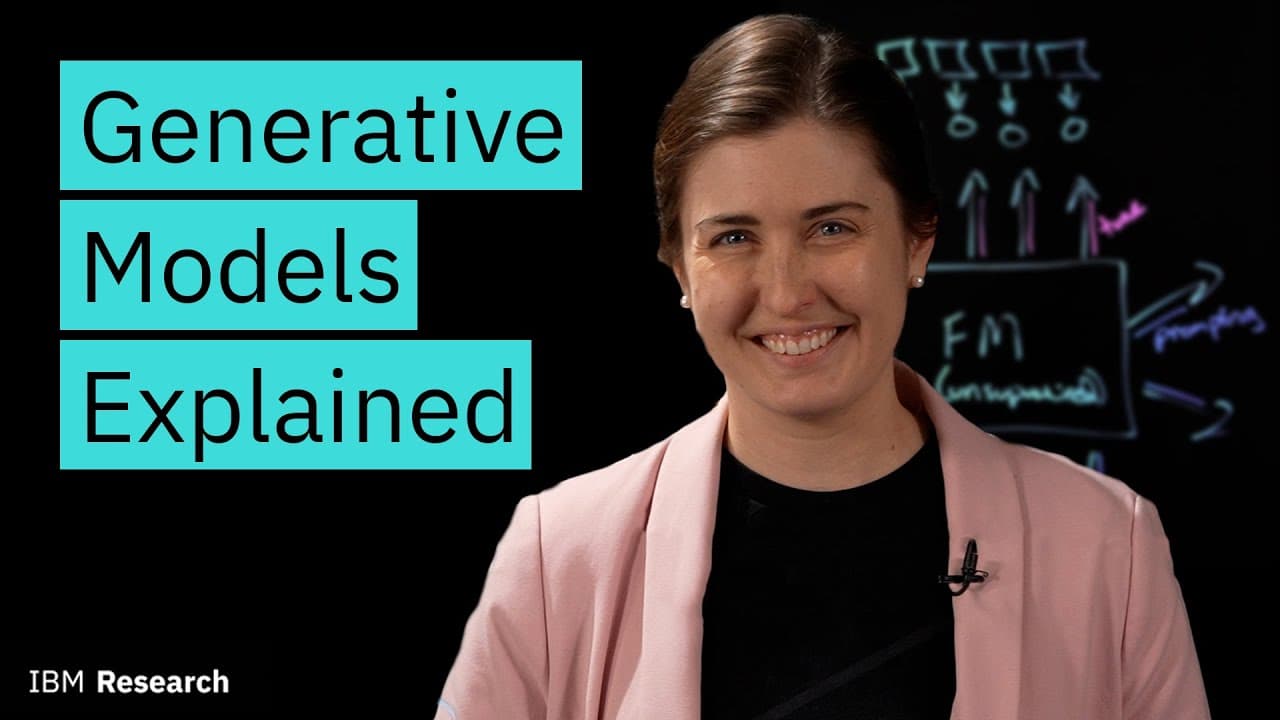
Foundation models are advanced AI systems capable of generating content and adapting to various tasks by leveraging extensive unstructured data. While they excel in performance and productivity, they also face challenges related to high computational costs and trustworthiness, which IBM is working to address for business applications.
Transcript
Over the past couple of months, large language models, or LLMs, such as chatGPT, have taken the world by storm. Whether it's writing poetry or helping plan your upcoming vacation, we are seeing a step change in the performance of AI and its potential to drive enterprise value. My name is Kate Soule. I'm a senior manager of business strategy at IBM ... Read More
Key Insights
- 👶 Foundation models belong to a new paradigm in AI, enabling them to generate new content and perform multiple tasks.
- 🥠 These models can be fine-tuned with labeled data, providing flexibility in performing traditional NLP tasks.
- 🉐 The advantages of foundation models include superior performance and increased productivity due to their exposure to extensive training data.
- 💻 However, the compute cost associated with training and inference, as well as potential trustworthiness issues, are important considerations.
- 👨💻 Foundation models have applications beyond language, including vision and code generation, and IBM is actively innovating in various domains.
- 👨💼 IBM Research is addressing the disadvantages of foundation models, aiming to improve efficiency and trustworthiness for their application in a business setting.
- 👨🔬 IBM is actively developing foundation models in areas such as chemistry and climate change research.
Install to Summarize YouTube Videos and Get Transcripts
Explore YouTube Video Summarizer or Get YouTube Transcript Extractor
Questions & Answers
Q: What distinguishes foundation models from other AI models?
Foundation models, like large language models, have been trained on massive amounts of unstructured data, enabling them to generate new content and transfer their knowledge to various tasks and applications.
Q: How can foundation models be tuned for specific tasks?
By introducing a small amount of labeled data, foundation models can be fine-tuned or tuned to perform traditional NLP tasks such as classification and named-entity recognition.
Q: What advantages do foundation models offer?
Foundation models excel in performance due to their exposure to vast amounts of training data. They also offer significant productivity gains by requiring less labeled data compared to starting from scratch.
Q: What are the disadvantages of foundation models?
Foundation models can be computationally expensive to train and run inference on, making them less accessible for smaller enterprises. Additionally, the reliance on large amounts of unstructured data raises concerns about trustworthiness, as it becomes difficult to verify biases or toxic information.
Key Insights:
- Foundation models belong to a new paradigm in AI, enabling them to generate new content and perform multiple tasks.
- These models can be fine-tuned with labeled data, providing flexibility in performing traditional NLP tasks.
- The advantages of foundation models include superior performance and increased productivity due to their exposure to extensive training data.
- However, the compute cost associated with training and inference, as well as potential trustworthiness issues, are important considerations.
- Foundation models have applications beyond language, including vision and code generation, and IBM is actively innovating in various domains.
- IBM Research is addressing the disadvantages of foundation models, aiming to improve efficiency and trustworthiness for their application in a business setting.
- IBM is actively developing foundation models in areas such as chemistry and climate change research.
- The provided video offers more insights on IBM's efforts to enhance foundation models and make them more trustworthy and efficient.
Summary & Key Takeaways
-
Foundation models are a class of models that can be trained on large amounts of unstructured data and transfer their knowledge to multiple tasks and applications.
-
While these models are primarily generative, they can also be tuned with labeled data to perform traditional natural language processing (NLP) tasks.
-
Foundation models offer advantages in terms of performance and productivity, but also come with disadvantages related to compute cost and trustworthiness.
Read in Other Languages (beta)
Share This Summary 📚
Summarize YouTube Videos and Get Video Transcripts with 1-Click
Try YouTube Summary with ChatGPT & Claude or YouTube Transcript Generator
Explore More Summaries from IBM Technology 📚


Summarize YouTube Videos and Get Video Transcripts with 1-Click
Try YouTube Summary with ChatGPT & Claude or YouTube Transcript Generator