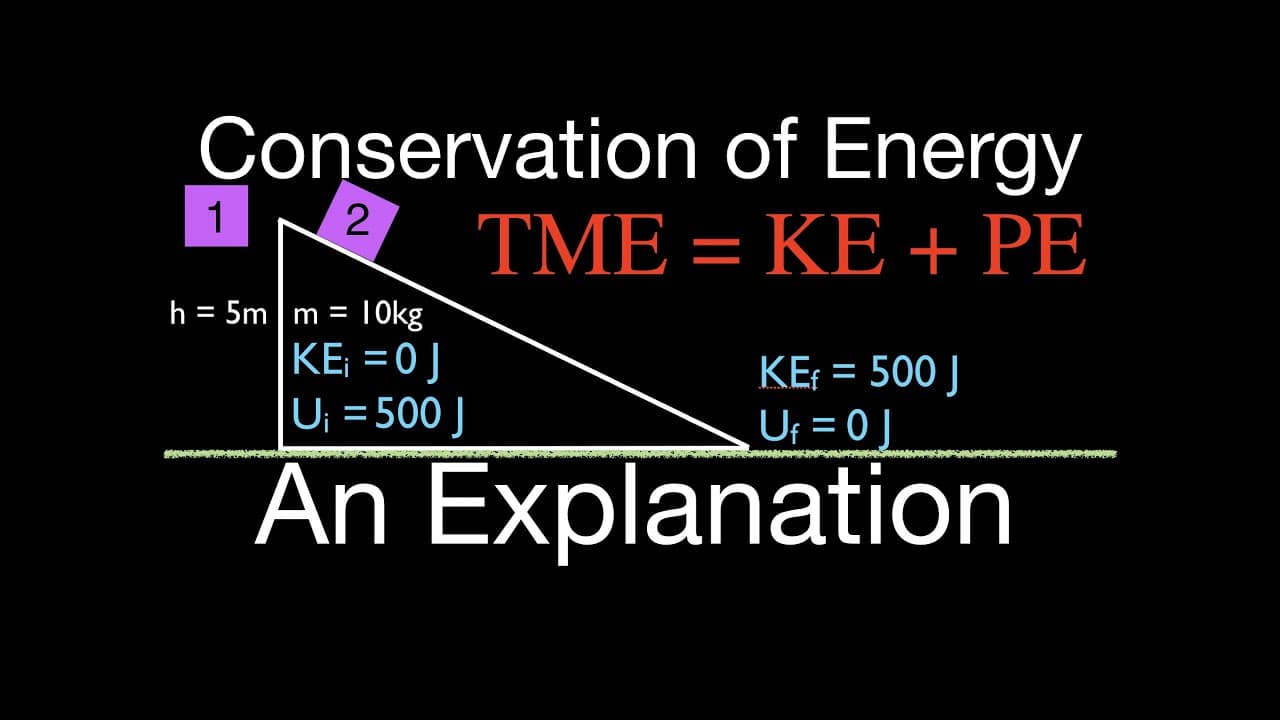
Energy, Work & Power (19 of 31) Conservation of Mechanical Energy, An Explanation
TL;DR
Total mechanical energy is the sum of kinetic and potential energies, key in conservation of energy.
Transcript
okay in today's video we are going to go over not just potential energy and not just kinetic energy but total mechanical energy because total mechanical energy which we can reavy eight tme is actually the sum of an object kinetic energy and its potential energies so if you want to know the total mechanical energy of an object simply add its kinetic... Read More
Key Insights
- 🦾 Total mechanical energy combines kinetic and potential energies.
- 🦾 Conservation of energy in a conservative system maintains constant total mechanical energy.
- 🍹 In a frictionless system, energy is conserved, and the sum of kinetic and potential energies remains constant.
- 🦾 Objects falling or sliding without friction demonstrate the principles of conservation of mechanical energy.
- 🍂 The energy distribution between kinetic and potential energy changes as an object falls in a gravity field.
- ❓ Understanding the concept of a conservative system is vital in energy conservation analysis.
- 🦾 Total mechanical energy can be calculated using the initial and final kinetic and potential energies.
Install to Summarize YouTube Videos and Get Transcripts
Explore YouTube Video Summarizer or Get YouTube Transcript Extractor
Questions & Answers
Q: What is total mechanical energy and how is it calculated?
Total mechanical energy is the sum of an object's kinetic and potential energies. It is calculated by adding the kinetic and potential energies of the object in a given system.
Q: What defines a conservative system in terms of energy conservation?
A conservative system is one that lacks friction and other non-conservative forces. In such a system, the total mechanical energy remains constant due to conservation of energy principles.
Q: How does conservation of mechanical energy apply to real-world scenarios?
Conservation of mechanical energy can be used to analyze scenarios involving objects falling or sliding with no friction. The initial total mechanical energy equals the final total mechanical energy in such systems.
Q: How does the distribution of potential energy change as an object falls?
As an object falls, its potential energy decreases, converting into kinetic energy. At any point along the path, the sum of potential and kinetic energies remains constant in a conservative system.
Summary & Key Takeaways
-
Total mechanical energy is the combination of an object's kinetic and potential energies.
-
In a conservative system with no friction, total mechanical energy is constant.
-
Conservation of mechanical energy equation: initial kinetic + potential = final kinetic + potential.
Read in Other Languages (beta)
Share This Summary 📚
Summarize YouTube Videos and Get Video Transcripts with 1-Click
Try YouTube Summary with ChatGPT & Claude or YouTube Transcript Generator
Explore More Summaries from Step by Step Science 📚

Summarize YouTube Videos and Get Video Transcripts with 1-Click
Try YouTube Summary with ChatGPT & Claude or YouTube Transcript Generator