How to Price a Bootstrapped App for Early Sales
TL;DR
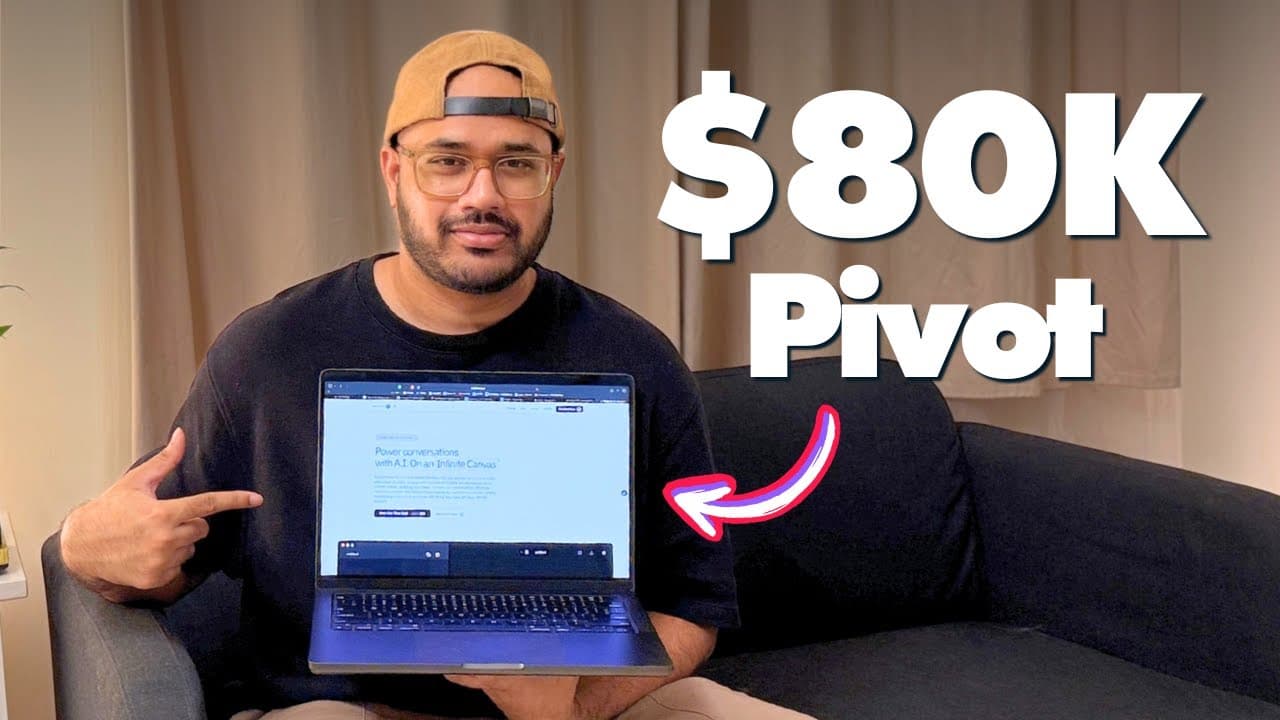
A one-time purchase helped Canvas Mode generate about $80,000 in six months after its free-trial subscription model failed to gain traction. The founder made the economics sustainable by turning the web product into a desktop app, requiring customers to supply their own AI API keys, and gradually raising the lifetime price as adoption increased.
Transcript
After launching my app and seeing no success, I rebuilt it and it made $80,000 in 6 months. Meet Prren, a builder from India who quit his software engineering job to go allin on building apps. But after launching the first version of his app, he saw pretty much no success. So he decided to make a simple pivot that changed everything. I was making 2... Read More
Key Insights
- The original subscription model failed to generate meaningful revenue because the founder lacked a large personal audience and targeted power AI users who were already paying for several AI services. Asking those customers to accept another recurring charge created additional friction for an unfamiliar early-stage product.
- The decisive pivot was changing the product from a hosted web application into a desktop application with a one-time price. That structure made the purchase easier to evaluate while allowing the founder to sell essentially the same software repeatedly without assuming ongoing AI or server expenses.
- Bring-your-own-key pricing transfers variable AI usage costs from the developer to each customer. Canvas Mode required users to connect and pay for their own AI access, making a lifetime purchase more sustainable than it would have been if the founder had funded every customer's model usage.
- The desktop architecture reduced operating costs by running the application on customers' computers instead of the founder's servers. This technical decision supported the one-time-purchase model because continued use did not create the same server expense that a centrally hosted web application would have created.
- The lifetime price increased alongside validation, beginning at $29 when the product had fewer than 100 users and rising to $49 after it passed 100. Early customers received the strongest deal, while their purchases demonstrated demand and supplied feedback before later pricing changes.
- Lifetime deals can give bootstrapped founders immediate cash, paying users, and stronger product feedback. Praneeth recommends offering one alongside other pricing options, even on a limited basis, although he notes that the exact structure must reflect each product's particular use cases and operating costs.
- The landing page was written directly for power AI users, the product's defined ideal customer profile. The copy named that audience in the main headline and elsewhere on the site, helping prospective customers quickly recognize that the branching interface addressed their long, complex AI conversations.
- The growth strategy combined audience-specific positioning with participation in relevant Twitter discussions. Instead of repeatedly posting direct purchase requests, Praneeth joined conversations about AI interaction and emerging AI workflows, then made comments connected to the problem his application was designed to solve.
Install to Summarize YouTube Videos and Get Transcripts
Explore YouTube Video Summarizer or Get YouTube Transcript Extractor
Questions & Answers
Q: How did changing the pricing model generate $80,000?
The founder replaced a free-trial subscription with a one-time purchase and rebuilt the web product as a desktop application. Customers supplied their own AI API keys and therefore paid their own model-usage costs, while the software ran on their computers instead of his servers. This kept continuing expenses low, encouraged serious customers to pay, and contributed to about $80,000 in gross revenue over six months.
Q: Why did the original subscription model fail to gain traction?
The initial web application offered a few free questions before requiring a subscription, but interest did not convert into meaningful revenue. Praneeth identified two important factors: he lacked a large personal brand to support building in public, and his intended customers were power AI users who already paid for multiple AI models. Another recurring subscription was therefore a difficult proposition for that audience.
Q: When does a lifetime deal make sense for a bootstrapped app?
Praneeth argues that bootstrapped businesses should consider a lifetime deal alongside their other pricing options, with terms adjusted for their specific costs and use cases. The approach is especially helpful for a solo founder or small team seeking early validation. It can produce an immediate block of cash, establish a base of committed users, and generate practical feedback about what the founder should build next.
Q: How can an AI app support lifetime pricing sustainably?
An AI app can reduce the risk of lifetime pricing by avoiding ongoing costs that grow with customer usage. Canvas Mode used a bring-your-own-key system, requiring customers to pay for their own AI access. It also became a desktop application that ran on users' computers, eliminating the founder's server burden. These choices aligned a one-time payment with a product that imposed limited continuing infrastructure expenses.
Q: How should a founder set the price of an early lifetime deal?
Praneeth began with a relatively low lifetime price to test whether customers were willing to pay. Canvas Mode cost $29 while it had fewer than 100 users, then rose to $49 after passing 100 users. The initial buyers received a better offer in exchange for adopting an early product, while their purchases and feedback gave the founder evidence that genuine market demand existed.
Q: How did Canvas Mode attract its target customers?
The founder first defined the ideal customer as a power AI user, then tailored the landing page to that specific group. The main headline and several other sections explicitly addressed those users. He also participated in relevant Twitter conversations about AI interactions and new AI workflows. His posts connected naturally to the product's problem instead of relying only on direct requests to buy it.
Q: What problem does the branching AI canvas solve?
Long, linear AI chats can lose their place and become difficult to manage when a user wants to explore several related directions. Canvas Mode presents conversations on a canvas where users can create a new node whenever an answer becomes interesting. Each node forms a separate branch, letting power users explore alternative ideas without abandoning or mixing up the original conversational path.
Q: Why was Canvas Mode changed from a web app to a desktop app?
A desktop application allowed the founder to make the one-time-purchase model financially practical. The app could run on each customer's computer, so the founder did not need to pay server costs for continuing usage. Combined with customer-supplied AI keys, the desktop architecture shifted both computing and AI expenses to users while preserving the product's canvas-based interface and access to multiple AI models.
Summary & Key Takeaways
-
Praneeth Pike left a software engineering job paying $250,000 per year to build apps independently. His initial product, formerly called Rabbit Holes AI and later called Canvas Mode, organized AI conversations on a branching canvas. Its first web-based version offered limited free usage followed by a subscription, but attracted interest without producing meaningful revenue.
-
The founder replaced the web subscription model with a desktop app sold through a one-time purchase. Customers supplied their own AI API keys, so they paid their AI usage costs, while their computers handled the application locally to avoid server expenses. The resulting model generated about $80,000 in gross revenue over six months.
-
The lifetime offer began at $29 while the product had fewer than 100 users, then increased to $49 after crossing that threshold. Growth came from landing-page copy written specifically for power AI users and relevant Twitter conversations. After reaching about 1,200 users, the founder planned a higher lifetime price and recurring option.
Read in Other Languages (beta)
Share This Summary 📚
Summarize YouTube Videos and Get Video Transcripts with 1-Click
Try YouTube Summary with ChatGPT & Claude or YouTube Transcript Generator
Explore More Summaries from Starter Story 📚





Summarize YouTube Videos and Get Video Transcripts with 1-Click
Try YouTube Summary with ChatGPT & Claude or YouTube Transcript Generator