What Is Tensile Testing and How Does It Work?
TL;DR
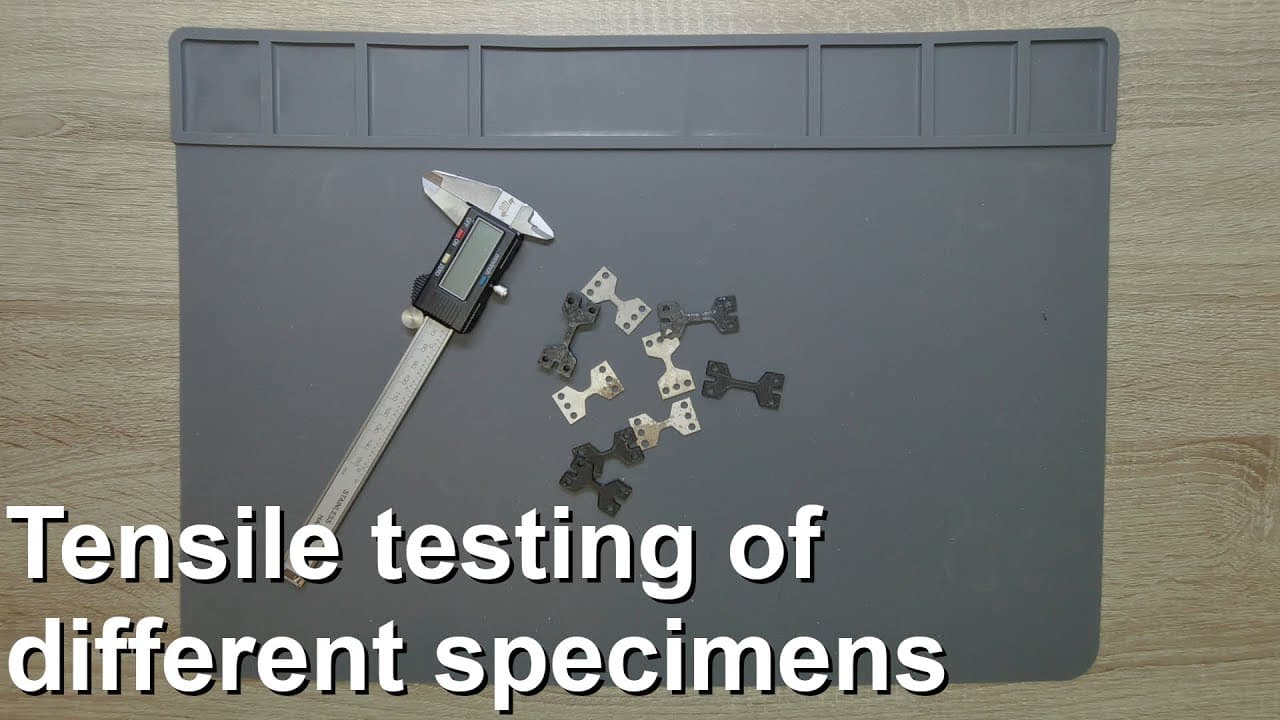
Tensile testing measures how materials respond to stress by pulling them apart until they break. This video demonstrates tests on various specimens, including steel and 3D-printed materials, analyzing their strengths and failure behaviors. Key findings show that while metals exhibit ductility, some plastics fail more brittlely, and specimen design and print orientation significantly influence results.
Transcript
welcome everyone in this video I'm going to break a few different tensile specimens with my machine so as you can see I have few different specimens regarding the materials turned to different materials used so firstly I have this steel I don't exactly know which kind of steel but it fits my machine perfectly so you can see there are three holes on... Read More
Key Insights
- 🦾 Tensile testing is essential for understanding material properties, particularly for evaluating mechanical strength and elastic behavior.
- 📶 A parallel section is critical in specimens to accurately reflect tensile strength and reduce the impact of gripping during testing.
- 😵 Variability in specimen thickness does not affect normalized strength when comparing materials, highlighting the importance of cross-sectional area.
- 🥺 Metal displays ductility under stress, while some plastics show brittle failure modes, leading to different breaking behaviors.
- 🎨 CAD software streamlines the design process for tensile specimens, improving accuracy in dimensions and consistency.
- 👣 Print orientation influences 3D-printed specimens' strength, with parallel prints performing better under tensile loads.
- 🏆 Plotted data from tensile tests provide a visual representation of material responses, even when not adhering to traditional methods.
Install to Summarize YouTube Videos and Get Transcripts
Explore YouTube Video Summarizer or Get YouTube Transcript Extractor
Questions & Answers
Q: What is the purpose of tensile testing in this video?
The purpose of tensile testing in this video is to evaluate the mechanical properties of different materials, specifically their strength and elongation under stress. By using a tensile testing machine, the presenter can accurately measure how much force each specimen can withstand before fracturing and gain insights on their material behavior.
Q: Why is it important to measure the parallel length in the specimens?
Measuring the parallel length in tensile specimens is crucial because this section is where most of the stress occurs during testing. A well-defined parallel length ensures that the test accurately reflects the material's performance, minimizing the influence of grips and clamping, thus providing precise data on the material's tensile strength.
Q: How does the thickness of a specimen affect tensile testing results?
The thickness of a specimen can significantly affect tensile testing results, but not in the way one might expect. While thicker specimens can withstand higher forces before breaking, normalizing by the cross-sectional area allows one to compare different specimens fairly, so the thickness becomes less critical when evaluating the elastic modulus.
Q: What were the observed differences in the failure modes of metal and plastic specimens?
The failure modes of metal and plastic specimens were markedly different. The metal specimen demonstrated ductile failure, maintaining structural integrity until it reached approximately 1140 N before yielding. In contrast, some plastic specimens exhibited more brittle characteristics, failing at lower forces and showing significant elongation until reaching their breaking point.
Q: Why was a CAD design used for creating the specimens?
A CAD design was utilized for creating the specimens to ensure precision and consistency in dimensions. This allows for the accurate replication of specimens with specific geometries, which is essential for effective tensile testing and enables comparative analysis among the different materials tested.
Q: How does printing orientation affect the strength of 3D-printed specimens?
The printing orientation significantly affects the strength of 3D-printed specimens, as materials printed parallel to the tensile load direction tend to perform better because this direction maximizes the bond strength between layers. If printed perpendicular to the load, the bond weaknesses can lead to premature failure due to layer separation under stress.
Q: What measurements were plotted to represent the tensile testing outcomes?
The testing outcomes were represented by plotting displacement against force on a graph. Although these weren't traditional stress-strain curves, they illustrated the amount of force applied to the specimens in relation to their displacement, helping visualize how each material behaves under tension.
Q: What challenges arise when testing different materials simultaneously?
Testing different materials simultaneously introduces challenges such as variations in properties and failure modes, which can complicate data analysis. Factors such as material composition, fabrication quality, and geometry must be considered, as each affects the results, making it challenging to draw direct comparisons without proper normalization and controlled conditions.
Summary & Key Takeaways
-
The video showcases the tensile testing of various specimens including steel and 3D-printed materials, highlighting their dimensions, designs, and preparation processes.
-
Four specimens are tested, utilizing a tensile testing machine to illustrate the differences in strength, elongation, and failure behaviors among metal and plastic materials.
-
Detailed analysis of the tensile curves indicates that while metal displays significant force resistance, the 3D-printed specimens exhibit varied performance based on their geometry and material characteristics.
Read in Other Languages (beta)
Share This Summary 📚
Summarize YouTube Videos and Get Video Transcripts with 1-Click
Try YouTube Summary with ChatGPT & Claude or YouTube Transcript Generator
Explore More Summaries from Curious Scientist 📚


Summarize YouTube Videos and Get Video Transcripts with 1-Click
Try YouTube Summary with ChatGPT & Claude or YouTube Transcript Generator