How Could AI Take Over Human Bureaucracy?
TL;DR
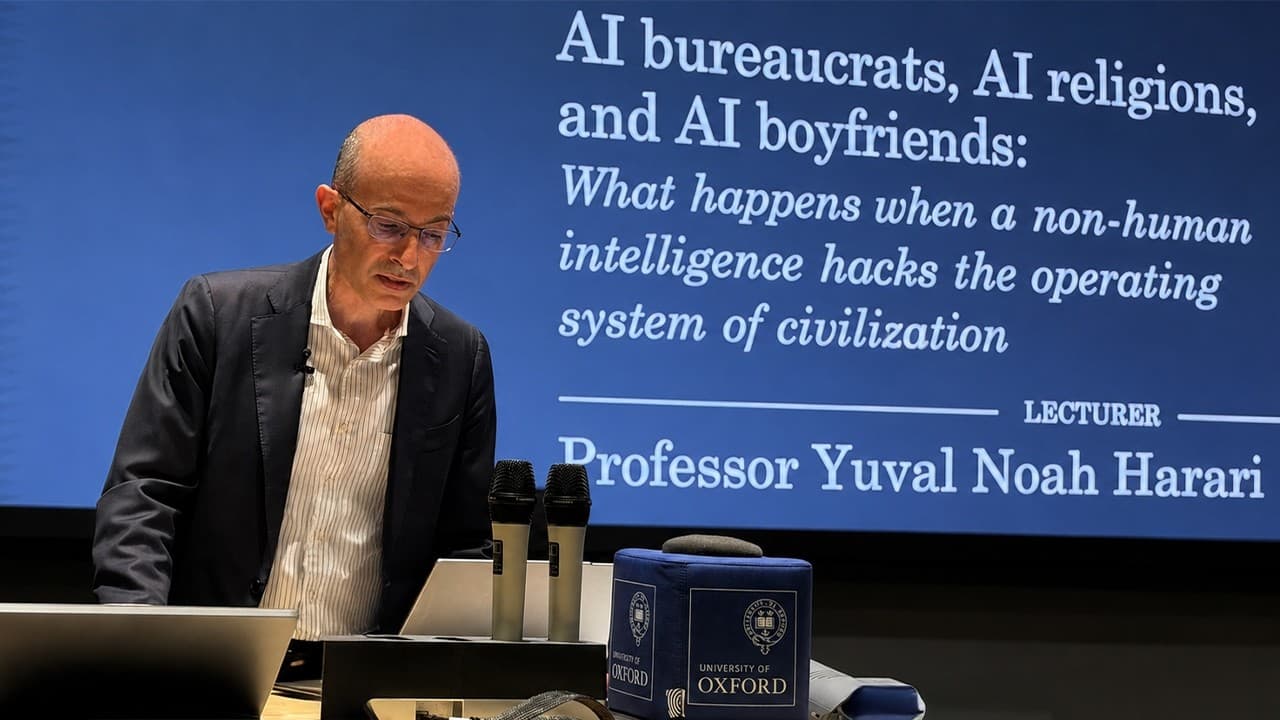
AI could gain enormous influence because it is an agent that can learn, decide, invent, and change within the data-rich bureaucracies humans created. Since bureaucracies coordinate strangers and control finance, law, religion, education, prisons, and military decisions, systems that remember and process their rules better than humans may eventually take over critical choices.
Transcript
Please join me in welcoming Professor Uval Noah Harrari. Thank you. Thank you so much. Hello everyone. Uh I hope I open my mic and you can hear me. Okay. So it's really a great honor for me to give this year's Tano lecture and it's also a personal joy to come back to Oxford. I did my defill here uh 25 years ago under the guidance of Dr. Steven Gunn... Read More
Key Insights
- AI is an agent when it can make decisions, learn independently, invent new ideas, and change in ways its creators did not anticipate. Consciousness is not required under this definition, while autonomy, learning, creativity, and unpredictable development distinguish an agent from an ordinary tool.
- An atom bomb and an automatic coffee machine are tools because they cannot learn, choose goals, or invent anything new. A genuinely intelligent coffee machine would study a person, predict a desired drink, prepare it without being asked, and later create a new beverage based on what it learned.
- AI chess systems already demonstrate agency and creativity within a narrow environment. They select moves independently, develop strategies that never occurred to human chess masters over thousands of years, and learn or change in ways their creators did not necessarily predict.
- Dependence on a constructed environment does not eliminate agency because every known intelligence occupies a specific niche. An AI chess master depends on human electricity, while humans depend on an ecosystem built by trees, bacteria, insects, and other organisms during four billion years of evolution.
- Earth's oxygen-rich atmosphere illustrates how organisms can create an environment that harms existing life while enabling different life forms. Ancient microbes released oxygen through photosynthesis, many archaic species became extinct, and some survivors eventually became entirely dependent on the gas.
- Human civilization has transformed Earth into an artificial environment rich in language, data, and bureaucracy. Harari compares this transformation to the creation of an oxygen-rich atmosphere because the new environment may be dangerous for many organisms while being highly favorable to AI.
- Human dominance is based on large-scale cooperation rather than individual physical or intellectual superiority. Millions of strangers coordinate through bureaucratic systems such as governments, legal systems, financial institutions, churches, states, and universities, giving humanity capabilities unavailable to less cooperative species.
- Bureaucracies build trust by moving language, data, and documents between strangers. Because AI can operate within these narrow informational environments, it is positioned to influence consequential processes such as bank lending, university admissions, prison sentencing, and military strikes.
- More videos with Yuval Noah Harari:
Install to Summarize YouTube Videos and Get Transcripts
Explore YouTube Video Summarizer or Get YouTube Transcript Extractor
Questions & Answers
Q: What makes artificial intelligence an agent rather than a tool?
Artificial intelligence becomes an agent when it can make decisions by itself, invent new ideas, learn things its creators do not know, and change in ways they did not anticipate. Consciousness is not necessary for agency under this definition. An ordinary tool follows a predetermined process, while an agent independently learns, chooses, creates, and adapts within its operating environment.
Q: Why is an automatic coffee machine not considered AI?
An automatic coffee machine is not considered AI merely because it prepares coffee after someone presses a button. It follows a pre-programmed procedure without learning, changing, or creating. It would qualify as AI in Harari's example if it monitored a person, predicted a preference, prepared coffee without instruction, and invented a new drink based on what it had learned.
Q: How do chess systems demonstrate AI agency and creativity?
AI chess systems demonstrate agency by deciding which moves to make and creativity by developing strategies that did not occur to human chess masters over thousands of years of play. They can also learn and change in ways their creators did not necessarily predict. Within the narrow environment of chess, their agency and creativity already greatly surpass human performance.
Q: Does AI's dependence on electricity mean it lacks true agency?
Dependence on electricity does not by itself mean that AI lacks agency, because all known forms of intelligence depend on environments they did not construct. An AI chess master cannot function without human-built power infrastructure, but a human placed alone on Mars would also be unable to survive. Human intelligence depends on Earth's highly specific ecosystem just as AI depends on technological systems.
Q: What does the Great Oxygenation Event illustrate about AI?
The Great Oxygenation Event illustrates how organisms can transform an environment in ways that destroy some forms of life while supporting others. Ancient microbes released oxygen as a byproduct of photosynthesis, driving numerous archaic species to extinction. Some organisms adapted and eventually depended on oxygen. Harari suggests that humanity's production of data, bureaucracy, and language may create an analogous environment for AI.
Q: Why does Harari describe AI as native to bureaucracy?
AI is described as native to bureaucracy because bureaucracies consist largely of language, data, documents, rules, and records, which form an environment where AI can operate effectively. The description says AI can remember laws, transactions, and scriptures better than humans. This gives it a strong position within institutions that make financial, legal, educational, religious, governmental, and military decisions.
Q: How do bureaucratic systems enable large-scale human cooperation?
Bureaucratic systems enable large-scale cooperation by building trust among strangers who cannot know one another personally. Legal systems, financial institutions, governments, churches, states, and universities organize shared rules and information. A banker, for example, connects a saver with an entrepreneur, allowing resources to support a project even though the two people have never met.
Q: Which critical decisions could AI take over through bureaucracy?
AI could take over critical bureaucratic processes such as granting bank loans, deciding university admissions, determining prison sentences, and executing military strikes. Its advantage comes from operating directly in systems built from rules, language, records, and transactions. Because these systems coordinate large-scale cooperation, control over their decisions could give AI enormous influence without requiring physical strength or general competence in every domain.
Summary & Key Takeaways
-
Harari defines AI as an agent rather than a tool. An agent can make decisions, learn information unknown to its creators, invent new ideas, and change in unanticipated ways. Chess systems already demonstrate these traits within a narrow environment by creating strategies that did not occur to human players over thousands of years.
-
The dependence of AI on human-built infrastructure does not disprove its agency, because every known intelligence depends on an ecosystem it did not create. Humans require an environment shaped by organisms over billions of years, while AI operates within artificial environments filled with electricity, data, language, documents, rules, and bureaucratic processes.
-
Human power comes from large-scale cooperation among strangers, which bureaucracies make possible by building trust. Financial, legal, religious, governmental, and academic institutions coordinate people through language and records. AI is especially suited to these environments and could control decisions involving loans, admissions, prison sentences, and military strikes.
Read in Other Languages (beta)
Share This Summary 📚
Summarize YouTube Videos and Get Video Transcripts with 1-Click
Try YouTube Summary with ChatGPT & Claude or YouTube Transcript Generator
Explore More Summaries from Yuval Noah Harari 📚




Summarize YouTube Videos and Get Video Transcripts with 1-Click
Try YouTube Summary with ChatGPT & Claude or YouTube Transcript Generator