How to Build Stateful AI Agents with LangGraph
TL;DR
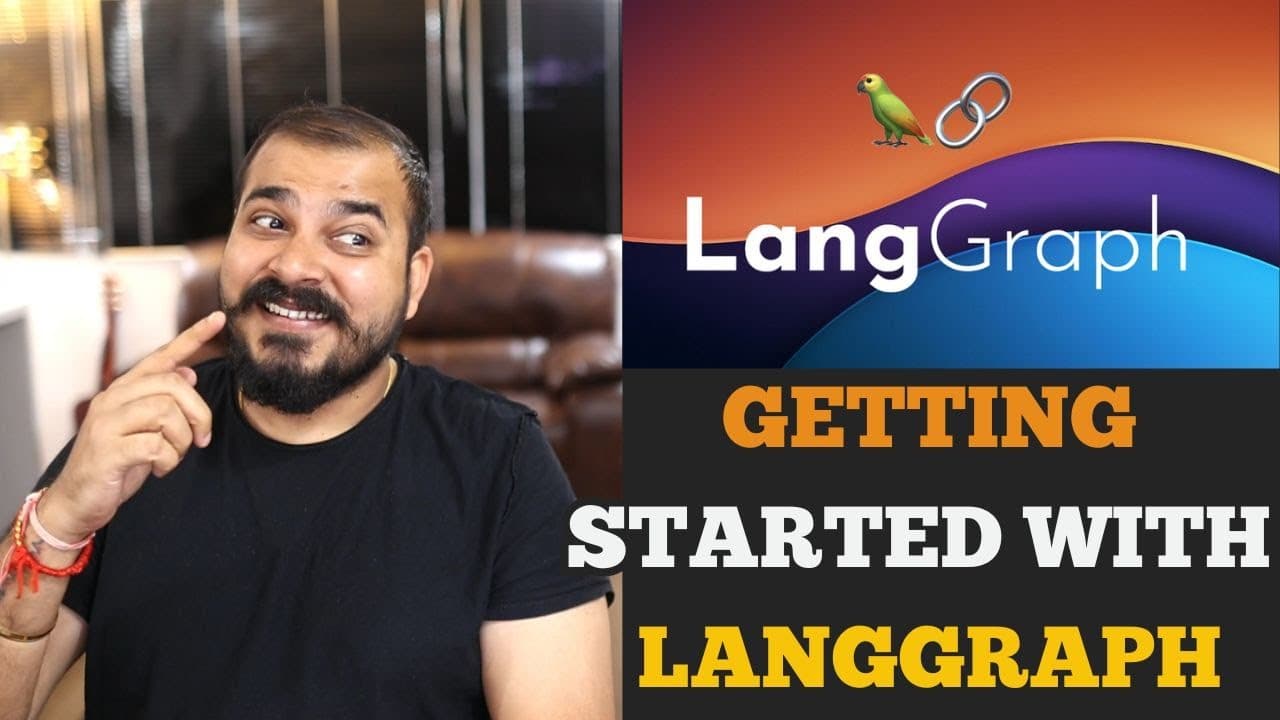
LangGraph builds stateful, multi-actor LLM applications by representing agents and their relationships as workflows that can include cycles. It simplifies state management and agent coordination while giving developers control over agent logic and communication protocols. These capabilities support customized chatbots and multi-agent systems with complex workflows and high volumes of interaction.
Transcript
hello guys so one of the most requested video uh by many of you was to start a series on developing multi agents using langra so finally I've started this particular Series in this video we are going to discuss about what is Lang graph why do you require langra along with this we'll also be getting started with one practical example how to probably... Read More
Key Insights
- LangGraph is a library for building stateful, multi-actor applications with large language models. It is used to create both individual agent workflows and multi-agent workflows through a graph-based structure composed of connected nodes and relationships.
- Cycles are a core benefit of LangGraph because they allow workflows to revisit earlier stages. The transcript describes cycles as essential for most agentic architectures and identifies them as a key distinction between LangGraph and solutions based on directed acyclic graphs.
- State management is the process of tracking the stage and work assigned to each agent. LangGraph simplifies this responsibility so developers can concentrate on defining application workflows and logic without manually managing every operational detail across multiple agents.
- Agent coordination is the communication that occurs among specialized agents. One agent may pass search results to another, or an agent may wait for a preceding response before beginning its own task, making coordination central to dependable multi-agent workflows.
- Graph structure is used to model the complete multi-agent workflow. Agents can be represented as nodes, while their relationships describe how information and control move through the application, similar to the node-and-relationship structure discussed for graph knowledge.
- Flexibility comes from allowing developers to define their own agent logic and communication protocols. This supports customized applications, including chatbots that handle different user requests and multi-agent systems that complete complex tasks for particular domains or workflows.
- Scalability is supported through an architecture designed for large-scale multi-agent applications. The tutorial states that these applications can handle high volumes of interaction between agents while also supporting complex workflows that remain comparatively simple for developers to construct.
- Specialized agents can combine several information sources within one chatbot. The example assigns separate agents to Google search, Wikipedia search, and vector database search, then coordinates their outputs according to the workflow and dependencies defined by the developer.
Install to Summarize YouTube Videos and Get Transcripts
Explore YouTube Video Summarizer or Get YouTube Transcript Extractor
Questions & Answers
Q: What is LangGraph used for in LLM applications?
LangGraph is used to build stateful, multi-actor applications powered by large language models. It supports both agent and multi-agent workflows by organizing application behavior as a graph of connected nodes and relationships. Its central concepts include graph structure, state management, and coordination, while its stated core benefits include cycles, controllability, and persistence.
Q: Why does LangGraph support cyclical agent workflows?
LangGraph supports cycles because many agentic architectures require a workflow to return to an earlier stage rather than move forward only once. The transcript identifies this capability as essential for most agentic architectures and as a major difference from DAG-based solutions. Cycles therefore allow developers to represent repeated or revisited steps within an agent workflow.
Q: How does LangGraph simplify multi-agent development?
LangGraph simplifies development by helping manage agent state and coordination within a defined graph workflow. Developers can focus on specifying the logic, dependencies, and flow of their application instead of manually handling every complexity involved in tracking agents and coordinating their communication. This approach is intended to make multi-agent systems more efficient to create and manage.
Q: What is state management in a LangGraph workflow?
State management tracks where an agent is in a workflow and what work it needs to perform. In a multi-agent application, several agents may be active at different stages, so their current status and responsibilities must be managed efficiently. LangGraph provides a structure for handling this state as agents progress through the developer-defined workflow and logic.
Q: What does agent coordination mean in a multi-agent system?
Agent coordination means managing communication and dependencies among multiple agents. For example, an agent performing a Google search may need to provide its information to another agent before a later agent can work. Some responses may depend on the output of preceding agents, so the workflow must specify when agents communicate and the order in which tasks occur.
Q: How can specialized agents work together in one chatbot?
A chatbot can use specialized agents for different tasks, such as Google search, Wikipedia search, and vector database search. The workflow determines whether each agent is needed, when it should execute, and where its output should go. An agent may pass information to another agent, while later tasks can depend on results produced earlier in the workflow.
Q: How flexible is LangGraph for custom AI applications?
LangGraph lets developers define their own agent logic and communication protocols, which allows applications to be tailored to specific use cases. The transcript gives examples ranging from chatbots that handle various user requests to multi-agent systems that perform complex tasks. This flexibility gives developers detailed control over how individual agents behave and exchange information.
Q: Why can LangGraph support large multi-agent applications?
LangGraph is described as having a robust architecture for building large-scale multi-agent applications. According to the transcript, it can handle high volumes of interaction, including interactions between agents, while supporting complex workflows. Its graph-based approach also makes those workflows comparatively simple to define, which helps developers structure larger systems involving many coordinated tasks.
Summary & Key Takeaways
-
LangGraph is a LangChain module for building stateful, multi-actor applications with large language models. It represents agent and multi-agent workflows as graphs containing nodes and relationships. Unlike DAG-based solutions, it permits cycles, which the tutorial identifies as essential for many agentic architectures and sophisticated agent runtimes.
-
Multi-agent applications require careful state management and coordination. Each agent may perform a specialized task, such as Google search, Wikipedia search, or vector database search. Their responses can depend on one another, so developers must define the workflow, communication sequence, dependencies, and logic that connect each agent to the chatbot.
-
LangGraph is presented as useful because it simplifies development, supports flexible customization, and enables scalable applications. Developers can define their own agent logic and communication protocols for specific use cases. Its architecture can handle high volumes of interactions between agents while making complex workflows comparatively simple to define and manage.
Read in Other Languages (beta)
Share This Summary 📚
Summarize YouTube Videos and Get Video Transcripts with 1-Click
Try YouTube Summary with ChatGPT & Claude or YouTube Transcript Generator
Explore More Summaries from Krish Naik 📚


Summarize YouTube Videos and Get Video Transcripts with 1-Click
Try YouTube Summary with ChatGPT & Claude or YouTube Transcript Generator