How Do Vector Databases Enable Semantic Search?
TL;DR
Vector databases enable semantic search by storing embeddings, arrays of numbers that capture essential characteristics of unstructured data. Similar items occupy nearby positions in vector space, allowing systems to retrieve related images, text, or audio through mathematical similarity operations. Approximate nearest neighbor indexes make this retrieval practical at large scale and support applications such as retrieval-augmented generation.
Transcript
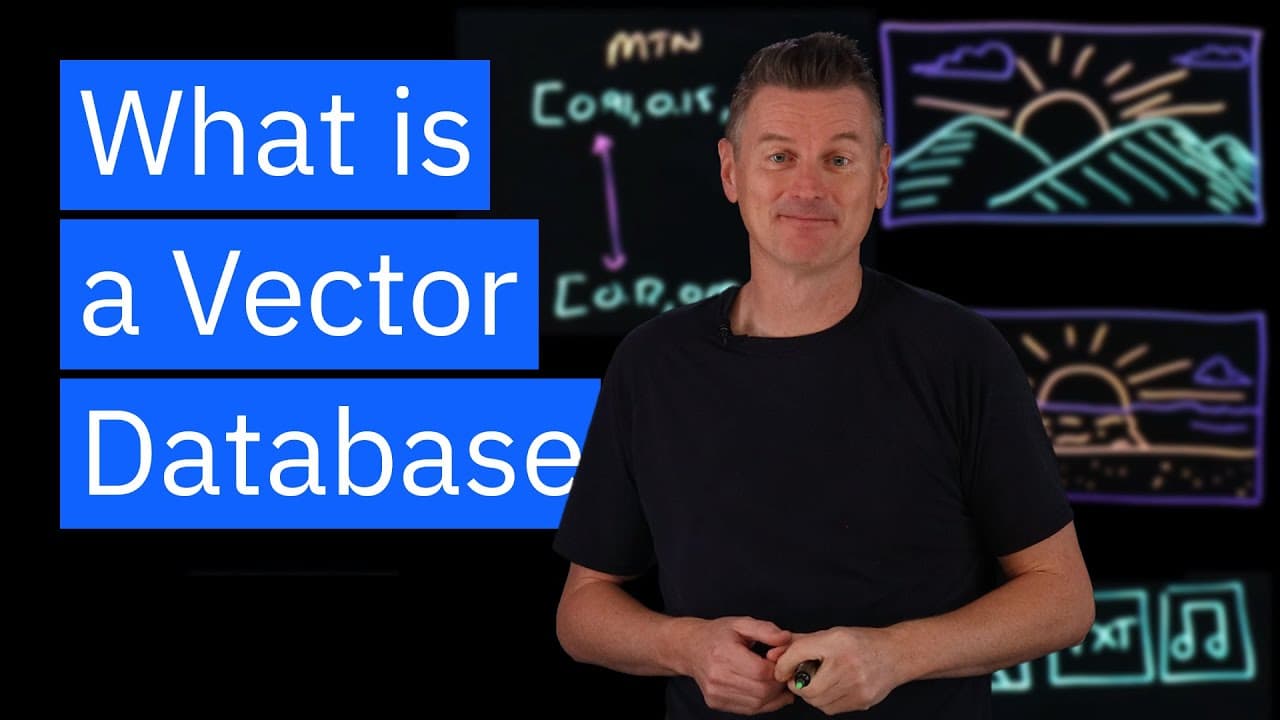
What is a vector database? Well, they say a picture is worth a thousand words. So let's start with one. Now in case you can't tell, this is a picture of a sunset on a mountain vista. Beautiful. Now let's say this is a digital image and we want to store it. We want to put it into a database and we're going to use a traditional database here called a... Read More
Key Insights
- A semantic gap is the disconnect between how computers store information and how humans understand its meaning. Relational fields, metadata, and manual tags can describe selected properties, but they often fail to capture the nuanced, multidimensional context contained in unstructured images, text, and audio.
- A vector embedding is an array of numbers that captures essential characteristics of an input. Similar items are positioned close together in vector space, while dissimilar items are farther apart, allowing semantic similarity to be evaluated through mathematical operations instead of exact structured-field matching.
- Vector databases are designed to store and retrieve representations of unstructured data such as images, text files, and audio files. The original complex objects are processed by specialized embedding models, transformed into vectors, and stored so they can be searched according to semantic similarity.
- Embedding models are trained on massive data sets and extract progressively more abstract features through multiple layers. Early image layers may detect edges, while deeper layers may recognize objects. For text, early processing may identify words, while deeper processing captures context and meaning.
- Real vector embeddings typically contain hundreds or thousands of dimensions. The simplified mountain and beach example assigns clear meanings to individual dimensions, such as elevation or warm colors, but actual machine learning dimensions rarely correspond to features that are so directly interpretable.
- Similarity search works by converting a query item into an embedding and finding nearby vectors in the database. This approach can identify semantically related content, such as images with similar palettes or scenery, even when those relationships were not represented by exact metadata values or manual tags.
- Vector indexing makes large-scale similarity search practical by using approximate nearest neighbor algorithms. Rather than comparing a query with every stored vector, these algorithms quickly identify vectors that are very likely to be among the closest, trading a small amount of accuracy for substantial speed improvements.
- Retrieval-augmented generation uses vector databases to store embedded chunks from documents, articles, and knowledge bases. When a question arrives, the system retrieves relevant chunks through vector similarity and supplies them to a large language model, which generates a response using the retrieved information.
Install to Summarize YouTube Videos and Get Transcripts
Explore YouTube Video Summarizer or Get YouTube Transcript Extractor
Questions & Answers
Q: What is a vector database and what does it store?
A vector database stores vector embeddings that represent the essential characteristics of complex, unstructured data. Images, text files, and audio files can be transformed into arrays of numbers by embedding models and placed in the database. The database then retrieves content semantically by locating embeddings that are close together in vector space, rather than relying only on exact metadata fields or manually assigned tags.
Q: Why are relational databases insufficient for semantic search?
Relational databases can store an image's binary data, basic metadata, and manually added tags such as sunset, landscape, or orange. However, those structured fields do not fully capture the image's broader semantic context. Queries about similar color palettes or mountain landscapes therefore become difficult because nuanced, multidimensional concepts are not represented well by exact conditions such as selecting records where a color field equals orange.
Q: What is the semantic gap in data retrieval?
The semantic gap is the disconnect between the way computers store data and the way people understand its meaning. A database may record a file format, creation date, or several tags while still missing relationships that are obvious to a person, such as visual similarity, contextual meaning, or a shared landscape. Vector embeddings help bridge this gap by representing essential characteristics in a mathematical space.
Q: How do vector embeddings represent semantic meaning?
Vector embeddings represent data as arrays of numbers, with hundreds or even thousands of dimensions in real machine learning systems. These dimensions collectively capture essential characteristics of the input. Items with related characteristics receive nearby positions in vector space, while unrelated items are positioned farther apart. Individual dimensions in real embeddings rarely map as clearly to specific human-readable features as simplified examples suggest.
Q: How are vector embeddings created for images, text, and audio?
Embedding models trained on massive data sets transform each input into a high-dimensional vector. Data passes through multiple layers that extract progressively more abstract features. Image processing may move from detecting edges to recognizing whole objects, while text processing may move from identifying individual words to capturing context and meaning. Specialized examples mentioned include CLIP for images, GloVe for text, and wav2vec for audio.
Q: How does similarity search work in a vector database?
Similarity search begins with a vector embedding for the query item. The database searches vector space for stored embeddings positioned near that query vector, since proximity indicates related semantic characteristics. This turns retrieval into a mathematical operation and enables searches for conceptually similar images, text, or audio, including relationships that exact metadata values and manually assigned tags may not adequately describe.
Q: Why do vector databases use approximate nearest neighbor indexing?
Comparing a query vector against every stored vector becomes too slow when a database contains millions of vectors with hundreds or thousands of dimensions. Approximate nearest neighbor algorithms avoid exhaustive comparison by quickly finding vectors that are very likely to be among the closest matches. The indexing process accepts a small reduction in accuracy in exchange for substantial improvements in search speed.
Q: How do HNSW and IVF accelerate vector search?
HNSW, short for Hierarchical Navigable Small World, creates multilayered graphs that connect similar vectors, helping the search navigate toward likely nearby matches. IVF, short for Inverted File Index, divides vector space into clusters and searches only the clusters most relevant to the query. Both are approximate nearest neighbor approaches that improve speed by avoiding comparisons with every vector in the database.
Q: How are vector databases used in retrieval-augmented generation?
In retrieval-augmented generation, a vector database stores chunks from documents, articles, and knowledge bases as embeddings. When a user asks a question, the system embeds or otherwise represents the query and compares it with stored vectors to find relevant text chunks. Those retrieved chunks are then supplied to a large language model, which generates a response using the selected information.
Summary & Key Takeaways
-
Traditional relational databases can store an image file, metadata, and manually assigned tags, but those structured fields do not fully represent semantic context. This limitation creates a semantic gap between computer storage and human understanding, making nuanced queries about similar color palettes, mountain landscapes, or other multidimensional characteristics difficult to answer effectively.
-
Embedding models transform unstructured images, text, and audio into high-dimensional vectors. Similar content receives embeddings that are positioned close together in vector space, while dissimilar content is farther apart. Similarity search converts retrieval into a mathematical task of finding nearby vectors rather than matching only exact values in structured database fields.
-
Vector indexing makes similarity search efficient across millions of high-dimensional embeddings. Approximate nearest neighbor algorithms identify vectors likely to be among the closest matches while trading a small amount of accuracy for major speed improvements. Vector databases also support RAG by retrieving relevant embedded text chunks for a large language model.
Read in Other Languages (beta)
Share This Summary 📚
Summarize YouTube Videos and Get Video Transcripts with 1-Click
Try YouTube Summary with ChatGPT & Claude or YouTube Transcript Generator
Explore More Summaries from IBM Technology 📚






Summarize YouTube Videos and Get Video Transcripts with 1-Click
Try YouTube Summary with ChatGPT & Claude or YouTube Transcript Generator