How Did Gandhi Become a Leader Without Violence?
TL;DR
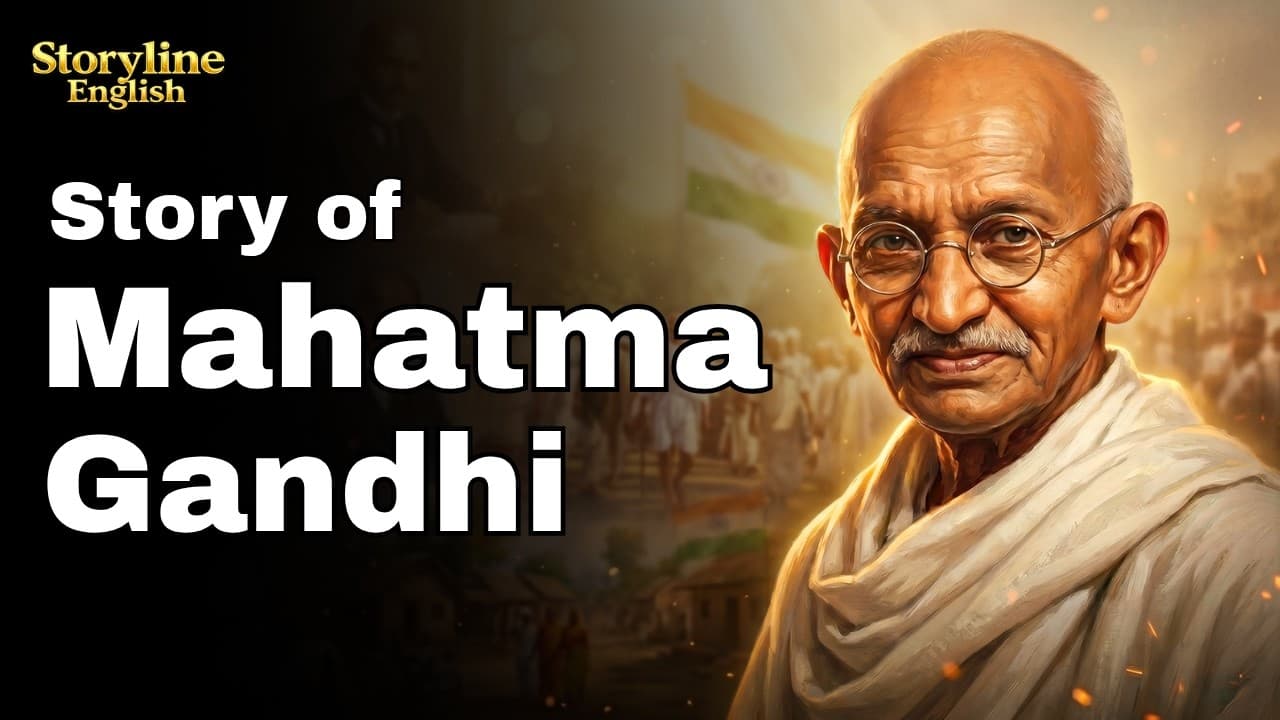
Gandhi became a powerful leader by resisting injustice with truth, dignity, nonviolence, and a willingness to accept punishment. His experiences with racism in South Africa shaped Satyagraha, while campaigns in Champaran and the Salt March showed that simple, organized actions could awaken ordinary people and challenge British colonial control.
Transcript
Hello, my friend. Welcome to our space here at Storyline English. Take a deep breath and get ready. Picture a world where one person with no army, no weapons, and no money changes the future of an entire nation. Picture a quiet man in simple white clothes walking slowly under the hot Indian sun. He does not shout. He does not fight. And yet, the wh... Read More
Key Insights
- Gandhi's early character was shaped by a religious home that emphasized truth and kindness. He was shy, afraid of public speaking, and not an exceptional student, showing that his later leadership developed gradually through experience rather than appearing naturally during childhood.
- Personal loss was a lasting source of reflection for Gandhi. His father's death occurred while Gandhi had briefly left his bedside, and his first child survived only a few days, leaving him with lessons about grief, responsibility, and being present for loved ones.
- Gandhi's years in London encouraged self-discovery rather than imitation. Although he initially bought expensive clothes and studied dancing and French, his reading of the Bible, the Bhagavad Gita, Buddhist teachings, and Tolstoy gradually directed him toward love, simplicity, and a more authentic identity.
- Racial discrimination in South Africa transformed Gandhi's direction. After officials removed him from a first-class train carriage despite his valid ticket, he chose to remain and confront injustice through truth, dignity, organization, writing, public meetings, and persistent refusal to accept unequal treatment.
- Satyagraha is a method of resisting unjust laws without violence. Gandhi's approach required people to disobey injustice, accept punishment with dignity, avoid hatred, and reveal oppression through their own suffering in the hope of changing both public opinion and an opponent's heart.
- Simple living became part of Gandhi's experiment with truth. He abandoned expensive clothing, prepared his own food, lived in a community where work was shared, and gave away most of his possessions, connecting his public principles with disciplined choices in everyday life.
- Gandhi's leadership in India began with listening to ordinary people. Following Gopal Krishna Gokhale's advice, he traveled third class, observed poverty and fear, documented farmers' experiences in Champaran, and built resistance around specific injustices before assuming wider national leadership.
- The Salt March turned an everyday necessity into a symbol of colonial control. Gandhi walked 240 miles to the sea in 1930, attracted thousands of participants and international journalists, and challenged the rule that Indians could not freely produce salt from their own coastline.
Install to Summarize YouTube Videos and Get Transcripts
Explore YouTube Video Summarizer or Get YouTube Transcript Extractor
Questions & Answers
Q: How did Gandhi overcome his shy childhood to become a leader?
Gandhi did not suddenly overcome shyness through natural confidence. His development came through difficult experiences, study, moral reflection, and repeated public action. He once froze while trying to speak in an Indian courtroom, but later organized communities, wrote letters, published a newspaper, addressed meetings, led marches, and accepted imprisonment. Each challenge strengthened his ability to act despite fear.
Q: Why was Gandhi's train experience in South Africa important?
The train incident forced Gandhi to decide how he would respond to racial injustice. Although he held a valid first-class ticket, officials ordered him into third class and then removed him from the train. Sitting at the station on a cold night, he chose to remain in South Africa and resist unequal treatment through truth and dignity instead of returning to safety in India.
Q: What is Satyagraha according to Gandhi's life story?
Satyagraha means truth force or soul force in the account. It is the practice of refusing to obey an unjust law without using violence. Participants accept punishment with dignity, make injustice visible through their suffering, and avoid hatred toward their opponents. Gandhi tested this approach through peaceful marches, worker protests, repeated imprisonment, and persistent community organization in South Africa.
Q: How did Gandhi's time in England influence his beliefs?
England exposed Gandhi to unfamiliar food, clothing, language, and social customs. He initially tried to become an English gentleman by purchasing expensive clothes and studying dancing and French. His deeper transformation came through reading the Bible, the Bhagavad Gita, accounts of the Buddha, and Tolstoy. These works helped him embrace love, simplicity, self-knowledge, and his own identity.
Q: What did Gandhi accomplish for Indians in South Africa?
Gandhi organized an Indian community facing severe racial restrictions and limited political rights. He founded a newspaper, wrote letters, spoke at meetings, led peaceful marches, supported workers, and repeatedly went to prison. Through these campaigns, he refined Satyagraha and gained increasing support. By 1914, the Indian community had secured important legal rights, after which Gandhi returned to India.
Q: How did Gandhi help the farmers of Champaran?
Gandhi went to Champaran after learning that farmers were forced to grow indigo for the British instead of food for their families. He listened to hundreds of farmers and documented their accounts. When British authorities ordered him to leave, he calmly refused and was arrested. Thousands of farmers supported him, the resistance gained attention, and the farmers ultimately won their case.
Q: Why did Gandhi choose salt as a symbol of resistance?
Salt was simple, necessary, and directly connected to British control. The government controlled salt production, prevented Indians from making it even from the surrounding ocean, and required them to buy it and pay a tax. Gandhi recognized that ordinary people could understand and join a protest over salt, making it an effective symbol of wider colonial domination.
Q: What happened during Gandhi's Salt March in 1930?
Gandhi began the Salt March on March 12, 1930, with a small group of followers and walked 240 miles toward the sea. More people joined each day, and thousands were present by the time he reached the coast. International journalists observed as he picked up salty mud, publicly challenging British restrictions and encouraging Indians across the country to make salt.
Summary & Key Takeaways
-
Mohandas Karamchand Gandhi was born in Porbandar on October 2, 1869, and grew up with teachings about truth, kindness, prayer, and self-discipline. Although shy and academically average, painful experiences involving marriage, family loss, responsibility, and personal failure gradually shaped the character that later supported his public leadership.
-
Gandhi studied law in England, where reading religious and philosophical works helped him value authenticity, love, and simplicity. After struggling as a lawyer in India, he moved to South Africa in 1893. Racist treatment there inspired him to organize Indian communities and develop Satyagraha as a disciplined method of nonviolent resistance.
-
Returning to India in 1915, Gandhi traveled among ordinary people before leading local resistance in Champaran. His calm refusal to leave helped indigo farmers win their case. In 1930, he transformed the British salt monopoly into a national symbol, walking 240 miles as growing crowds and international journalists followed his campaign.
Read in Other Languages (beta)
Share This Summary 📚
Summarize YouTube Videos and Get Video Transcripts with 1-Click
Try YouTube Summary with ChatGPT & Claude or YouTube Transcript Generator
Explore More Summaries from Storyline English 📚
Summarize YouTube Videos and Get Video Transcripts with 1-Click
Try YouTube Summary with ChatGPT & Claude or YouTube Transcript Generator